
I. Prologue A testimony with solid details
Among the thousands of sightings that populate the archives of the unexplained, most do not withstand the slightest scrutiny. They are shaky and contradictory tales: diffuse lights, silhouettes that could well belong to imagination or dreams, photographs so blurry that any cinematic trick would match them in credibility. The witnesses, almost always alone and at night, recall with that characteristic imprecision of someone who has seen something the brain refuses to categorize. Serious researchers soon learn to separate signal from noise, and in that process dismiss the vast majority of reports without much consideration.
However, every so often, a story emerges that possesses a different quality. It is not that it is more spectacular or more dramatic than the others—often quite the opposite—but that it contains concrete specifics, physically detailed observations that elevate it above mere emotional testimony. The so-called Codera File is one such case. It is distinguished not by the magnitude of the phenomenon described, but by the nature of what the witnesses described: behavior that flagrantly and repeatedly violates the fundamental laws of classical mechanics. That, and only that, justifies giving it attention that other files do not deserve.
The case was formally reported on June 6, 1973, to the National Guard of Venezuela, on the northern coast of the country. What follows is the original file, reproduced in its entirety and in its own style, followed by the scientific analysis that the facts demand.
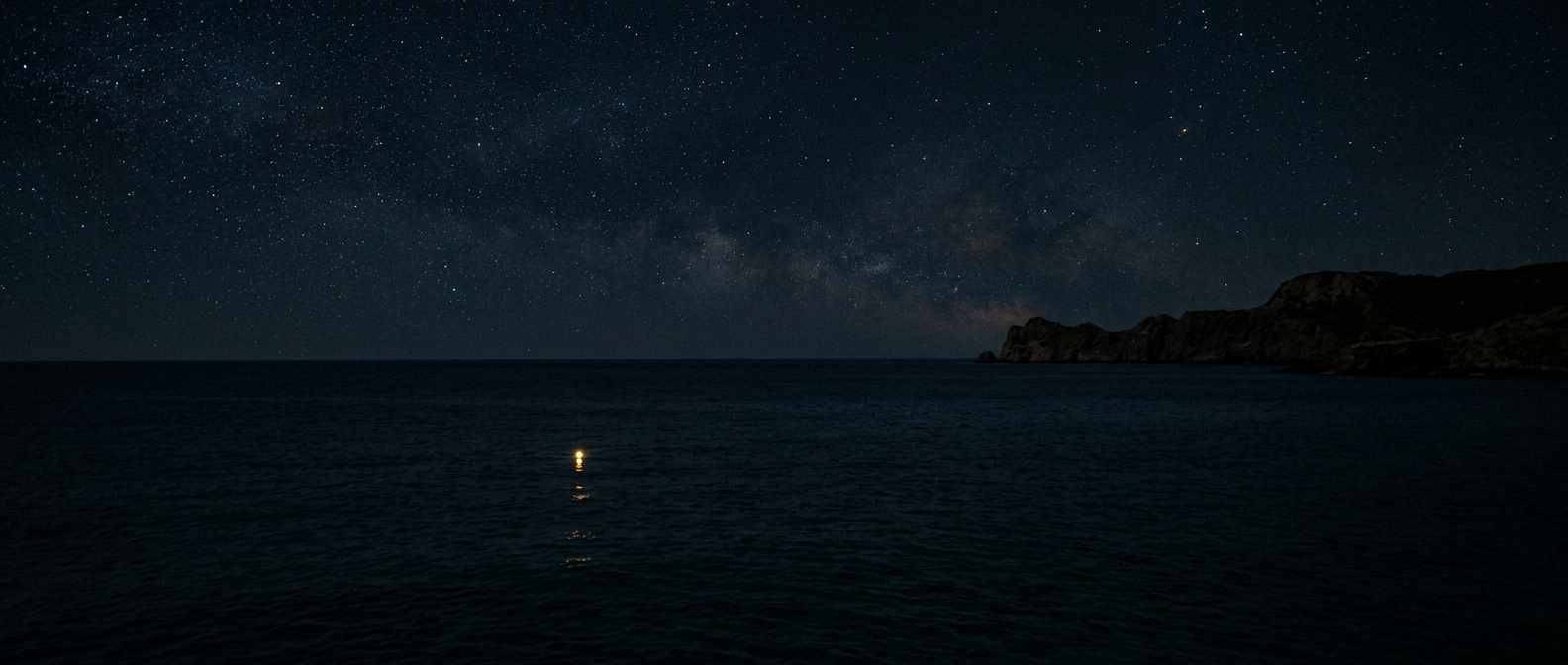
Cabo Codera, coast of Venezuela. Site of the phenomenon of June 4, 1973.
The names of the protagonists and the document numbers appearing in this manuscript have been modified to protect the privacy of the individuals involved. Everything else—the facts, the dates, the locations, the descriptions, and the scientific analysis—is literal and authentic.
II. The Codera File Official Document — National Guard of Venezuela

REPUBLIC OF VENEZUELA
NATIONAL GUARD — ZONE COMMAND Nº 5
REPORT OF POSSIBLE AIR-MARITIME SPACE VIOLATION
Date of report: June 6, 1973
Receiver: Lieutenant Colonel Eusebio Rondón, National Guard
Designated Scientific Advisor: Prof. Jean-Pierre Imbert, Doctor of Solid State Physics, Senior Researcher, Central University of Venezuela (UCV)
— IDENTIFICATION OF THE COMPLAINANTS —
Citizen Miguel A. Molero Venezuelan National, ID V 1.832.932 — Student, 23 years old, Faculty of Architecture, UCV.
Citizen Ramón Andreas Spanish National, ID 239.672 — Student, 29 years old, Faculty of Architecture, UCV.
Citizen Wilfred Mora Klein Venezuelan National, ID V 1.221.455 — Student, 25 years old, Faculty of Journalism, Simón Bolívar University.
NOTE: The three witnesses have given separate testimonies. Their accounts coincide in essentials, with minor differences attributable to the position and angle of observation of each one.
— ACCOUNT OF THE EVENTS —
On the night of June 4, 1973, the three citizens identified above were gathered at the top of Cabo Codera, a promontory on the Venezuelan coast in the Caribbean Sea, whose headland rises approximately fifty (50) meters above sea level. The chosen location was the tip of the cape, from which it is possible to observe the water at a wide angle. To the left of the promontory opens the small cove called Puerto Francés.
The gathering was for recreational purposes. The night of June 4 presented exceptional visibility conditions, favored by the total absence of light pollution. The surface of the sea was perfectly calm. The witnesses describe the water, in their own words, as "a pool of oil."
At an unspecified hour of the night, estimated between 10:00 PM and 11:30 PM, the complainants observed a light on the sea surface, of similar intensity and appearance to that of a fishing vessel. Approximately one (1) minute later, one of the witnesses, citizen Andreu, noticed that the light had moved an estimated distance of five hundred (500) meters, which drew the attention of the other two to the object. From this moment on, all three witnesses focused their observation on the light continuously.
What they observed next is described in the terms used by the witnesses themselves:
(a) The light traveled along extended paths in time intervals that the witnesses describe as "milliseconds," making it impossible to perceive the intermediate movement.
(b) The stops were instantaneous and absolute, with no observed deceleration whatsoever.
(c) The resumptions of movement were equally instantaneous, with no observable progressive acceleration.
(d) At no time was any sound emission attributable to the object recorded.
The total duration of the evolutions over the sea surface is estimated at approximately fifteen (15) minutes. At the end of this period, the light ascended vertically at a speed the witnesses describe as "immediate," disappearing into the darkness of the stratosphere in an imperceptible time.
— SCIENTIFIC ADVISOR'S ASSESSMENT —
"The testimonies are internally coherent and present a coincidence in physically significant aspects that goes beyond what could be attributed to chance or mutual suggestion, given that the witnesses were interrogated separately. The behavior described—instantaneous start and stop, absence of inertia, absence of sound—is not consistent with any known object of terrestrial or atmospheric origin. The opening of an investigative file is recommended."
Lieutenant Colonel Eusebio Rondón — National Guard of Venezuela
III. The laws of physics Are they meant to be broken?
The Codera File would be nothing more than another forgettable sighting were it not for one detail that categorically separates it from the mass of similar reports: the witnesses did not merely describe a light. They described physical behavior. And that behavior, if the fidelity of the testimony is accepted, systematically violates some of the most firmly established laws of modern science.
Newton's First Law and the problem of inertia
Formulated by Isaac Newton in 1687 in his Philosophiæ Naturalis Principia Mathematica, the First Law states that every body persists in its state of rest or uniform rectilinear motion unless acted upon by an external net force. This resistance to change in state of motion is inertia, a universal property of matter. What the witnesses described—instantaneous starts, stops without deceleration—directly and flagrantly violates this law. Any object with mass moving at the speed implied by the testimonies and stopping in zero time violates one of the most robust principles of physics.
Newton's Second Law: infinite force
The Second Law (F = m·a) allows us to quantify the absurdity. If braking time tends to zero, acceleration tends to infinity, and the required force does as well. No known material structure could withstand it, no known energy source could generate it. The advising physicist Jean-Pierre Imbert raised the only loophole: what if the light source was not a material object? What if the observed light was not produced by a body with mass?
The nature of light and its own restrictions
Light is composed of photons: massless particles that propagate at ≈300,000 km/s in a vacuum. Because they lack mass, photons are not subject to Newton's laws in the classical sense, which would seem to offer a way out. However, this is illusory. A photon cannot be accelerated or decelerated, cannot be born from rest or stop at will. What the witnesses described is not compatible with any known luminous phenomenon, whether corpuscular or wave-like. Even if some type of unknown radiation or plasma is postulated, the problem of inertia reappears when trying to explain the origin of the luminous signal.
The silence: an added test
One aspect of the testimony that has received less attention is the total absence of sound. Any material object moving at the implied speeds should generate considerable atmospheric disturbances, at least a pressure wave comparable to thunder. The witnesses, located at fifty meters altitude above a calm sea on a windless night, would have perceived any sound with great clarity. They heard nothing. The silence is compatible with only one known scenario: that the object moved in a vacuum or that it was not an object in any conventional sense. The first possibility can be ruled out (it occurred in the atmosphere). The second returns us to the dead end.
IV. The Fermi Paradox And the loneliness of the cosmos
There is an additional reason, of a completely different scale, to approach the Codera File with a mixture of perplexity and skepticism. In 1950, the physicist Enrico Fermi asked with apparent naivety: "Where is everybody?" The Fermi Paradox begins with a simple calculation: the observable universe is 13.8 billion years old; the Milky Way contains hundreds of billions of stars, and at least half harbor rocky planets in habitable zones. The time available for life to develop intelligence and technology is orders of magnitude greater than it took on Earth. The statistical conclusion seems inevitable: the universe should be teeming with civilizations.
And yet, the silence is total. There are no unequivocal artificial signals detected by SETI, no megastructures, no evident planetary modification. In this context, claims of frequent contact are statistically grotesque. Interstellar distances are colossal: Proxima Centauri is 4.24 light-years away, a journey of over 70,000 years with current technology. The window of existence for a technological civilization may be brief. Cosmic loneliness does not mean there is no one, but rather that contemporaneity and proximity are an almost impossible luxury.
The extraterrestrial hypothesis for the Codera File, therefore, would require evidence of extraordinary forcefulness. We do not have it. But the file remains open as a factual anomaly.
V. Possible? — noUnexplained? — for now, unexplained
And yet, here is the Codera File. Three people, on a clear night over the Caribbean, observed for fifteen minutes something that should not exist according to any available theoretical framework. Their testimonies are consistent with each other. The physicist who evaluated them considered them coherent enough to recommend a formal investigation. The behavior described—instantaneous start and stop without inertia, absolute silence, impossible speeds, instantaneous vertical ascent—admits no explanation within the Newtonian paradigm, nor within standard quantum physics, nor within any other accepted theory.
The honest position is not to claim that it was an extraterrestrial spacecraft—the Fermi Paradox and interstellar distances make that hypothesis one that would require a much higher quality of evidence—but neither can it be to dismiss the account outright. Dismissing it would be comfortable. It would also be, from a methodological point of view, a form of intellectual dishonesty.
What the Codera File documents is an unclassifiable phenomenon. Science has a name for that: anomaly. And anomalies, when sufficiently robust and verified, are not filed away: they are investigated. Not because one expects to find in them the answer to age-old questions, but because the alternative—not asking—is the only failure that science cannot afford.
Fifty years after that night at Cabo Codera, there is no answer. The Caribbean Sea remains the same. The firmament, more light-polluted than then, hides the same stars that Miguel A. Molero, Ramón Andreas, and Wilfred Mora Klein were contemplating when something, over the dark water, began to move in a way that should not have been possible.
The End