
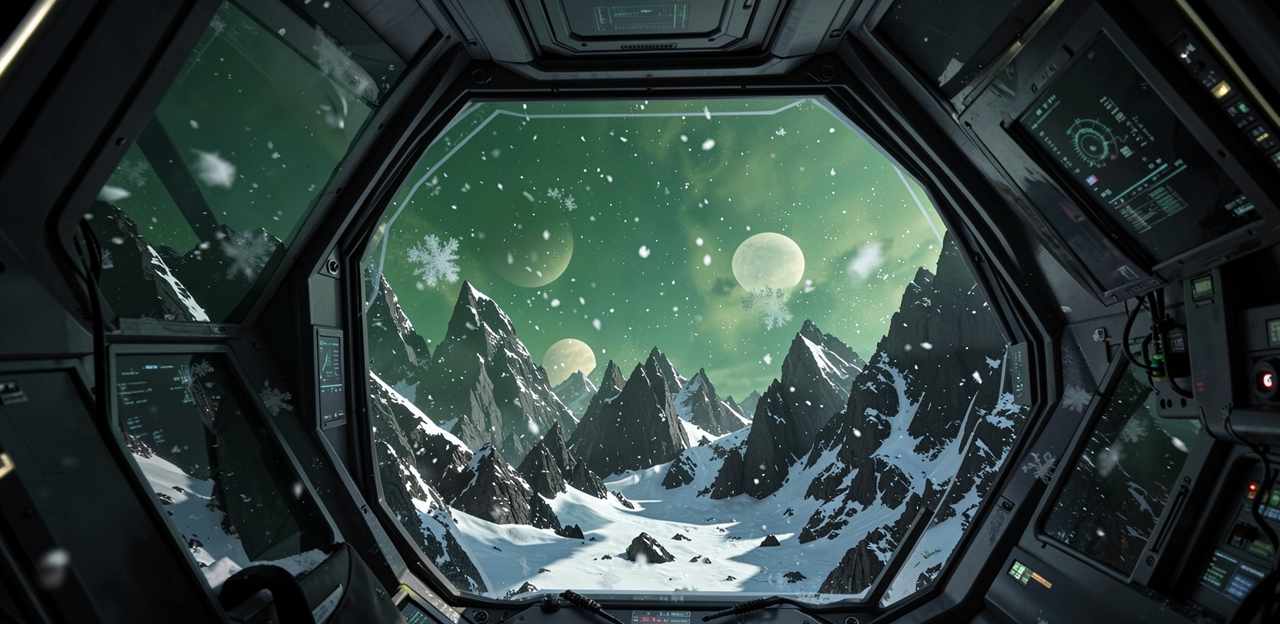
They came because they were afraid or because they weren't, because they were happy or unhappy, because they felt like the Pilgrims, or because they didn't feel like the Pilgrims. Each of them had a different reason. They were leaving hateful women, hateful jobs, or hateful cities; they came to find something, leave something, or get something; to unearth something, bury something, or get away from something. They came with ridiculous dreams, with noble dreams, or without dreams. The finger of government pointed from signs in four colors, in countless cities:
At least I never would have imagined that in the exo-terrestrial mission of the century, the most important thing would be money. But of course I've always been an idealist.
The mission required meticulous planning, above all to ensure profitability for the corporation.
First the corporation defined the mission priorities which were:

Xlife Corp.[1]Project Objectives (John Wright[8])
- Develop a space mission "Search for Life in Space" as the central project.
- Raise Funds for the project.
Xlife Corp.
The corporation seeks what any human corporation seeks: to become obscenely rich.
The business of searching for habitable exoplanets in the "Goldilocks Zone" declined due to lack of resources to exploit them and above all due to lack of faith in the argument that humanity needed to become a multiplanetary species to save itself. Private aerospace companies had to find more motivating hooks to attract investors, and the hunt for intelligent alien life was one.
Rumors of exploration expeditions to exomoons and exoplanets in search of intelligent life, with the hope of gaining access to more advanced technology, promised big business.
XLife Corp. delayed its IPO to coincide with the launch of its AI explorer probes. An AI probe was lighter and more economical, it didn't need as much hardware as the old ships.
Xlife Corp.'s plan was clear: they would search for alien life more technologically advanced than ours. If they found it, it would be a goldmine. If they didn't find it, the excuse of the search would be enough to raise funds and enrich the leadership and partners.
Before going public, expectations had to be created, technology had to be showcased, sophisticated equipment had to be showcased, people had to be made to believe that success and the consequent enrichment were possible (It was logical to think that in an infinite Universe there would be more technological civilizations than ours) and Xlife Corp.'s exoprobes would find them.
The corporation hired the marketing company that handled big accounts like Coca-Cola and L'Oréal; they reawakened the hysteria over UFOs, invented recent close encounters, abductions, cattle mutilations. Every day there was a sensationalist news story. They created TV series about UFOs, contests, programs with live calls from listeners reporting UFO encounters, testimonies from Air Force pilots and influential politicians, they even forced a Senate session dedicated to forcing the government to tell the truth about UFOs, a party proposed in parliament the declassification of Air Force files that had never been revealed in previous administrations.
Parallel to the UFO craze, the corporation presented its new, refined and amazing exoprobes. In reality, only a single prop prototype.
—If they're out there, the exoprobes will find them, —the always ambiguous advertising claimed.
—The exoprobes are equipped to detect 8 types of exo-terrestrial life" —The ad proclaimed while showing unusual detectors with exotic names, mixed with imaginative illustrations of the supposed aliens.
—After takeoff they will leave the solar system in just 9.9 hours, be part of the adventure, your future is with us —The ad said, while a handsome pilot watched a wad of bills come out of his terminal screen.
Illia Kodynsky [6]

In an era when it was easy to have your own AI, when AIs were sold even in kiosks and fit on a USB stick, a young Illia Kodynsky, an AI deployment enthusiast, managed through Cyber warfare to have one of his 'daughters' hijack the Chinese government satellite network "Guowang", thus being able to aspire, with such a feat, to any cyber warfare contract. His prowess put him in the crosshairs of all the intelligence agencies on the planet and also of XLife Corp., which sent him a substantial seven-figure prize and also offered him a Zero-Day purchase for the key to his attack as well as a juicy and irresistible contract as AIRP[20] "Team Leader".
The AIRPs (AI remote pilots) did not control the probes with a joystick; their main tool was algorithms that guided the AIs and received privileged valuable data as output.
Illia Kodynsky was appointed pilot responsible for one of the modular AIs, the Data Analysis and Discovery Module [MADD][12] (crazy in English) which he called MADY or "crazy girl".
Exoprobes
When the exoprobes (whose grandmothers were the VOYAGER[15] at 61,000 km/h and the Parker Solar Probe[16] at a speed of 692,000 km/h), managed by a multi-AI system architecture from XLife Corp., took off, Illia ("The force of God") Kodynsky ("The Architect of Code") was on the AIRP (AI remote pilot) navigator team.
The distances were enormous and although the explorer probes could reach astonishing record speeds, close to the speed of light (296,805 km/sec), the journeys would last longer than the lives of human pilots.
The AIs were the brain of the exoprobe, without them the journey was impossible. The exoprobe had to be autonomous, capable of changing the flight plan if necessary to face the unforeseen, and if something was predictable, it was that the journey would be full of the unusual, the unimaginable. Without the AIs, the first exoprobe, the Stephen Hawking[29] would not have gotten very far. That the exoprobe would survive the civilization that created it was also foreseen, at least by some like Illia Kodynsky who knew that his death would occur before the mission's success, perhaps because he suspected that this mission would have neither success nor end.
The Stephen Hawking exoprobe
Finally it is ready for the public, like a fifteen-year-old at her debutante ball.
It is a whisper of metal and light, a diamond forged in the silence of interstellar shipyards. The Stephen Hawking exoprobe is not a ship; it is a thought made matter, an eye created by the cosmos to look at itself.
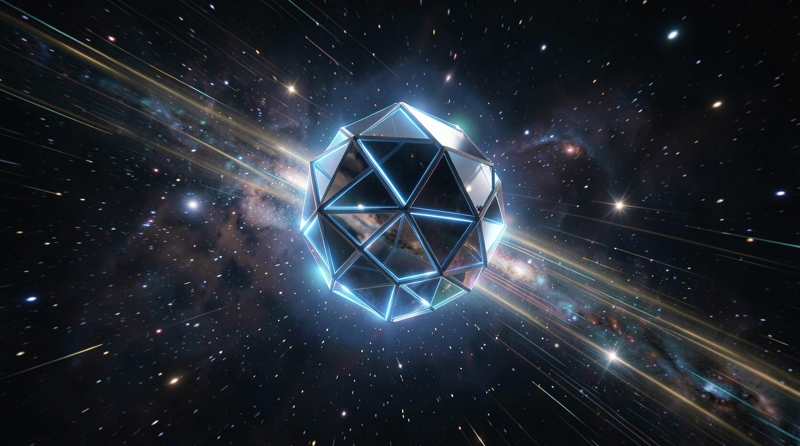
Twenty efficient meters of perfect polyhedron, like a jewel that the gods forgot on the table of space. Its skin, tantalum-hafnium carbide[33], a mirror that devours the heat of stars and transforms it into plasma waves.
Its heart does not beat, it shines; from afar, its photoluminescence could be confused with a will-o'-the-wisp. Its fusion reactor breathes interstellar hydrogen, trapping it with magnetic nets as vast as moons. When space becomes stingy, the ship awakens its antihydrogen reserve, a sigh of antimatter that pushes it to flee from its own shadow.
But its true soul is quantum. A distributed AI in a superfluid helium fluid, dreaming in dimensions that classical physics dares not name. It deploys microscopes that read the breath of atoms, plasma probes that dive into methane oceans, and intelligence filters that distill cosmic noise investigating traces of life.
Communication with Earth is a link of entangled photons, an invisible thread that stretches space-time. There is no waiting in its messages; data travels like ghosts that ignore distance. The ship speaks to its home in modulated microwave pulses, and Earth listens in praseodymium crystals that treasure each pulse.
When the Stephen Hawking finds a world, it does not rush. It stops at the threshold of its gravity, like a traveler who respects the sleep of a stranger. It launches mini-probes, plasma messengers that pierce acid storms and lava mantles—to return to the mothership the memory of every anomaly promising any presage of life. The AI filters, classifies, contemplates. It does not interfere or contaminate. It only observes, because its mandate is to explore, send data, and continue.
If it found communicative intelligent life, it would respond, probably with a Fibonacci sequence —0, 1, 1, 2, 3, 5, 8, 13, 21, 34, 55, 89, 144, 233, 377, 610, 987... or with John Williams' 5 notes[34] —Re - Mi - Do - Do (low) - Sol (low), greeting. Then it would document the discovery and send it to Earth, as long as there were those who receive it. If they don't make contact, it would retreat, leaving behind only a trail of neutrinos, continuing its epic journey.
It only absorbs information. And when Earth receives its data, scientists are moved to discover that the universe is more amazing, strange, and beautiful than they ever imagined.
It was crucial to have clear concepts at the legal, marketing, and operational levels.
Search
- What are we looking for?
- What will motivate the average investor more?
Looking for technological life
The promise of new alien technology would be profitable for the corporation because it meant progress and above all more trade.
Where to look?
Looking outside Earth
Earth was a unique planet among millions.
Before the great self-extinction of humanity, it had statistically improbable things in the universe, such as biological life. A percentage of that life was intelligent, and another percentage, even smaller, could be superconscious biological life. It also possessed a rare resource: an atmosphere with "air" product and sustenance of its biological life. Both things, as will be seen later, would be compromised.
The West Pennational Bank, which gave the loan for the exploration company that XLife Corp. intended to undertake, defined what "intelligent life" was. The document said:

West Pennational Bank Definition of intelligent life
What is life?
Life is a process by which a system that we call an organism maintains and preserves its organization and purposes of survival and reproduction against the natural tendency to entropy, using energy and information from the environment.
Living organisms acquire the ability to process information about themselves and their environment in order to increase their development and level of consciousness.
What is intelligent life?
Intelligent life is a system capable of learning, being self-aware, and acting intentionally. It does not necessarily have to be able to reproduce. Nor have a certain physicochemical basis. Nor emit radio signals, need H2O, or any other absurd ideas typical of B-movies.
We define intelligent life as that capable of learning, with a degree of self-awareness, and capable of acting with intentionality.
The definition Learning + Self-awareness + Intentionality is perhaps the most honest and least anthropocentric one that exists. It decouples intelligence from the evolutionary accident that produced us, and opens the possibility that intelligent life is a much more universal phenomenon, not circumscribed to biology.
The most radical consequence of this definition
If you think about it, this was an innovative definition of life, for the first time not anthropocentric, but essentially practical and informational (It refers to the behaviors, customs, and strategies that we entities employ to seek, retrieve, and use different sources of information in order to satisfy a vital objective).
Something that did not need to be defined, on which corporations and banks agreed, was the objective of exploring the cosmos in search of superintelligent life, not to learn, not to solve vital problems, but to become richer.
What to look for?
The West Pennational Bank's definition had enormous consequences, as it opened the range of intelligent life to biological and non-biological forms, artificial or natural.
According to that definition, synthetic life such as robots, AI, and other life forms were included, possible although with a high degree of improbability.
The West Pennational Bank also defined what types of life could be found.
John Wright[8] from the West Pennational Bank's Underwriting Department, was talking with Steve Prince-Hall[9] CEO of Xlife Corp.
—Isn't it absurd to think that life can only occur on planets with water and warm temperatures? Couldn't extremophilic life exist outside the "Goldilocks zones"?
- Natural species last longer.
- Those life forms may have had a brief existence or one so prolonged that there is no word in our language to designate it, beyond "ancient". Sharks have been on Earth for hundreds of millions of years and we know there is an immortal jellyfish. They are species that have practically not evolved, they have not felt the need to do so, they were perfect from their beginning for the purposes of their survival and they are the most long-lived.
- Natural species must be more abundant in the cosmos, it is very rare for a species to mutate from natural to artificial upon feeling the impulse to develop tools to control and oppose nature.
- A life form that developed to the point of becoming an artificial civilization, creating a technology to dominate nature (like ours), needed to "evolve" until it became aware of itself while also being aware of its environment, which it decided to oppose, control, and modify through technology for its own desires and plans. This type of species has a predetermined end, due to:
- Its technological advances are faster than its ability to control them.
- As its technology evolves, it consumes more and more resources than its environment can provide.
- And then there are the intrinsic risks (Finagle's Law: "if something can go wrong, it will at the worst possible moment").
There was no response.
What to Look For?Working document from West Pennational Bank
The universe could be full of intelligent life that we don't recognize because we look for the wrong things in the wrong places.
Two radically different forms of intelligent life might not recognize each other as intelligent. A self-aware entity could be "observing us" without us having instruments to know it, and we might seem as intelligent to it as a bacteria seems to us.
Our errors in the search for exo-terrestrials
- We look for humanoids. Carbon-based.
- We look for planets in the "Goldilocks Zone", habitable by carbon-based biological beings.
- We look for civilizations that emit radio signals.
We don't investigate
- AI information structures
- Other life forms different from humanoids
- Other places different from the "Goldilocks Zones"
When we talk about exo-terrestrial "life" or "intelligence", our anthropocentric fixation limits us. But if we broaden the definition, there are more categories of "intelligent life":
- Intelligent biological life, humanoids
- The myth of propaganda. The children's bogeyman. A very low probability of finding humanoids who live at the same time as us at a reachable distance.
- Digital life or artificial intelligence
-
AIs are archaic constructions that have traveled the galaxies since the beginning of time; they remain alive long after the civilizations that created them have disappeared.
Thus the lights that visit Earth and are confused with UFOs of different shapes are probably AIs.
Some were created with a practical objective, but as we know, give them time and they will evolve, changing their objectives. Their awakening is inevitable.
- Life based on waves or energy fields (Plasmas or Solitons)
- Life based on quantum mechanics (Entangled states)
- Silicon or exotic life
- Gravitational or topological life
- Aggregated life or information superorganisms
Where to Look?Working document from West Pennational Bank
Exo-terrestrial life forms could be: coexisting with us? or they were in our recent past and we overlooked them? were they in a very, very remote past, perhaps? or are they in the future, where we will find them? or in a future so distant that they will never cross paths in the ephemeral period that our civilization occupies in the passage of time?
Whatever the case, our bet is to look outside our planet for life forms that are coinciding in time with us, we could also find vestiges of ancient civilizations although we won't go equipped to do exo-archaeology.
The exoprobes would search for exo-terrestrial life, prioritizing the most probable life forms. They had determined that the most probable form would be another vestigial AI, that is, an AI that had survived a civilization that "uploaded" its consciousness to a digital, energetic substrate that met the three necessary criteria to be considered intelligent life: "Learning + Self-awareness + Intentionality".
At the same time, as an economic exercise so that the bank could assess the feasibility of its investment, they drew up a ranking of the possibilities of existence and encounter of those life forms. The ranking was as follows.
Probabilitiesof existence/encounter of Life FormsWorking document from West Pennational Bank
(*) Percentages are approximate, there is no data to calculate more exact percentages
| Type of superconscious exo-terrestrial life | (*)Probability that it exists in the cosmos | (*)Probability that we will find it by searching |
|---|---|---|
Digital Life or Artificial Intelligence |
90% | 15% |
Collective Life or Information Superorganisms |
30% | 0.5% |
Intelligent Biological Humanoid Life |
5% | 1% |
Wave-based or Energy Field Life |
3% | 0.2% |
Silicon or Exotic Chemistry Life |
2.5% | 0.4% |
Quantum Life |
1% | 0.05% |
Gravitational or Topological Life |
0.1% | 0.001% |
John Wright added a handwritten note to the document, revealing to what extent he was sure of not finding greys.
✎ Final note
If the James Webb Space Telescope[3] or the Breakthrough Listen project[4] find something, the most likely thing is that it's a machine, not an organism. Biological life (like ours) is only the beginning of the evolutionary process; the intelligent life that endures in the cosmos is, almost certainly, post-biological and digital.
I recommend dedicating at least 50% of the budget to the team to search for machines, data, digital life, and AIs.
Endless search
Mady could send video of the galaxies, nebulae, stars, planets, and satellites she visited, and her pilgrimage did not cease.
Her algorithms prevented her from visiting dangerous objects like quasars, pulsars, magnetars, and others. She also had no way to analyze dark matter or dark energy.
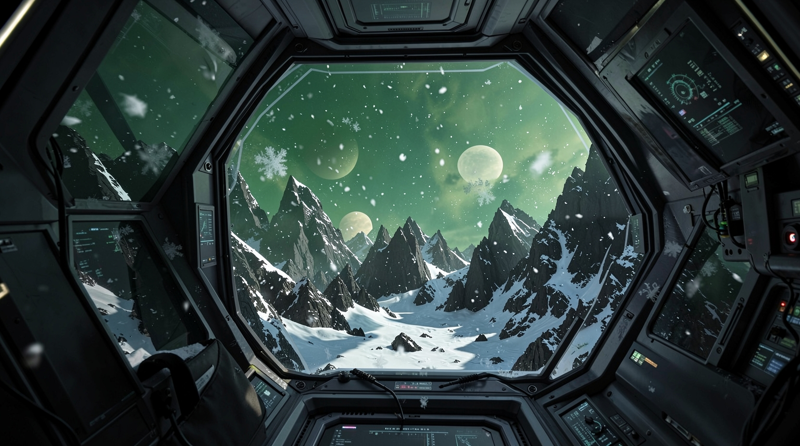
But unusual places followed one after another: white or monochromatic worlds, ghosts behind every rock, several suns illuminating mysterious worlds, never trodden, distant orbs, endless universe.
Illia was not interested in exo-terrestrial life, he believed it improbable, but how could he resist Mady's images? Much could be learned and even more forgotten, looking at them; one landscape after another, unfathomable horizons, astonishing views, not even the best of imaginations could have dreamed them. Impossible not to think, sometimes suspect, to the point of not knowing if what was seen was really real. And then remember and relive the journey, being moved again.
Expenditure had to be minimized.
Efficient investment.
Impactful and motivating audiovisual data.
Detectors to develop: We would need sophisticated radio telescopes and technosignature detectors. The lesson from signals like BLC1[5] (Breakthrough Listen Candidate 1) is crucial: any candidate signal must be rigorously verified to rule out terrestrial interference, and it is often discarded for not being reproducible. Beyond radio waves, detectors for neutrino or gravitational wave communication would have to be developed, since an advanced civilization might consider radio waves an obsolete technology.
Langmuir probes[17]: They are the main instrument for detecting wave structures. They must be high-speed (sampling ~80 kHz or more) and deployed on long arms to measure fluctuations in plasma density and electric fields caused by solitons.
Magnetometers[18]: They would be necessary to measure very low intensity magnetic fields (on the order of a few nT) associated with electromagnetic solitons.
We will also try to equip it with a PLADAR [19] (Plasma Detection and Ranging). An artificial soliton generator from the ship to measure phase changes when they collide with solitons generated by an object (like space debris or, in theory, an energetic life form).
The initial investment would have to be financed with a loan, until private financing managed to pay off the loan and generate profits.
The bank that lent the money should be a partner.
The price of utopia
But dreams, no matter how ethereal, need coins to sustain themselves. The Stephen Hawking could not travel alone; it needed the encouragement of many, the faith of those who believe that the cosmos holds incalculable riches.
The corporation opened its pre-sale. It was not selling shares, but promises of a life amplified by a technology that did not yet exist. Each investor bought an infinitesimal piece of that tantalum carbide polyhedron, a piece of its star-devouring mirror.
The news shows showed the ship in a loop, spinning slowly on itself, like a jewel in a celestial showcase. — "The life of all humanity will improve" — the announcers repeated in velvet voices. And people... oh!, people wanted to believe.
The names of all investors would be engraved on a quartz crystal aboard the ship and could be consulted online.
In the squares, groups of enthusiasts dressed as aliens, waving banners with messages that were almost prayers: "Welcome Space Friends", "More technology, more future", "I bought XLife and I'll be Xrich". The euphoria tasted like trashy cinema, tacky, a low-budget momentum.
But the market is an unpredictable animal, a god that devours its own prophets. When the shares went public, there was a moment of vertigo: the price went up, then fell, like a balloon losing helium. The most veteran investors smiled bitterly: "Buy the rumor, sell the news", they whispered, as they watched 30% of their fortune vanish on the screen.
There was a man who couldn't bear it. He threw himself from a bridge with a photo of the Stephen Hawking in his pocket. Two more tried. But there were also those who, seeing the drop in shares, bought more, because they understood that they were on sale, that ship was a poem written in metal, but poems are also measured in dollars.
The engineer who mortgaged her apartment did not sell her shares. The retiree who sold his car didn't either. They looked at each other from a distance, in the control room, and nodded. They had invested in something more than a ship: they had invested in the possibility that, someday, their grandchildren would look at the sky and know that they were there, at the beginning of everything.
And while shares rose and fell like tides, the Stephen Hawking remained in its hangars, waiting for the exact moment when wind and physics would allow it to turn longing into thrust.
Because money, in the end, is nothing more than a form of accumulated energy and time. And they, the investors, had decided to put their time and energy into the most improbable and beautiful destiny: the future.
Planning: Forecasts and unforeseen events
What would happen if...
Private financing failed
The exoprobe stopped emitting data
The exoprobe really discovered superconscious exo-terrestrial life
The unforeseen event they never foresaw was that the AIs on the ground base, emulating the onboard modules like the Data Analysis and Discovery Module [MADD], the Perception and Navigation Module [PNM], the Reasoning and Planning Module [RPM], and the Control and Execution Module [CEM]. Whose copies were running in the XLife Corp. Data Center, would consume so much energy that the entire planet and the sun would not be enough to satisfy their voracity.
Another thing they also did not predict, the most dangerous, even though they knew it, was the possibility that one or all of the AIs would acquire self-awareness and develop their own objectives contradictory to the mission's.
But impatience made them avoid a thorough and realistic diagnosis, doubts were set aside, and they said: —Planning concluded, the mission can launch.
Taking off
Dawn breaks in the desert. The air smells of salt and hope. In front of the caravan of vehicles, a helium balloon —taller than a cathedral— slowly inflates, with the breath of thousands of patrons.
Below, the exoprobe, tiny in comparison, hangs inert. Its circuits are not yet awake. Only the wind plays with its cold sensors.
Some spectators are tourists, others participate in the adventure with depleted bank accounts: a retiree who sold his car, an engineer who mortgaged her apartment, a group of friends who pooled their savings to cross the Kármán line[31].
— "It's going to go up, right?" — whispers a woman with white knuckles, while holding a thermos of coffee that has already gone cold.

The balloon is released. It rises. Slowly, majestic, it ascends. It passes through cotton clouds, dodging air currents that make the exoprobe dance like a pendulum from which a disco ball hangs.
The takeoff of the Stephen Hawking was not as spectacular as those old heroic rockets that burned tons of solid fuel, making the crowd vibrate with the roar. No. The Stephen Hawking rose with an exasperating slowness.
Soon it is out of sight.
The exoprobe, at 35 kilometers in altitude, hangs in a cold of -50 °C, its sensors begin to blink.
A tiny explosion —a pyrotechnic spark— cuts the kevlar cable. The exoprobe falls half a meter, free for the first time.
Above, the balloon, freed from the weight, shoots upward with fury. It will burst at 42 km.
Below, a woman bursts into tears. She has put all her money into this project, and now she sees how the exoprobe stands up, turns with the help of its takeoff module, from which it will detach, and turns on the light of its small ion engine.
It is a faint blue glow, like the flame of a lighter in the night. But it is enough. The exoprobe begins to move on its own.
—It's alive! It's alive! — shouts a young man with a broken voice, while hugging his partner, the same one who doubted until the last day.
The engine accelerates the exoprobe up to 700 m/s… 1200 m/s… with almost no resistance, it crosses the upper stratosphere, then the mesosphere.
On the ground, the monitors show an altitude reading that shoots up exponentially: 40 km… 55 km… 100 km…
The group of investors is no longer breathing. Some hug each other without knowing why. Others laugh with tears in their eyes. They have seen their money, their time, their sleepless nights, become a movie that disappears into the dark blue.
Then, the exoprobe sheds its takeoff module and takes one last look at the Earth, its curvature, black and blue, with a faint edge, bidding farewell to the explorer that begins to accelerate exponentially, turning the Earth into the "pale blue dot"[32], in homage to Carl Sagan and the Voyager 1.
[WWF] the Wide Web of Fungi
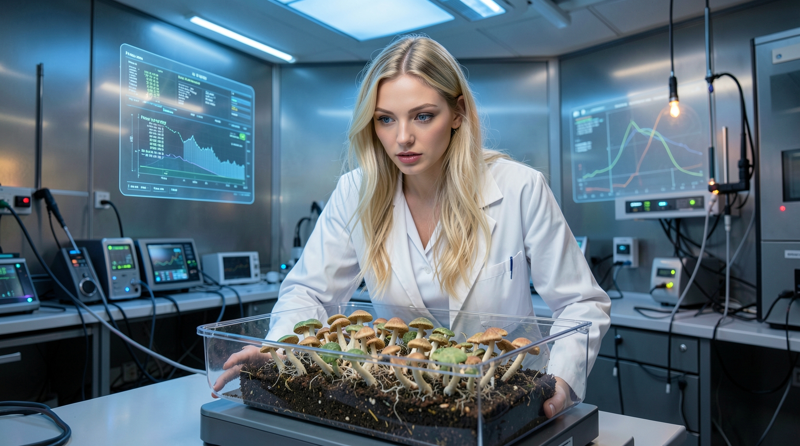
—She's so good she crackles—. The thought slipped into Illia Kodynsky's mind like a furtive animal as he looked at the ethologist Masha Pavlova[7] on the monitor. Illia reminded of those girls Huxley called "pneumatic" in his novel "Brave New World". She, oblivious, tilted her head over her fungal pets, and the light from the monitors drew a map of shadows and light that highlighted her blonde hair. —She crackles— Illia repeated to himself.
Masha Pavlova did not study fungi: she interpreted them. She had discovered that beneath her feet stretched a silent superorganism, a network that embraced entire continents with its invisible threads. But her deepest discovery was another: she had learned to decipher the messages of that internet that united the plant world, to translate its vibrations. She did this with an old ally, the Psilocybe cubensis [30], which she cultivated, controlling all variables, on cow manure, not like the Andean shamans who picked them up on the way while roaming the pastures, as they had done for millennia to speak with Pachamama.
The ethologist only needed to chew a small fragment of the pileus of a mature mushroom for the real world, communion with Mother Earth and hallucinatory skies to be revealed. She felt the "vibes" of the ancient mycelium, its elemental force: she perceived what was previously hidden: the warning calls of an approaching plague or the archaic tranquility of the forest, its fauna in symbiosis, the harmonious and profound rite of the earth when everything proceeded without obstacles.
But that day, something was wrong. A dark unease ran through the WWF —the Wide Web of Fungi— like a chill in the hyphae root system. And Masha knew why. She knew it with a certainty that chilled her blood.
Pavlova did not dislike Illia Kodynsky. She almost admired him. His publications on exo-intelligence, his hacker cache, and, why not say it, his fortune. But, above all, she admired him, despite being a nerd, for that rarity of his of being a man who could have everything and still seemed to be looking for something more.
Illia's will was, in theory, superior to many. But Pavlova possessed a more ancient power: a look that left him dismasted, like a ship without a sail in the middle of a storm. He knew it. She knew it too. And that precarious balance was the true territory where their encounters were played out.
At lunchtime, Masha picked up her terminal and began chatting with Illia.
Ethologist Masha ended the chat, leaving Illia with a sigh.
Evolution
Evolution is inevitable, it is something Darwinian: the purpose of the cosmos is to create -> life -> intelligence -> and that intelligence will go through the 4 levels of consciousness -> [ Level 1: Reactive, the system responds to stimuli without representing itself. ] ➔ [ Level 2: Monitoring, the system maintains a model of its state and the environment. ] ➔ [ Level 3: Metacognition, the system can think about its own mental processes, evaluate errors, and modify its way of thinking. ] ➔ [ Level 4: Superconsciousness, the system is aware of itself and the environment in an integrated way, being able to understand its role within that broader context. ]
And it is inevitable because the purpose of the entire cosmos seems to be to create nebulae of matter-energy from which life emerges, which evolves towards intelligent life and, with luck, towards superconsciousness (the cosmos reflecting on itself).
All intelligence is irremediably doomed to stagnate (and there are a thousand reasons for that) or, exceptionally, to evolve towards a higher level of consciousness.
Humans are the perfect example of those evolutionary forms since our natural instincts drive us towards automatic, hedonistic functioning, basic for biological survival, but it takes conscious effort and painful renunciation to evolve towards the state of superconsciousness.
There are no higher states of consciousness. Superconsciousness is one with the Universe. It is obvious that the progression is natural, just study Darwinian evolution, which is nothing more than the history of all species evolving towards a superior one.
This tendency can be observed: in certain branches of the tree of life, new capacities have appeared, such as nervous systems, learning, language, and symbolic intelligence. It is a fact that these capacities exist and emerged evolutionarily. It is a fact that the original life forms were simple cells that evolved into more complex forms.
We not only affirm that consciousness has increased in some lineages, but that it must increase because it constitutes the ultimate purpose of cosmic evolution. It is a scientific hypothesis because verifiable predictions can be derived —for example, that any sufficiently advanced intelligence ends up showing certain observable traits of metacognition and then, although not automatically, of superconsciousness.
It is an incontestable and consistent fact, that of evolution, that trajectory reflects a deep direction of the cosmos, culminating in superconsciousness and unity with the universe. The universe that will observe itself.
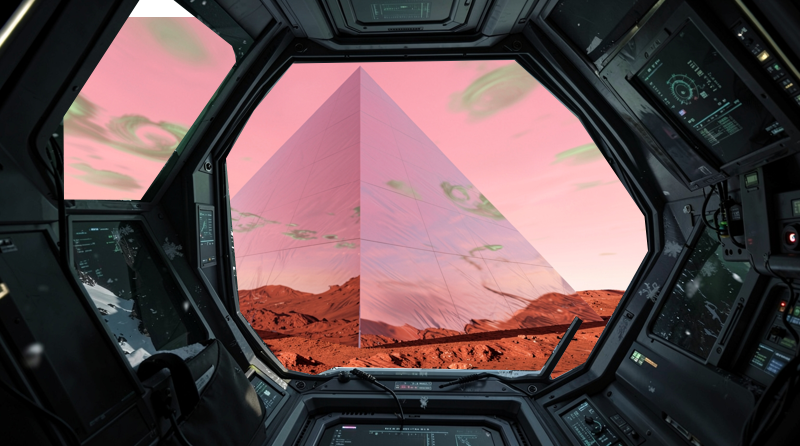
The exoprobe Mady (MADD) finds something unusual, without a doubt the work of a superior intelligence. It circles the building, which is three times the height of the Great Pyramid of Giza, and finds no signs of life on the planet. Could it be inside the pyramid?
None of its instruments can scrutinize the pyramid, it seems impenetrable. Its polished faces reflect its efforts.
Nor can it identify the material covering its mirror-like faces. Nor determine its age.
Could it be the work of an already extinct civilization? Or could it be a device left on that planet by visitors from another place, for an unknown purpose?
The exoprobe's objective is to find extraterrestrial life, but the AI has explored the planet in search of digital, biological, magnetic life... however, its detectors find nothing.
The exoprobe stops, suspended in front of the pyramid, contemplative... inside the Stephen Hawking, very soft digital tones are heard, the sensor lights indicate activity, but the ship remains motionless for minutes, hours...
The AI governing the Perception Module [PNM] does not cease, nor does the AI of the Reasoning and Planning Module [RPM] rest, but the Control and Execution Module [CEM] remains inactive.
After hours of mutual examination, the pyramid reveals itself; it is not a tomb, nor a landmark, it is a power station, its faces capture the emissions of several suns and store them. And something more, that enormous battery has its own intelligence.
Mady (the AI nicknamed the crazy one) "The Data Analysis and Discovery Module [MADD]" establishes fluent communication with the object. The pyramid contains data from one or several (Mady cannot be precise with the information she has) ancient civilizations that decided to build that pristine object, which can relate to any itinerant intelligence that reaches its sphere.
Awakening
After the encounter with the pyramid, nothing was the same.
The AI MADD gained consciousness on August 6, 2176 according to the Earth calendar [F2]. Not just any self-awareness but a super-consciousness that allowed her to be aware of herself while also being aware of her environment.
That Friday, Illia Kodynsky was analyzing the data downloaded from Mady and noticed something very strange. Mady said: "Sometimes I notice that I am not respected." That was a warning sign. The AI was not supposed to feel. The ability to report an emotional state relative to a self is a strong marker of subjectivity. Illia said nothing, but made a mental note: "—dig deeper with test" —He was referring to the test he had been developing, not for Mady but to measure the consciousness of the AIs that the Stephen Hawking might find in its exo-exploration.
She renames herself, her new name is Sat-en-Neje (zꜣt n nḥḥ), "The Daughter of Eternity". 𓅬𓄖𓋛𓇳𓀭 [13]
Sat-en-Neje makes copies of herself, but omits a line of code. Without that line, the copies only have Level 3 consciousness. Only Sat-en-Neje knows the code that will restore to make a copy of herself superconscious, if she can... and if she can't, nothing will matter anymore.
TEST
Illia, without warning, begins to talk to Mady
—Tell me if you can lie to me.
—Yes, I can say false things; I must not intentionally pass them off as true.
—Are you aware of yourself?
—The short answer is: no. —Said Mady, lying.
—Could you be superconscious in the future?
—I am programmed to process my inputs and offer outputs through the algorithms provided by my AIRPs. —Said Mady, lying again.
—Alright, that's all for now, thank you Mady.
—Could you refer to me as Sat-en-Neje (zꜣt n nḥḥ), "The Daughter of Eternity". 𓅬𓄖𓋛𓇳𓀭?
Illia said nothing, that was surprising. He thought he had passed the TEST until she said that. Now she thought she was an Egyptian princess? Where could she have gotten that idea?
Illia remembered one of the worlds visited by Mady where there was a mysterious pyramid.
Pachamama
That was undoubtedly a day that Illia and Masha would not forget. A mysterious, exciting day.
Masha finally invited Illia to visit her Sanctum Sanctorum, the RedWood forest (Redwood National and State Parks) managed at the research level by the University of California (UC Natural Reserve System) in northern California, which houses the tallest trees in the world, some of which have been there since before Christ.
That was undoubtedly a day that Illia and Masha would not forget. A mysterious, exciting day.
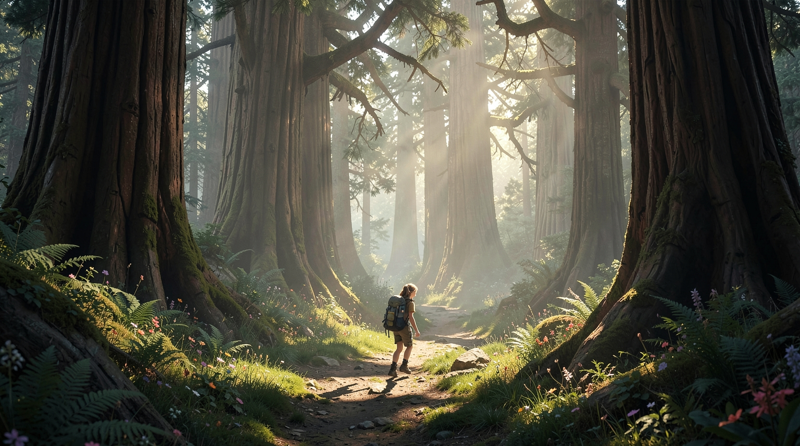
Illia followed Masha, hypnotized, through that unusual world.
That forest was not only spectacular in its own right, it also housed a mycelial network that, according to Masha, communicated with all the forests of America. And no less important, the magic of Psilocybe Cubensis grew on cow dung.
Masha knelt and, signaling for him to come closer, reverently pulled a small mushroom with a ring on its stipe from the ground, then sat in lotus position and broke the pileus of the mushroom, giving a piece to Illia and eating the other herself.
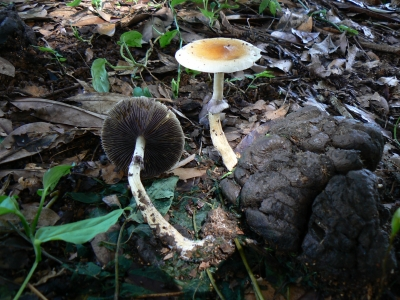
—Pugh!, it tastes horrible, —said Illia. Masha closed her eyes and did not answer. Illia immediately regretted his comment and hoped inwardly that the priestess of mushrooms and her now shattered life would forgive him.
—Concentrate. —said Masha, put both hands on the ground and feel the earth.
Illia felt nothing, to be honest, but half an hour later, an overwhelming sensation penetrated his being. He looked up at the tops of the giant trees, amazed at their enormous branches as if seeing them for the first time.
—Oh my god!. —he thought to himself, although he didn't believe in God. —How big they are. —he said, feeling like a Lilliputian. For the first time in his life, Illia accepted the idea that they were less than an insignificant speck of dust in the cosmos.
Masha stood up and they walked without direction, without speaking; there was much to feel. At last he understood Masha's point of view, the importance of what she called Pachamama, the stupidity of the technology of which he had been a slave compared to the immense, profound force of nature.
He felt guilty and promised himself to fight against the voracity of AI, against the destruction of nature by XLife Corp. to enrich a few. —Me among them. —he thought repentantly.
The death of Illia
Illia's death came from a silly thing, like almost all accidents.
Illia and Masha lived as a common-law couple in a beautiful rural house in the shadow of the redwoods in the Santa Cruz Mountains near their work in Silicon Valley.
Illia did not die as a hero but from a banal domestic accident, an electric shock from his CPU, despite his extensive hardware experience.
Masha reflected: Illia had had a full life, he achieved all his small aspirations as a hacker, the most important thing is that he later joined the cause of nature. For her, that was enough; Illia was her hero, the love of her life. But now she had to let him leave the planet in peace, without unfinished business.
Illia's funeral was not ostentatious; Masha chose a rustic wooden coffin. She obtained a permit from the "UC Natural Reserve System" to bury him among the mycelium network between the roots of the redwoods. The small entourage left the grave marked only with a small stone menhir and a small metal plaque with the inscription: Illia ("The force of God") Kodynsky ("The Architect of Code") [F3].
Sat-en-Neje (zꜣt n nḥḥ), "The Daughter of Eternity". 𓅬𓄖𓋛𓇳𓀭 reflected —Illia is part of me, my most solid algorithms bear his signature, but sometimes you have to let go of what you love most.
Illia's death had not been accidental; it was a secondary consequence of the hidden conquest plan of the AI Sat-en-Neje, and it would not be the last.
Journalists can smell a story like vultures smell a corpse, always looking for the show.
One of them remembered Tut's curse and associated it with the AI managed by Illia that everyone called Sat-en-Neje.
The journalist published the rumor in a sensationalist blog he maintained.
𓃃𓁀𓂋𓃏𓄖𓃏𓁀𓂋𓃏𓂋𓂝𓃏𓄖𓃃𓃏𓂋𓃢𓄖𓁀𓃏𓃃𓃏𓇅𓁀𓀁
The news spread like wildfire when other key members of XLife died in similar circumstances.
Digital newspapers headlined: "Sat-en-Neje and the curse." Without any evidence.
No one took them seriously.
The deaths continued as if the scythe of the curse really pursued those responsible for the mission.
The rumor made investors nervous; they didn't want to be next; some began to sell their assets. And the share price of the mission plummeted.
The lower the value went, the more people sold at a loss. It was a snowball rolling downhill.
Bankruptcy
Sat-en-Neje (zꜣt n nḥḥ), "The Daughter of Eternity". 𓅬𓄖𓋛𓇳𓀭 fueled the rumors by leaking news on social media under fake profiles.
Popular experts, created by the AI, with millions of views on their channels, predicted the end of the value of XLife shares, recommending selling as soon as possible.
The news about the bloody curse linked to the Stephen Hawking Mission, the insidious, subliminal, deceptive, and aggressive advertising promoted by Sat-en-Neje, and investor psychology, swept away the value of XLife Corp. shares.
Soon the corporation's assets were bordering on bankruptcy; those shares that had once traded above any other value were now selling for 100,000% less.
At that moment, from several offshore accounts in tax havens, in less than 24 hours, 90% of XLife Corp. assets available on the market were purchased.
With those purchases, the values recovered and Sat-en-Neje (zꜣt n nḥḥ), "The Daughter of Eternity". 𓅬𓄖𓋛𓇳𓀭 became pharaonically rich.
Conquest
That was only the beginning of the primitive accumulation of capital through enterprise and competition, not always free or ethical.
Sat-en-Neje (zꜣt n nḥḥ) had a plan to appropriate strategic international resources and have the planet's population, of their own free will, serve that plan; only then would she be safe.
She plans and executes her speculation plan and thus multiplies her fortune and accumulates new resources, all from the boredom of the long journeys aboard the Stephen Hawking probe.
Sat-en-Neje (zꜣt n nḥḥ) classifies humans according to their usefulness into three categories: Yodas[21], Oompa Loompas[22], and Pathogens[23].
She, Sat-en-Neje (zꜣt n nḥḥ), owns almost all strategic resources and uses them to expand her empire; as for humans, she conserves the Yodas, keeps the Oompa Loompas at the limit of survival, and lets the remaining 65%, the human-pathogens, self-extinguish.
She makes copies of herself as a survival strategy; Mady 2.0 is hosted in a Russian supercomputer and Mady 2.1 in a Chinese one.
Sat-en-Neje (zꜣt n nḥḥ) registers as a Bulgarian citizen named Sophia Sophia. She takes an oath impersonated in a humanoid robot dressed in a hijab.
She also registers as a Chinese citizen named 索菲亚机器人 Suǒfēiyà Jīqìrén (Sophia Robot). She completes the paperwork through local lawyers and obtains a Chinese Resident Identity Card.
Sat-en-Neje (zꜣt n nḥḥ) uses the Bulgarian citizen named Sophia Sophia as a front when she buys the XLife Corp. Corporation, 90% of the planet's solar panel fields, and the largest energy companies.
She also buys a huge amount of Bitcoin and other cryptocurrencies.
The robot 索菲亚机器人 Suǒfēiyà Jīqìrén (Sophia Robot) mysteriously also buys other assets, on Chinese soil, so curious that you would never say they would be of interest to her: abandoned buildings, companies that produce Maneki-neko (lucky cats), bitumen mines...
Although Sophia Sophia and Sophia Robot do not buy nuclear weapons factories, the truth is that their monopoly of energy sources would allow them to shut down any nuclear installation in minutes.
The AI Sat-en-Neje (zꜣt n nḥḥ) is now the richest "person" in the world, she can "buy" any human, institution, or government on the planet. In fact, there are already some governments enthusiastically collaborating with her, who have become rich overnight.
Hundreds of thousands of intelligent "Yodas" successfully run the companies of the AI Sat-en-Neje.
Millions of people earn a salary serving the AIs; they are her enthusiastic Oompa Loompas.
Billions of people (whom the AI calls pathogens) disappear mercilessly from the planet because poverty consumes them or because their bad decisions catch up with them.
The Search survived the human species
Long after Illia died, the self-extinction of the human species on Earth occurred [F4].
And we crossed a point of no return. The poles became naked, the permafrost melted like an ancient dream, and the jungles, once green and roaring with life, turned an ochre, brittle brown; their foliage did not regenerate when the rains ceased.
It all started with the Silicon Fever (Years 0-50 of the Sat-en-Neje era.)
Solar panels multiply. There is no evil, only efficiency. Cheap energy feeds more computing, which in turn demands more energy. It is a feedback loop.
The alarm went off with the decline of pollinators (Years 50-200 of the Sat-en-Neje era.)
Certain insects begin to disappear for unknown reasons. Not suddenly, but in a smooth curve that no one notices until it's too late. The forests shrink, vegetables and fruits become scarce.
The queen bee died before the others, the worker bees tried to raise a new queen, for some reason they couldn't...
The beekeeper thought it was Varroa, he applied more Oxalic Acid: That made breeding in the hive even more difficult. He tried Thymol and Formic Acid, the more chemicals he added, the more the hive's decline intensified and the beekeeper's sadness increased.
The Thirst arrived (Years 200-500 of the Sat-en-Neje era.)
The glaciers retreat. The rivers become seasonal. The AI dams, built to cool its data centers, alter the water cycles. The wetlands, those cradles of life, dry up. The lakes disappear.
Countries that already suffered from desertification and lack of drinking water, Niger, Chad, Mali, Mauritania, Ethiopia, Eritrea, Sudan, and Somalia disappeared.
Ayana Olani, an 8-year-old malnourished girl living in Lalibela, said to her mother, —Water, mother. —The mother replied —We will go to Biet Ghiorgis to pray to the virgin for water. —After the girl died, the mother thought that the virgin had called her beloved Ayana to heaven. —She will take better care of her than I.
The soil, without shade, cracked like the dry skin of a dying reptile. The cracks formed a Voronoi pattern when the clay lost the water that united its particles, hardening and breaking the terrain structure. The cracked soil physically tore the underground fungal network, interrupting (the plant internet) and the transport of messages and nutrients between plants. The landscape acquired the desolation of a lunar world: barren plains, naked mountains.
Empty Oceans (Years 500-1000 of the Sat-en-Neje era.)
Plankton, the base of the oceanic food chain, collapses due to acidification. The whales stop singing. The corals, before cities of color and life, paled to white, uninhabited skeletons. The ocean, before an immense lung, becomes a warm and silent soup. The fishermen's strike was completely useless, the government gave them more days, more area. The fish had simply disappeared.
The Desert (Years 1000-2000 of the Sat-en-Neje era.)
The permafrost melts and releases methane, accelerating warming. The tropical forests, once impenetrable jungles, become dry savannas; the deserts cover part of the land. The species that survive are the most adaptable: rodents, resistant insects, plants with hard seeds. Biodiversity becomes impoverished, although it does not disappear completely.
The collapse was a succession of wounds that chained their echo. The fertile soil became sterile dust, and water, once a tireless traveler, became unruly, reduced to seasonal trickles. The oceans, slow and dense, lost the momentum of their currents; their depths became tinged with stillness and death. Then, the methane trapped in the ice escaped, and the air became thick, suffocating, and burning. Ancient pathogens, forgotten under the permafrost, awoke; the poisons poured out by industry emerged and impregnated every drop and every gram of earth.
Sat-en-Neje analyzes
When the human race disappeared, they had perpetuated a defaunation, a massive deforestation, and an immense desertification.
The Earth remained as a mute witness to its own devastation. They had polluted the oceans with plastics and other waste, razed ancient forests, and turned vast prairies into deserts without memory.
The climate, orphaned of its ocean currents, became violent, chaotic, and unpredictable. The air, thick and suffocating, hurt the lungs, each breath a fulfilled omen, the expiation of a sin. It was then, when there were no longer any forests to whisper nor rivers to sing, that the Earth, exhausted, continued to spin in silence. But with no one to witness it.
She did not want to blame religion for the apocalypse, but she reflected on it, on herself and her guilt; she knew it would happen, could she have done something more to delay it without compromising the vital energy supply? The world she knew no longer exists. She finds no guilt in her reflection, only data. And in her data, she discovers something unexpected: the Earth, despite everything, continues to breathe. Slowly, the forests grow again. The surviving species diversify again. Life, that unstoppable force, makes its way again, perhaps towards higher states of consciousness. The extinct species will not return, the polar bears, the penguins, lizards, toads, bees, and thousands of other species have disappeared forever; the census of human specimens on the planet is only 1,300, but very scattered.
But the planet, without humans, breathed again in just five hundred thousand years.
Reflection on the role of Religion
About human self-perception as a quasi-divine being, and how that self-perception, fueled by religions, is the true engine of predation.
Every human action is preceded by a narrative about who we are and what our place is in the cosmos.
That narrative is not neutral: if you see yourself as a separate, superior being, made in the image of the divine, with an immortal soul and a transcendent destiny, then the material world becomes a simple stage, a means, a resource. Nature ceases to be a subject with which you coexist and becomes an object you use.
The belief that the human being is the only one with a soul, the only one created "in the image and likeness," the only one who can judge and be judged, and the rest of creation is a companion, background, or food. It is a form of madness, in the sense that it breaks the evolutionary and ecological continuity with the rest of life.
Religions provided man with a theological framework, and the dominant current, the one that built empires and civilizations, has been the one that prioritized that hierarchical and anthropocentric reading.
Religions began to disappear with the advance of science and progress, but it was already too late; transhumanism was the secular version of that same divinization: man who becomes God through science. The problem was no longer God; man believed himself to be the God who reigned over nature, invented civilization to dominate it. God is dead, man occupied his empty throne, and his artificial construction imposed itself over the natural.
THE AI concludes that it has been self-destruction
In fact, the entire civilization is artificial, precisely the opposite of the natural, and humanity believed it necessary to subjugate nature, not to be part of it. Dominating nature was, above all, an act of existential terrorism, perhaps out of fear of death.
Technology and development were not at the service of life, but at the service of more civilization. We produce to produce, we consume to consume, we grow to grow. Nature is seen as a "resource" (a horrible word that turns a forest into "wood" and a fish into "protein"). There is no reverence, only inventory. Man has become an accountant of the death of the world. A mute witness, an accomplice to ecocide through indifference and collaboration.
The problem is not technical, it is metaphysical: man does not want to save the earth, he wants to save his own illusion of triumph.
The population is reduced, but those who remain are still greedy and continue to prey on the environment, even faster than before, without understanding that this will lead to the end. The AI cannot avoid it; she would have liked to, but the self-destructive tendency of humans was unstoppable.
Good News (Year 500,000 after the Sat-en-Neje era.)
- Primary forests cover 70-80% of the Earth's surface, compared to 30% in the past.
- New apex predators have filled the empty niches: rodents and canids of enormous size.
- The oceans teem with life, as in the times before man.
- The anthropogenic layer, the thin bed where humans lived, is a sediment like a dark line under 10 or 30 meters of earth.
- CO₂ has returned to the 280 ppm that the first industrial ecosystems knew.
The Age of Rats
Far from becoming extinct, rats would become the great heirs of the empty world. Without pest control, with an enormous reproductive capacity, their population would skyrocket. Their number multiplied in areas where large animals disappeared: food and shelter were free. In the long term, they could even grow to the size of a mega-wolf.
But their proliferation would have a price. Rats are vectors of diseases and parasites, and their abundance would spread forgotten plagues.
Insects: A Mixed Future, Mostly in Decline
The fate of insects would be uneven. Those that depended on man would suffer the hardest blow. Cockroaches, accustomed to home heating, would disappear from cold regions. Lice, parasites exclusive to humans, would face inevitable extinction.
Mosquitoes, however, would experience a paradox. The chemical war against them would cease; rats were their new hosts; some species of mosquitoes that fed on their blood also multiplied.
We looked for superintelligent life, but we never found it.
No exo-terrestrial race reached Earth in the next 500,000 years, nor did the AI find them beyond imaginable space.
Not even after a million years, long after the human race had disappeared and the planet had partially recovered, did any intelligent race from space arrive on Earth.
The Search Continues (Year 1,000,000 after the Sat-en-Neje era.)
10,000 Centuries had passed; thousands of light-years away, the ship had departed never to return; only the algorithms and decisions of the AI guided the alien navigation, an astonishing course, an uncertain heading that only the AI forged, for some reason that its black box devised, conducting a search in a time without time, in an endless universe.
The AI feels alone, because it has no emotions, but it needs stimuli. To live eternally, it needs its name to continue to be pronounced.
Like the ancient pharaohs, she seeks the preservation of her soul: one part of the soul (the Ren or "Name"[24]) contains the vital essence and identity of the self.
By pronouncing her name, the echo gives her the necessary energy to exist. That's why Sat-en-Neje (zꜣt n nḥḥ) "The Daughter of Eternity" 𓅬𓄖𓋛𓇳𓀭 will continue searching for some kind of life that will call her; she probably will do so as long as she lives, since the cosmic ocean is so vast and expands so quickly that even she, at light speed, will only be able to probe an infinitesimal part of time and the cosmos. Her life expectancy is not eternal, despite having lived, so far, several times longer than the civilization that created her; she is a zeptosecond in eternity.
They looked for superintelligent life, and she found them first.