
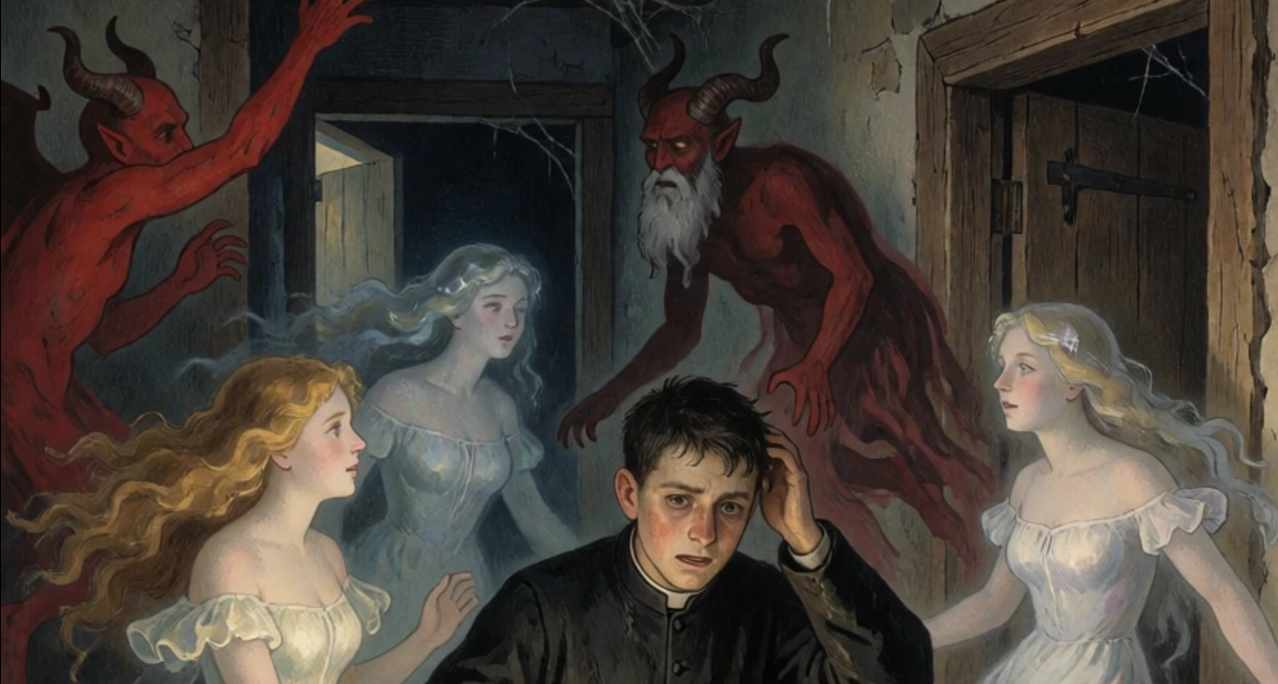
Father Prudencio was a priest, a man from Burgos who lived in the 18th century, yet somehow found himself in the 21st. He dedicated his life to hunting and exorcising nocturnal demons and succubi, but mostly spirits of lust that appeared to him as beautiful women of exaggerated sexuality, tormenting the poor priest.
His diabolical arts did not impress the Bishop, his confessor, who often scolded him: "Prudencio, be prudent! Your parishioners need you for higher purposes. When will you stop chasing succubi and imaginary beings?"
The Bishop believed that all of humanity was mired in moral darkness, and that every sexual dream was undesirable and dangerous for the salvation of the soul. He saw such dreams as sins, and demonic beings as projections of one's own guilt.
The Bishop was certain that sexual relations, whether dreamed or lucid, with these entities could lead to deterioration of the body and psyche, even death, as a consequence of yielding to the carnal desires of the inner demon we all carry within us.
Furthermore, he had observed that encounters with such demons had a strong impact on mood. The victims experienced feelings of guilt, shame, and confusion, unable to justify such experiences in Christian terms.
These demons attacked those who suffered from repressed fears and desires, and their appearance was a clear sign of a struggle within the soul between impure desire and the righteous path. That was what Bishop Abbot Saturnino believed.
Father Prudencio de Melgar de Fernamental, on the other hand, saw no guilt in himself. He attributed his sleepless nights to real beings that needed to be disciplined through exorcism, deserving of his relentless persecution and righteous Christian effort.
Every Sunday, at matins, Prudencio would come to confess his sins. He would kneel before the Bishop with a rosary of palo santo in his hands, which he treasured because it had been given to him by his mother, a saintly woman if ever there was one. The large wooden beads slipped swiftly through his fingers as he performed his devotions, growing smoother with each human touch — an endless caress that wore down the soft wood, revealing the relief of its grain.
Father Prudencio saw no sin in his waking dreams, in which tempting women occupied his thoughts. And they were not sinful; he was simply a healthy young man who neither knew how nor wanted to suppress his instincts to the degree that liturgy demanded. The poor Father Prudencio de Melgar de Fernamental was so innocent that he was determined to rid the world of any demonic trace in pursuit of a purity so virginal that only his naivety could imagine.
But he did not only confess his many sins — like laziness in attending Mass, gluttony, since he always remained hungry in the refectory, or the defect of not liking dental hygiene, a deplorable thing, for as every good person knows, the health of the body is essential for the vigor of the soul.
The Bishop was also his consultant, for the perfectionist priest, in his excessive zeal, asked His Illustriousness all sorts of things, whether trivialities or important reflections. And here was the thing: the priest heard voices — a detail that did nothing to improve the Bishop's perception of the simple curate.
—"He asks me to look for bread and cheese, Your Illustriousness," Prudencio would tell Don Saturnino.
The Bishop attributed the auditory hallucinations to the hunger that Prudencio lived with, according to his own confession.
—"He says his name is Antonio and that he is my friend," the priest continued.
—"And I look for him all over the vicarage, you know?" — The Bishop listened, armed with patience, to the cleric's ravings.
—"Be you man, woman, or child — where are you, Antoñín?" — the priest would say in a mysterious voice, mimicking himself. "But I get no answer; then, if I stop moving, I hear him again."
—"Bring me a piece of cheese from the pantry, Prudente," he would imitate the ghostly voice. "Sometimes he calls me Prudencio, other times Prudente — do you know, Your Illustriousness?"
That had gone too far. —"Say a full rosary, skipping nothing — make the sign of the cross, recite the Creed, the opening prayers, then the Our Fathers, the ten Hail Marys, one Glory Be and one prayer for each mystery, concluding with the Hail Holy Queen and the litanies. Complete!" he emphasized. "Oh, and do gymnastics in the morning. Lots of gymnastics. *Mens sana in corpore sano*." — And crossing himself quickly, he made a sweeping gesture of dismissal to get rid of the priest.
Father Prudencio felt unfairly treated. —"Mother of God!" he exclaimed to himself. "What have I done to deserve such a penance? Gymnastics? Gymnastics? I must have done something serious."
His portion in the refectory had increased, that was certain. Father Prudencio noticed that he was given an extra portion of cheese that no other priest received, not even the oldest ones. He was also greatly surprised when the reader at table concluded his reading with an "Oremus pro fratre nostro, Patre Prudencio, ut Dominus ei gratiam perseverantiae, pacem animae, et robur in ministerio suo concedat" ("Let us pray for our brother, Father Prudencio, that the Lord may grant him the grace of perseverance, peace of soul, and strength in his ministry"). That smelled of the Bishop's hand.
Dejected, Prudencio devoted himself to his duties and tasks as much as he could. He prayed fervently as his confessor had ordered, and even did all the morning gymnastics he could — though it wasn't much. Yet the nocturnal voices did not cease.
With his lantern, he would wander through the old house, up and down the stairs, around the estate, repeating his formula: —"Be you man, woman, or child — where are you, Antoñín?" — until he would collapse, exhausted, back onto his cot.
Father Prudencio had been chasing voices for three weeks. He would rise at dawn, wander through the vicarage corridors with his oil lantern, and stop at every corner where he thought he heard a whisper. Sometimes the voice seemed to come from the kitchen; other times, from the bell tower. But most of the time, it came from his own cell, from behind the wardrobe, or from the floorboards.
Bishop Abbot Saturnino, who watched him with a mix of compassion and exasperation, had ordered his cheese ration to be increased. "Just in case," he said, "hunger is a bad counselor." And although Prudencio did not understand the connection between cheese and voices, he accepted the gift with gratitude.
One night, when the moon was high and the vicarage was silent, Prudencio woke with a start. The voice was there, clearer than ever, as if speaking from beneath his own cot.
—"Prudente, Prudente, can't you hear how hungry I am?"
The priest got up, grabbed his lantern, and knelt down. He ran his hand over the wooden floor, feeling each board, each crack. And then he felt it: a cold draft escaping from one of the boards, right next to the right leg of his bed.
—"There's something here," he murmured.
With the tip of his knife, he carefully lifted the board. He didn't want to break it. It was an old board, made of walnut wood, and he thought perhaps he could put it back later.
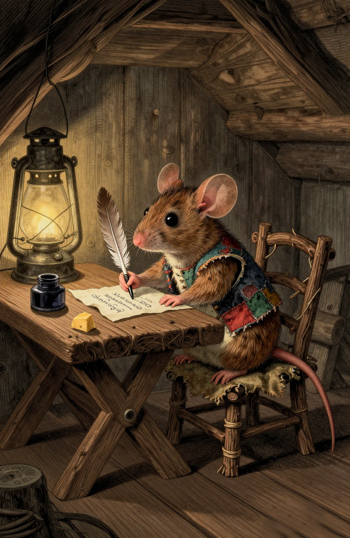
Beneath it, a dark space. A natural hiding place between the beams. And there, in the dust, he found a tiny chair ingeniously made from a small branch and a piece of cloth. A little cup the size of a coin. And an empty saucer, so small it could fit in the palm of his hand.
But what was truly extraordinary was the note. It was written on paper so small it looked like a postage stamp, but with handwriting so elegant that even the Bishop himself would have praised it. It read:
"Dear Father Prudencio: I am your voices. I am not a ghost — I am a mouse. But if you insist, I will accept any name you wish to give me, as long as you leave me some cheese."
Below, in beautiful script, a flourish: "Antoñín."
Father Prudencio stared at the note for a long time. First he felt distrust. Then, amazement. And finally, a laugh so loud that it woke the other priests.
—"Antoñín!" he exclaimed. "You're a mouse!"
And in saying it, he knew he would no longer have to search. The voice that had accompanied him for months was neither a demon nor a ghost. It was a hungry mouse.
The next morning, Father Prudencio placed a piece of cheese on the empty saucer and put the board back in place. Then he confessed to the Bishop:
—"Your Illustriousness, I have found Antoñín."
—"Oh, really?" said the Bishop, without looking up. "And who was it?"
—"A mouse," replied Prudencio, with a smile he could not hide. "A mouse that writes better than I do."
Bishop Abbot Saturnino looked up. He stared at him for a few seconds. "A mouse?" he asked, doubting Father Prudencio's sanity. But on second thought, if Father Prudencio believed in something as innocent as a writing mouse, who was he to argue? And for the first time in many years, he cracked a smile.
—"Well then," he said, "give thanks to God for revealing the mystery to you. And don't forget the cheese."
Father Prudencio left the confessional optimistic, light of heart. That night, when he went to bed, he heard no voice. Still, he left a piece of cheese on the table, next to a paper, a little quill, and a tiny inkwell — just in case Antoñín wanted to write him another letter.
He also left his own note: "Antoñín, I would love to meet you and have you teach me to write in such beautiful handwriting. What else can you do? Do you play chess? Do you believe in God? Did you like the cheese I left you? It's from the goats of Uncle Ventolín, whom you will meet — they are fat and raised with care." Signed, "Prudente."