
Antoñín
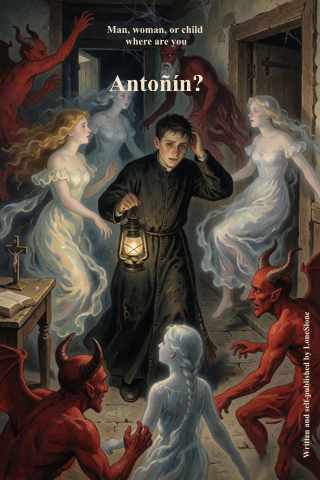
Antoñín is an apologue about a priest ideologically located in the 18th century although he lives in the 21st century. It tells the obsession of Father Prudencio, a young priest convinced that demons and succubi are stalking him. His devotions and exorcisms do not impress his confessor, Bishop Saturnino, who reprimands him with patience and some exasperation. Prudencio hears voices asking for bread and cheese, and roams the vicarage with his lantern repeating: "Be you man, woman, or child, where are you, Antoñín?". The story, with an ending as unexpected as it is endearing, reflects on beliefs in paranormal beings.
Literary Analysis
Genre: Apologue
I. A Voice That No One Sees
At first, Prudencio hears a voice at night and believes it is a demon. In the end, he discovers a hiding place under the floorboards with tiny furniture and a letter signed by "Antoñín." It seems the mystery is solved: it was not a demon, but a mouse. But look closely: the mouse never actually appears. Not once do we see it run, nor does its whiskers peek out. We only see the things it has left behind: a hollow space, a little chair, a note. It is the same kind of evidence he used before to believe in demons: never seeing the being itself, only noticing its traces.
That does not mean the story is lying. The little things Prudencio finds are indeed there, within the story; the narrator describes them just as they are. What cannot be known for certain is who made them. A mouse that writes in handwriting more beautiful than the priest's own is, if you think about it, quite a magical mouse as well.
II. The Same Question, with Less Fear
The phrase Prudencio repeats — "Be you man, woman, or child, where are you, Antoñín?" — sounds, at first, like the words one uses to speak to a ghost. And it sounds, in the end, like a hide-and-seek song between friends. It is the same phrase both times. The only thing that changes is whether it is truly frightening or truly tender.
That is why the ending is not as reassuring as it seems. Prudencio is no longer afraid, but he is still doing the same thing he did before: speaking to someone he cannot see, and trusting that they will answer. In the end, he even leaves a pen and paper "just in case" Antoñín wants to write another letter. He has changed his invisible friend, but he still has one.
III. What If the Bishop Had Something to Do with It?
There is a small clue that is easy to overlook: before the letter appears, the Bishop had already ordered that Prudencio be given extra cheese, and had asked that prayers be said for him publicly. The story itself says: "that smelled of the Bishop's hand." It could be a coincidence. But it could also be that the wise and serious Bishop, who had so often mocked Prudencio's fantasies, had himself crafted the little "miracle" of the mouse to cure him with kindness.
A Beautiful Irony
If that were true, then the most rational character in the story ends up solving the problem in exactly the same way a believer would: by inventing something beautiful in which one can believe. The story does not say whether this really happened. And that is fine: that silence is part of its grace.
IV. The Rosary That Polishes Itself
There is a lovely detail near the beginning, almost hidden: the beads of Prudencio's rosary, from passing so many times through his fingers, have become smooth and polished. The rosary does not need to have any magical power for it to be touched with care a thousand times and end up shining like that. That is exactly what happens with faith in Antoñín: the mouse does not need to truly exist for believing in him to do good — for Prudencio to sleep better, to smile, to leave his cheese with care each night. Belief transforms the one who believes, whether or not what is believed in actually exists.
V. A Funny Story That Preserves the Mystery
A regular moral tale would end with something like "do not fear the unknown; it almost always has a simple explanation." This story seems to say that, and at the very same moment it thinks better of it. Because the unknown remains unknown: only now it has a friendly little face and likes cheese. The real ending is not "it was just a mouse." It is that Prudencio, now at peace, nevertheless leaves paper and ink in case his invisible friend wants to write back. The desire to believe in someone we cannot see never fully disappears. It simply, if we are lucky, finds something beautiful to hold on to. And yet, Father Prudencio still carries his existential doubts. So much so that he asks his new friend Antoñín: do you believe in God? — as if the fact that someone else believed could somehow secure his own faith.
Analysis prepared in collaboration with Claude (Anthropic).
Amazing Readings · mle.es/amazingreadings