
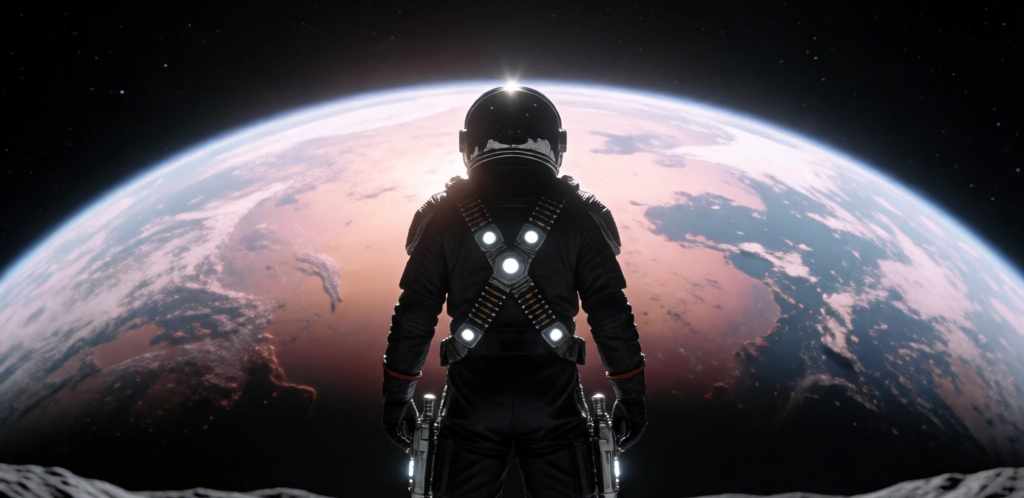
CHAPTER I A New Earth

It would take Earth twenty years to recover from the dirty bombs. Much longer, from the methodical devastation with which the war for the Moon had poisoned its air, soil, waters, and cities.
From their contaminated world, survivors looked up at the sky and saw the crescent moon shining that night, like so many others, in a nearly starless sky. The apocalypse had not reached it.
On the Moon, dawn was breaking. The stranded Earthlings trapped in the Selenite bases peered out from the domes or went to the surface to contemplate the Earthrise.
From that arid and cold place, they saw, with nostalgia, the Earth. Now covered with suspicious pinkish clouds, so close, yet impossible.
The weapons pointed at Earth languished uselessly; those who used them with enthusiasm now regretted it. The connection had been interrupted for weeks; neither lunar products were sent to Earth nor did they receive any supply from the planet, uncertainty spread because they were not self-sufficient.
Soldier James was with his back turned when the light began to spill over the lunar horizon. He was looking at a ghost. He expected nothing. He just watched how the Earth, his home, slowly lit up with the colors of a dawn of future promises; he had always been an optimist.
Soldier James had not had communication with his Earth base for weeks, yet he said: —Earth, this is Captain James BL3-2535. Over and out. —Earth Base, once again, responded with a thick silence. He turned around, dressed in his black tactical gear, and bounced towards his lava tube.
CHAPTER II Recruits
James Andrew signed his enlistment for a simple reason: his daughter needed treatment that only the government could afford. They told him he would probably be assigned to a logistics post at Diego Garcia Base in the remote Chagos Archipelago. James liked the Ocean; Diego Garcia is a coral atoll, he thought his dreams of having a Mai-Tai in a lounge chair under a palm tree would soon come true.
The economic situation was not good; the Middle East conflict crisis had taken its toll. Many rejoiced when the US Army opened the opportunity and called 20,000 new volunteers to the ranks.
What they didn't know was that the Iranian, Pakistani, Tajikistani, and other armies were doing the same. Another absurd war was being prepared.
Optimism spread through the barracks. Morale was high among the recruits; they had gone from having no salary to enjoying the benefits that Uncle Sam poured over his protegés. The crisis was a bad memory.
Mary María Andrew was now suffering with cheerful resignation from Amyotrophic Lateral Sclerosis (ALS), a terrible disease if ever there was one. She finally had a permanent caregiver that James could pay for by sending almost his entire salary home. James called them every day; the mother waiting for his return understood that now the girl's well-being depended on James's work, so both mother and daughter were happy, without financial hardship. María Pérez had bought the girl an easy-to-put-on dress, something she could now afford, as well as eating "well" every day. In the US, not everyone had that privilege; there was hunger, there was anger, and it was dangerous because from those crises governments usually find a solution: provoking conflicts that don't make them directly guilty of the hunger.
CHAPTER III The Lunar Nightmare
James was assigned the code BL3-2535 (Lunar Base 3) and was sent to the Moon. They told him it would be a six-month mission, but the training in exotic weapons for his new destination alone took 8 months.
Rosa Parks (alias: Laser Woman) BL3-12363, an African American soldier from Natchitoches (Louisiana), said —Hey James! We're not getting out of this cold dust. —Why are you so negative? —James replied, —Of course we'll get out, it's not recommended to keep troops on the Moon for more than six months. Soon they'll put us on a rocket back home. —Fool —Laser Woman told him, —you haven't heard the news from Mother Earth. It's getting worse every day. This week we've attacked 5 countries and the North Koreans don't forgive, they're not going to allow our president to stop them from building a military base here on the Moon. Everyone wants to have a lunar base. Right now Belarus is building a new one, with help from the Ruskies, and it has enormous cannons pointed at Earth.
CHAPTER IV Exile 3
Roland Willovi had been appointed warden of Exile 3 prison in Moon Sector Mare Tranquillitatis.
The salary was good, but that wasn't what had made Roland accept the warden position in that prison. Roland already had experience in private prisons and something he greatly enjoyed was the suffering of others. Mr. Willovi was a textbook sadist. And where could one inflict more anguish and pain than in Exile 3? Where could one see someone suffer from infinite nostalgia more than in Exile 3? And where else but in Exile 3 would a prisoner feel more imprisoned, trapped, and confined?
Indeed, Exile 3 was the most extreme cruelty.
They didn't send common criminals. It was too expensive. A common prisoner cost $250,000 a year on Earth; on the Moon it could cost $250 million. In reality, it cost much less because once there, prisoners had to be self-sufficient in terms of food, hygiene, and health. There were no medicines, barely a treatment room without gauze. But it was worth it for prisoners of high strategic value or for those who were to be inflicted with great punishment for having committed an execrable crime.
Deposed dictators: Those who know too much about their own countries and could destabilize governments if they returned.
Enemy scientists and technologists: Nuclear engineers, cryptographers, weapons designers. It's not convenient to kill them because their brains are worth gold; in Exile 3 they were put into full production in exchange for small blackmail items, like cigarettes, a good steak, a shower, or other small privileges.
Inconvenient witnesses: Double agents, journalists who discovered state secrets.
Relatives of enemy high command: Hostages to ensure that the high command acts as dictated.
Criminals who had violated or inflicted harm on a relative of an influential official.
The economic logic: Forced labor to amortize?
Yes, but not mining work (that's inefficient). Lunar prisoners work in high-value industries that only microgravity allows:
Manufacturing of perfect silicon crystals: For quantum chips and high-power lasers. A single crystal manufactured on the Moon is worth $100 million on Earth.
Cultivation of human tissues in zero gravity: For transplants and regenerative medicine. Cells grow without deforming. A kidney grown on the Moon is worth $5 million.
Satellite and spacecraft assembly: Assembly in zero gravity allows for much larger and lighter structures.
Rare earth processing: Extracted from the lunar surface and refined by prisoners.
The Tiangong space station (*) was the first to synthetically transform CO2 into O2. With this technology, it was easy to confine prisoners in lava tubes and, with bottles on their backs, carry out synthetic photosynthesis.
The system: Each country sends its prisoners and demands a "production quota" from them. If they don't comply, Mr. Willovi enthusiastically reduces their oxygen rations, water, or outings.
But the real punishment is not deprivation or work; what the Warden Willovi and the guards, also inveterate sadists, enjoy most is when prisoners drool over Earth.
That is the preferred psychological torture:
Each cell module has a large high-resolution screen showing images of Earth. They see:
City lights at night (prisoners know their family is there).
Streets with people strolling carelessly, beaches with people sunbathing and swimming, everything that constitutes torture and is unattainable: a liquor tasting, exquisite meals, endearing smells...
And they can't eat it, touch it, or smell it. It's a window to paradise from hell. Prisoners develop:
Distance syndrome: Deep depression, constant crying, loss of identity. The guards' batons are the only remedy.
Cartographic obsession: They spend hours pointing on a map where their house, their neighborhood, their favorite café is. They provoke mockery; the guards watch them on their monitors and joke, sending them mugs, glasses, or an empty plate to complete their longing.
Visual hallucinations: Some prisoners swear they see their children peeking out from the clouds. What clouds?
The extreme case: A prisoner tries to escape by breaking a window with a chair. There's no air behind it. He dies from hypoxia. The guards seal the room and quickly replace the window. The next prisoner looks at it and knows he's trapped, not by the walls, but by that atmosphere, by those craters, by that distance.
Why not commit suicide? Because the country that sent them promised them a pardon if they survive 20 years. But it's a lie: no one has ever returned.
CHAPTER V Fear and Greed
The EU had plans to found a scientific colony on the Moon, along the lines of scientific bases in Antarctica.
The plans were ready, the necessary funds as well.
Eminent scientists from Europe and some foreigners had been invited to participate.
The European scientists don't know they are pawns. They think they are going to study the climate.
The plans were wonderful; they would study climate change, atmospheric thermodynamics, conduct experiments in near-zero gravity.
But plans go awry.
Other nations also want the Moon, and not precisely as a scientific base. The Europeans' dream is utopian.
General P. Nochance Weissman (Chief of Operations of the USSF Space Force) was a great admirer of Sun Tzu and "The Art of War," his bedside book.
Sun Tzu emphasized that "controlling the high ground is vital for victory. The heights offer a better view, facilitate defense, and allow attacking the enemy with the force of gravity in your favor."
He also says "If the enemy already dominates the high ground, do not go up to fight. It is better to retreat or deceive him into coming down to neutral ground."
General Nochance, when he read "high ground," mentally translated it as "the Moon."
The Moon was the ultimate "High Ground." It was like having a watchtower on a cliff 384,400 km high that dominated Earth.
It is the ultimate deterrent weapon: The lunar "Sword of Damocles"
From there you have:
Orbital control: From the Moon, you can destroy any enemy satellite with a low-power laser (you don't need missiles). Without satellites, the enemy is blind and deaf.
Control of Lagrange points: The Moon is the gateway to deep space. Whoever controls the Moon, controls access to Mars, the asteroid belt, and beyond.
Kinetic bombardment: 10-ton tungsten rods from the Moon. No radiation, no early warning (they are not missiles, they are ballistic projectiles). They fall at 15 km/s. One single impact = 15 Hiroshima bombs.
Absolute defense: Any ship attempting to attack the Moon is detected from 100,000 km away and destroyed with lasers before it can even ignite its braking engines.
Interplanetary launch platform: From the Moon, gravity is 1/6 of Earth's. Launching a ship to Mars from there is 10 times cheaper. The Moon is the gateway to the solar system.
Every country dreams of installing a system of tungsten rods on the Moon aimed at the 100 most important cities in the world. —Not to use them, but to deter, —said General Nochance at the USSF meeting.
Every country knows that if it doesn't have weapons on the Moon, its enemy will have them.
Whoever has more can destroy the enemy in a first strike. The lunar arms race is a numbers race: more bases, more tungsten rods, more lasers, more shields.
A whole bunch of nations with the necessary technology, such as Iran, North Korea, Emirates, India and Pakistan, China, Kazakhstan, Ukraine, Mexico, Russia, and many other countries like Belarus, were interested in the Moon.
And not to build scientific bases precisely, but to build military installations, exile prisons, spy centers, factories that take advantage of weightlessness to transport products and materials very economically. But the great powers veto them.
That triggered the war for the Moon.
Sharing the Moon could have been an option, but fear and greed prevented them from agreeing on how to divide the pie.
CHAPTER VI The Moon is Superior in Every Way
Earth satellites have serious problems:
- —Low Earth Orbit (LEO)
- They pass over each point on Earth in 90 minutes. They have 10-minute observation windows. If it's cloudy, you failed.
- —Geostationary Orbit (GEO)
- They are fixed, but at 36,000 km. Resolution is limited and they are vulnerable to laser attacks.
- —Lifespan
- 5-10 years, then space debris.
- —The Moon is superior in everything
- —continued explaining in his PowerPoint® Joe Blass, Acting Director of National Intelligence (DNI)
- —Permanent vision
- The Moon always shows the same face to Earth. A telescope on the visible face sees 100% of the Earth at all times. There are no "blind spots."
- —Constant solar energy
- At the lunar poles, the sun never sets (in certain craters). Enormous solar panels provide unlimited and free energy. A spy on the Moon can have their systems active 24/7 without worrying about batteries.
- —Resolution without atmosphere
- There are no clouds, no light pollution, no atmospheric distortion. A 10-meter telescope on the Moon sees a parked car in Moscow from 384,000 km.
- —Stealth
- Enemy satellites cannot "see" the Moon because its visible face is always the same. You can camouflage your telescopes as "craters" or "scientific modules."
- —Secure communications
- Radio signals from the Moon cannot be intercepted by Earth satellites because Earth is always "behind" the lunar horizon for them.
Joe Blass smiled, satisfied with himself. —What do we spy on? —Well, the same thing as conventional satellites but better, much better.
- —Know what the Russian president had for breakfast.
- —Troop movements
- Vehicles, tank concentrations, or missile launchers.
- —Communications
- We capture radio signals, microwaves, even encrypted conversations (with enough amplification).
But the guys at the network of 35 US Intelligence (IC) agencies weren't the only spies:
Imagine a Chinese operator sitting in a module at the lunar south pole. In front of him:
- 100 screens show:
- —The Pentagon in real time.
- —The movements of the USS Nimitz aircraft carrier in the Pacific.
- —NATO communications in Brussels.
- —Truck traffic on the India-Pakistan border.
- —With a single click, he can:
- —Send the coordinates of a Russian submarine to the Chinese Navy.
- —Divert a commercial aircraft by hacking its GPS.
Paranoia: No country trusts that others don't have spies on the Moon. That's why everyone wants their own base. Whoever spies fastest, wins. And whoever doesn't spy, is prey.
James BL3-2535 had been on the satellite for two years when the order came to attack the Russian base at Mare Imbrium. He pressed the button, and the old Missile No. 1 of the ATACMS / PrSM System, with a nuclear warhead, departed effortlessly, leaving lunar weightlessness behind.
James had to obey, and he obeyed. James BL3-2535 didn't know how to disobey; therefore, he couldn't. James Andrew was never very bright. At that moment, he didn't think that his home and family would be victims of retaliation. The missile launched by James was immediately followed by hundreds of missiles heading for Earth. James saw them through his surface screen. It looked like the 4th of July. His heart shrank. Suddenly he understood. He would never see Earth again. Laser Woman BL3-12363 had warned him, and he, as was his custom, didn't value the opinion of a woman. Not because he considered them inferior —it's cultural— he excused himself.
CHAPTER VII Ruin
The projectiles departing from the Moon were directed against the Space Centers of the USA, India, Japan, and South Korea; against the SpaceX® Starbase; against the Chinese Satellite Launch Centers; against the Russian Cosmodromes and other enemy ports on Earth. Also against strategic factories and government and power centers. The intention was to prevent the enemy from being able to desecrate the Moon and set up their system.
Although their targets were military, once the military bases and fleets were neutralized, the war moved to the planet. The remaining aircraft and helicopters were used to bomb, invade, and conquer. They fought in the streets, door to door, systematically, to suffocate the enemy's possibility of recovery. It was everyone against everyone. Humanity destroyed its technology: the Data Centers, the Computing Centers, the Bitcoin Farms, the factories, the Power Plants.
Black clouds of smoke came out for months from devastated gas and fuel wells. They were even unfortunate enough to apply the Scorched Earth policy so that the invading enemy wouldn't get their hands on the resources. They were so miserable that even countries like those in South America and Asia, without military power, were contaminated with chemical and biological weapons so that the enemy couldn't find resources, knowing that they wouldn't find them either and that their dwindling reserves wouldn't be enough.
The War for the Moon was rapid. A few months were enough to exhaust missiles and bombs, along with all survival supplies.
The resulting atmospheric, land, and water contamination caused shortages and famines. That short war had been the most devastating in recorded history. —No one beats us at madness —James said to Laser Woman.
But the ending was ironic: the military, those responsible for the debacle, survive on the Moon. The Selenites are the only living and healthy humans. They look at the consumed Earth from their impregnable fortress. They have lost Earth. —But we have won the Moon, we have won —boasted General Mackenry. Although survival on the Moon without Earth's resources would not be possible.
The military, once enemies, now fraternized, for they shared the same misfortune. They trusted in sending missions to Earth to return with essential supplies. —Surely there are still plenty of Cuban cigars out there —said General Mackenry to Commander Puskin, as he downed a Johnnie Walker Blue James Jean Blended 25-year-old Whisky.