
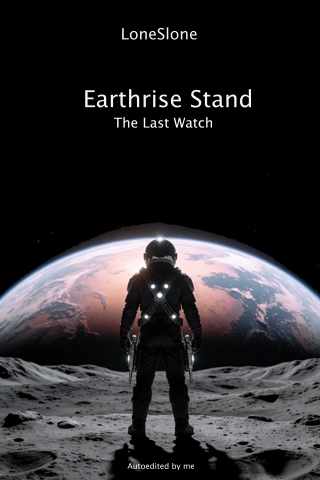
Earthrise Stand
In the near future, the Moon becomes a "Damocles sword" hanging over the Earth. What begins as a war for lunar dominance, triggered by the fear and greed of the superpowers, inevitably becomes the terrestrial apocalypse executed from the Moon.
The characters provide the counterpoint to a succession of scientific data that underpins the motivation for the outcome. Through the eyes of soldier James BL3-2535, an ordinary man trapped in the conflict; the lucid Laser Woman; the sadistic warden Roland Willovi; or the military men who care more about winning than about reason. The story prophesies the war for the Moon. The final irony is cruel: the military, the cause of the debacle, survive on the Moon, complacently contemplating a poisoned and unreachable Earth, unconscious victims of their own victory.
Literary Analysis
Genre: Prophetic science fiction
"Earthrise Stand" prophesies the war for the Moon, combining logical possibilities and basic trends of current society. It is a speculative essay on orbital geopolitics and a meditation on obedience, poverty and nostalgia. This analysis explores its three layers: the literary, the scientific-technical and the humanistic.
1. Genre, structure and tone
The story belongs to speculative military science fiction of near-future anticipation, a subgenre that shares genealogy with Kubrick's Dr. Strangelove (the satire of deterrence logic taken to its absurd extreme), Nevil Shute's On the Beach (the aftermath of a war no one wanted to win) and Heinlein's The Moon is a Harsh Mistress, with which it dialogues by reversing the sign: there the Moon was the colony rebelling against Earth; here it is Earth that arms the Moon against itself.
The subtitle "Prophetic Story" explicitly claims a function of speculative warning, in the tradition of Wellsian extrapolation science fiction or Cold War dystopias: it does not limit itself to imagining a future, but projects forward dynamics —the militarized space race, the privatization of war, servitude through healthcare debt— already present in 2026.
The work deliberately alternates two structural registers. The "narrative" chapters (I, II, IV, V) follow the intimate line of James Andrew, a private soldier driven by economic necessity. The "expository" chapters (III, Exile 3, Fear and Greed, The Moon is Superior in Everything) interrupt that line with lengthy worldbuilding digressions —the Exile 3 prison, Sun Tzu's doctrine applied to the "high ground", the technical superiority of lunar surveillance— presented almost as briefings or dramatized PowerPoint slides.
This friction of registers (lyrical versus bureaucratic-technical) is the story's central structural device. The narrator is omniscient and distant, but changes tone: sometimes pausing on James's interiority, sometimes rising to a panoramic view of lunar geopolitics. It is not narrative inconsistency, but versatility: the reader experiences the same dissonance as its characters, caught between the beauty of the Earthrise seen from the Moon and the numerical coldness of megatons, dollars and kilometers per second.
"He was looking at a ghost. He expected nothing. He just watched how the Earth, his home, slowly lit up with the colors of a dawn of future promises."
This passage, placed at the beginning, functions as an ironic counterpoint to everything that follows: the promise of dawn is revealed, chapter by chapter, as the illusion before the disaster.
2. The "high ground": science and allegory
The story builds its war scenario on concepts with real foundations, but uses them as an allegory of absurd deterrence, not as technical prediction. The Moon as "high ground" —the quote from Sun Tzu that General Nochance mentally translates— is the story's interpretive key: strategic height, when pursued as an end in itself, ends up turning against its possessor, because it does not resolve the underlying conflict (fear and greed), it only transfers it to a larger scale.
The story takes liberties with the speed of escalation: the transition from orbital discommunication to an exchange of hundreds of nuclear missiles over a few chapters compresses what, in any real deterrence scenario, would involve weeks of diplomacy and preparation. This compression is, however, a deliberate narrative decision: it accentuates the sense of inevitability that titles the original English story, "The Inevitable", and criticizes the speed with which decisions are made in modern warfare.
The microgravity economy —silicon crystals, tissue cultivation, satellite assembly— is not just a technical detail, but a metaphor for carceral exploitation: extractivist capitalism finds its purest form on the Moon, where the value of a kidney or a chip is measured in dollars and human life is just another resource.
3. Central themes: fear, greed, obedience
The story is explicit: "fear and greed prevented them from agreeing on how to divide the pie". There is no single villain; there is a logic of mutual deterrence (the lunar "Damocles' Sword") that becomes a self-fulfilling prophecy. It is a rereading of the prisoner's dilemma on a planetary scale.
James does not enlist out of ideology or patriotism, but because his daughter needs treatment for ALS. This is the story's sharpest social critique: the "levy of poverty", the army as a substitute social safety net in the absence of accessible public healthcare. In 2026, with real wars, health crises and cuts in public services, the story is not futuristic, but extrapolation of the present.
The chapter on lunar surveillance describes a permanent orbital panopticon —spying on "what the Russian president ate for breakfast"— that turns deterrence into structural paranoia: "he who does not spy is prey". It is a direct critique of the militarization of space as a business and surveillance as an industry.
4. Characters as instruments
The characters are not ends in themselves, but instruments of the fable. James Andrew (BL3-2535) is the passive antihero, the soldier-instrument who "did not know how to disobey, therefore he could not". He is heir to Hannah Arendt's reflections on the banality of evil: he does not act out of conviction but out of an inability to imagine alternatives.
Rosa Parks / "Laser Woman" (BL3-12363) is the story's lucid voice, correctly anticipating the outcome. Her name —deliberately homonymous with the civil rights activist— and the fact that James dismisses her warning "out of habit" and for not giving "value to a woman's opinion" make her character an explicit critique of gender bias in command structures.
General Mackenry and Commander Puskin appear only at the end, and that is enough: they are useful for showing the irony of empty victory. The fraternity between enemies, the whisky, the Cuban cigars —all of it underscores that those responsible for the catastrophe have learned nothing.
5. The inverted "earthrise": symbol and warning
The title itself turns the Earthrise —a real symbol of awe and unity, from the famous photograph taken by the Apollo 8 mission in 1968— into a "stand", a position of resistance or last resort. The image that in 1968 united humanity in the face of their home's fragility becomes here the backdrop to their own destruction.
The story deliberately inverts that symbol: here the vision of Earth does not generate cosmic empathy, but torture, greed and war. It is a corrosive rereading of the most optimistic space icon of the 20th century.
The final toast between generals —"I'm sure there are still many Cuban cigars around there"— is the story's bitterest image: camaraderie arrives when they share disgrace, paradoxically among those who caused the disaster. It is the banality of evil in its most everyday and cynical form: drinking whisky because the world is burning and that was always the military leadership's goal.
6. Final assessment
"Earthrise Stand" achieves a rare balance between rigorous technical speculation and philosophical critique of war, necessity, ignorance, good will or innocence in the face of manipulation and blind obedience. Its greatest achievement is turning a symbol of hope —the Earthrise seen from the Moon— into a warning: strategic elevation, without agreement or empathy, protects no one; it simply escalates the catastrophe.
As a "prophetic story" it fulfills its function: while it does not literally predict the future, it bluntly exposes the present logics that will lead us toward it. The war for the Moon is not a distant fantasy; it is the extrapolation of a military race already underway, of an economy that already turns health into debt, and of a politics that already prefers conflict to agreement.