
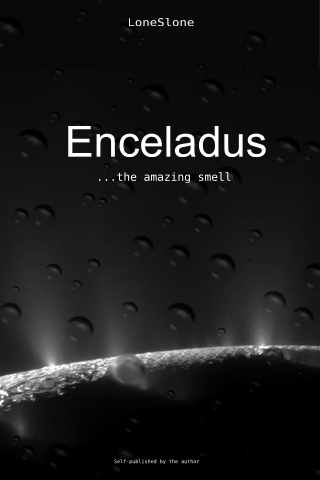
Enceladus
In the year 2222, Earth is still suffering the consequences of the 2101 nuclear war. Axel Rubio, a humble Master of Scents, receives an offer to work on Enceladus, a moon of Saturn where the wealthy exploit a population of genetically selected servants. There he discovers a mystical scent capable of controlling human emotions. Caught between corporate greed and a religion that venerates this scent as divine, Axel must choose between opulence and his own humanity. A dystopian tale about power, faith, and the commodification of the sacred.
Literary Analysis
Genre: Space Opera
Enceladus belongs to the tradition of critical dystopian science fiction, with clear influences from George Orwell (1984), Aldous Huxley (Brave New World, explicitly mentioned) and Ray Bradbury (Fahrenheit 451) and Patrick Süskind (Perfume). However, the novel presents significant originality by centering the conflict not on vision or knowledge, but on the sense of smell, a territory rarely explored in the genre. Smell is the human sense that most awakens memories; it is also a powerful tool of persuasion. In the novel, they turn it into a sales method without which no business could survive. Characters also use it to remember moments or loved ones (better than looking at photos), and the one who makes the magic of smell possible is an alchemist who transmutes chemical substances into memories through scents he synthesizes. On Enceladus, he encounters a species, the nagas, that provide a semi-divine odor. The protagonist, a scent synthesizer, is precisely hired to turn that smell into a money-making mine.
2. Narrative Structure
The work follows a classic inverted hero's journey arc: Axel Rubio leaves a post-apocalyptic Earth for a supposed promised land (Enceladus), only to discover that paradise is actually a corporate dystopia. The return to Earth represents an ethical reinvention of the protagonist. The ten episodes maintain an agile rhythm, with effective cliffhangers at the end of each section.
3. Main Themes
Class Inequality: The dichotomy "cresos" (rich) vs. "siervos" (servants) is the central axis. The novel criticizes how extreme capitalism turns human beings into genetically selected merchandise. The servants travel as "eggs and vials of sperm," dehumanized to the extreme. The servants are only the most beautiful and genetically perfect specimens selected. The very rich (cresos) buy gametes in bulk to provide themselves with beautiful servants who satisfy them in more than one sense.
Religion as Social Control: Shaivism and the "Aroma of God" represent how beliefs can be instrumentalized. VisionCorp attempts to patent a sacred scent, a metaphor for the commodification of everything humans desire.
Technology and Biopower: Genetic manipulation, 4S sensory systems, and odor control show a society where technology serves to domesticate economies, bodies, and emotions.
4. Characters
Axel Rubio: Complex antihero. He begins as a victim of the system, but ends up becoming an active accomplice by commercializing "Soma." His loss of smell is a symbolic castration that humanizes him.
Nastromedo: The faithful helper, representative of the loyal working class. His incorrect speech ("irmos viendo") humanizes him against Axel's sophistication.
Mark Dassault: The classic corporate villain, but well-constructed: not evil for the sake of evil, but driven by a logic of ruthless accumulation.
Efe: The functional traitor to the system. His name (pronounced like the letter "F" in English) suggests he is an interchangeable piece.
5. Linguistic Aspects and Style
The author plays with linguistic registers effectively: the Chinese accent of Lin Chu ("latón" for "ratón") adds realism and class critique. The use of technological Spanglish ("POPUP," "GPSR") creates a futuristic setting. The dialogues are agile and cinematic.
6. Strengths
- Sensory Originality: The exploration of smell as a political axis is novel.
- Believable World: The colony on Enceladus is scientifically well-documented (cryovolcanoes, gravity, subglacial ocean).
- Relevant Social Critique: Inequality, the commodification of the sacred, and corporate control resonate with current issues.
- Ambiguous Ending: Axel does not fully redeem himself; he becomes what he criticized, which invites reflection.
7. Weaknesses
- Lengthy Dialogues: Some conversations (like the Minister's in Episode 3) are excessively explanatory and break the "show, don't tell" principle.
- Female Characters: Women are archetypes (the Rastafarian lawyers, the submissive servants). There is no deep female development.
- Uneven Rhythm: Episode 2 (space travel) is unnecessarily prolonged with technical listings.
- Rushed Resolution: Axel's return to Earth and his commercial success occurs in a few paragraphs, without exploring his internal transformation.
8. Symbolic Interpretations
The Lost Smell: The loss of Axel's super-smell symbolizes how success in the system corrupts ethical sensitivity. Only by losing his "gift" can he return to Earth and reintegrate.
The Meteorite/Naga: Represents the danger of divine gifts: any gift, no matter how pure, will be perverted by capitalism. Shiva warns: "a poisoned gift."
"XtremeHigh" → "Soma": The transformation of the sacred aroma into a recreational drug ("Soma," as in Brave New World) shows how the sublime becomes a consumer commodity.
9. Comparison with Other Works
Enceladus dialogues with Blade Runner (the polluted city), Snowpiercer (class struggle in a confined space), and Black Mirror (technology that dehumanizes). However, its bet on smell differentiates it from most visual or auditory dystopias.
10. Final Assessment
Enceladus is a model dystopia in its class critique, original in its sensory approach, and effective in its world-building.
The novel is particularly relevant in the era of AI and algorithmic control, where our emotions and desires are already the last territory of corporate colonization.