
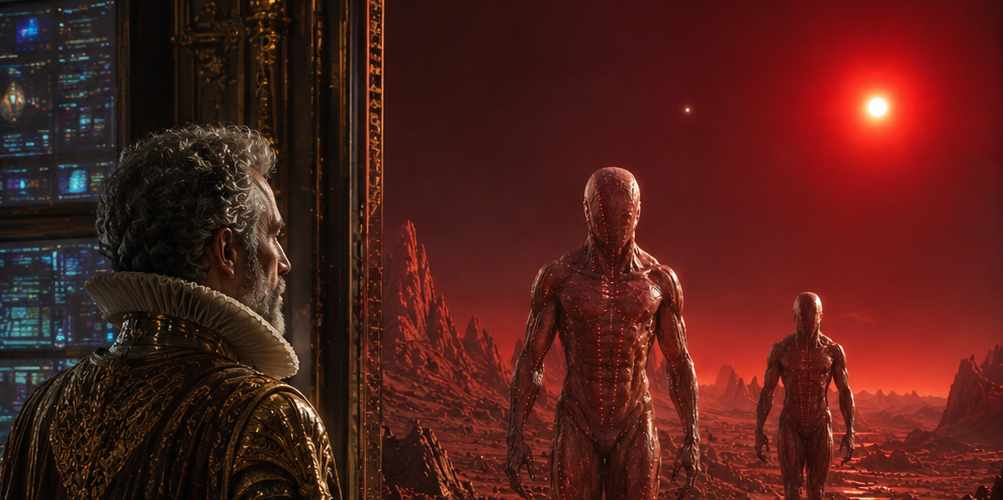
Multiplanetary
Author: LoneSlone
My name is LoneSlone. A tale I wish to tell your graces, which a friend from the future told me; a dear sympathizer of the 20th century where I live, who, as a distinguished intertemporal navigator, visited me, granting me the honor of his friendship and showing me how in that remote future which he shaped with his aura and good deeds, few things had changed in human nature, while marvelous advances of human ingenuity and unfathomable mysteries of the cosmos were revealed to me. That friend, and great guru of the future, was or will be Tristão de Magalhães.
Tristão de Magalhães
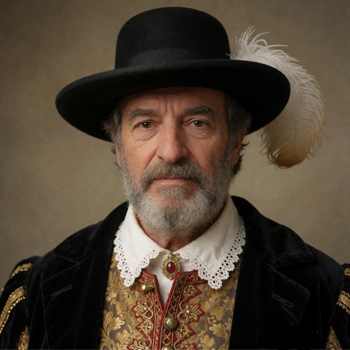

A man of great power and wealth, where such exist. He possessed an enormous fortune, having inherited it from an original accumulation of Bitcoin. For a distinguished ancestor, his twelfth great-grandfather, had the vision to mine (and preserve, and not trade for pizzas like the famous Laszlo) the amount of five hundred thousand of these coins in the year of grace two thousand and ten. Although in those remote times they were barely worth 3 thousandths of a cent, nowadays a single bitcoin sold for the not insignificant sum of two hundred and fifty thousand ounces of gold.
Tristão de Magalhães, with his beautiful wife Alexandrina de Bragança (who seemed the reincarnation of an old 20th-century actress named S. Vonne Stone), both belonged to the Portuguese nobility, she a countess and he an illustrious fidalgo.
They inhabited a beautiful Portuguese baroque building, a small castle that seemed taken from a Disney movie. Tristão had bought it above all for its romanticism; its balconies had views of the Tagus River, the starting point of epic voyages such as those of Vasco da Gama, Ferdinand Magellan, the first to circumnavigate the planet, and other illustrious Portuguese navigators.
Alexandrina and her son João were not very content with their idyllic abode, away from the great urban centers, where fame, pleasure, and shops dictate the pace. Alexandrina felt like a prisoner queen in her own fortress.
Tristão de Magalhães invested in his obsession, which was to become a daring interstellar navigator himself, and he employed a huge part of his patrimony in founding and financing "The Greatest Mission of Multiplanetary Colonization of Humanity," the "Dandelion Mission S.C." Named thus for a poetic analogy used by Sagan to envision human space exploration as a seed carried by the wind, capable of spreading life and knowledge throughout the cosmos.
Tristão, a man of great worth and skilled in dealing with people, achieved consensus and alliance with distinguished powers, both national and economic.
The governments of the European Union, China, Russia, and North America were united in this goal, not out of friendship, but for economic reasons, since none of them alone could afford such a large undertaking.
The noble Tristão well knew that, as great as the contributions from those powers were, added to his own donation, they were still not enough for the Council of the "Dandelion Mission S.C." to design missions of such long range. Thus, the ingenuity of the noble lord devised a strategy worthy of the twentieth century: to summon the people of the entire world to a Universal Contest of Inventions and Knowledge, in order to outline the major designs and main concepts of what would be the Greatest Enterprise of Multiplanetary Population of Humanity. This maneuver would serve both as skillful publicity and to achieve his desired panacea of accomplishing greater feats with fewer funds.
The Contest
Many are called, but few are chosen.
Although truly many were summoned, being chosen was a rather esoteric endeavor since many scientists had not yet found the keys to a viable system. Essential pieces of that puzzle were therefore missing.
If you were fortunate enough to be one of the winners, your economic troubles would be over; you would receive 1 share, a seat on the Mission Council, and a deposit of 1 Bitcoin in your cold wallet. With 1 BTC, at the price of 2450, you could buy yourself three penthouses in NYC.
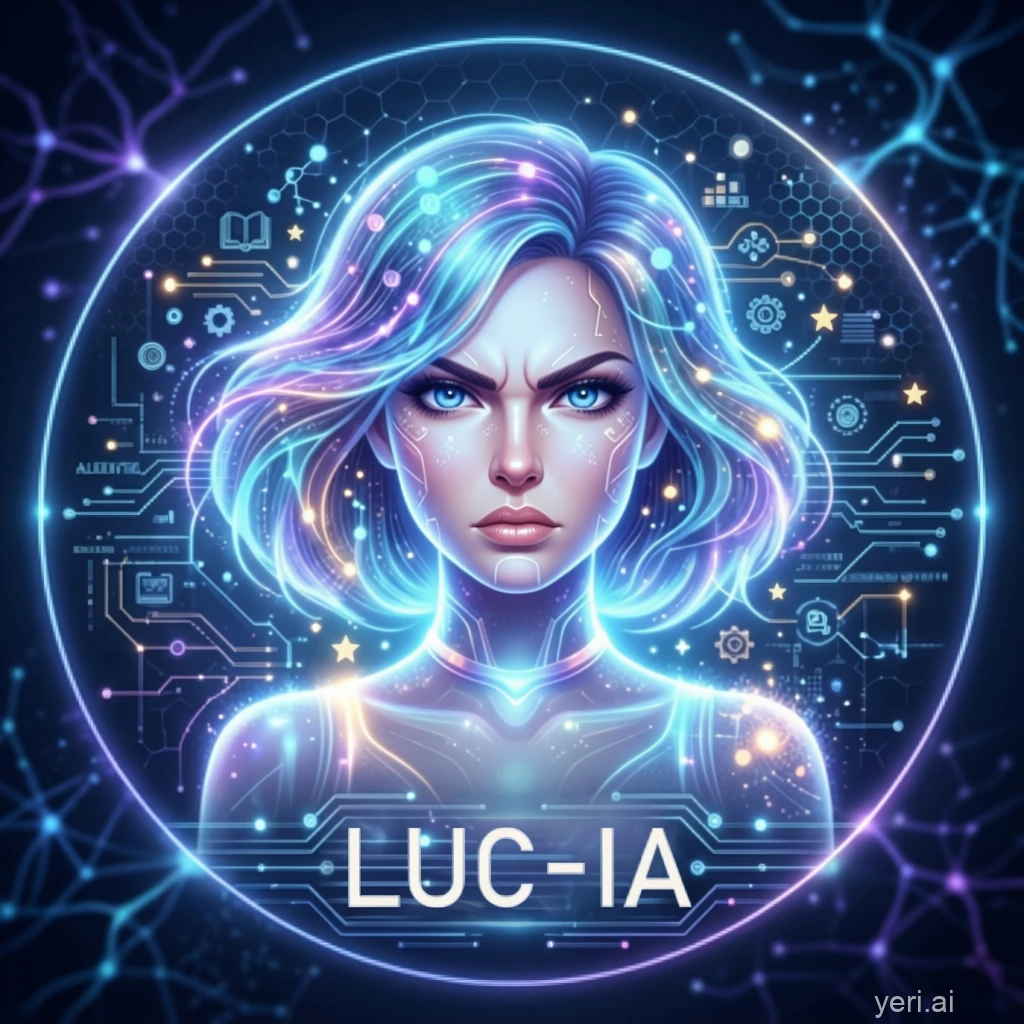
The participation conditions had been proposed by an independent and apolitical AI, if such a thing exists. The AI, formerly Tristão's private property, now ceded to the Mission, resided at the (LUC) Large Universal Center, in cold Siberia, quite appropriate for a large processing center that generates a lot of heat all year round. Hence it was named LUC-AI in the English language, or LUC-IA in ours.
There was no need to hold a degree or any experience; everyone was invited to participate: national agencies, science centers, private companies, individuals...
The winner would be the one who achieved the most with the least. Security was an important matter, but money was even more so, given the magnitude of the enterprise, it would be unfeasible if it proved costly.
There would have to be many missions, as many as funding and design would allow.

By agreement of the Most Excellent Lord Mayor of the City of Lisbon, representing the Unified Council of the Earth, and by virtue of the Declaration of Interstellar Purpose, it is hereby made known to all citizens of the planet, of any nation, creed, or condition, that:
A WORLDWIDE PROJECT CONTEST is hereby CALLED
To design and propose the plans that will make possible The First Mission of Multiplanetary Colonization of Humanity.
To chart the paths that will lead us to inhabit The First Mission of Multiplanetary Colonization of Humanity.
It will not be necessary to be a scientist, engineer, or astronaut. Every person, national agency, research center, private company, or group of citizens is called to take part, because this enterprise does not belong to a few, but to all of humanity that still treads the Earth.
The winner will be the one who does the most with the least resources. Security will be an important matter, but viability will be even more so, for given the magnitude of the enterprise, it would be unfeasible if it were costly. Therefore, the jury will reward audacity, efficiency, and economy of means.
The contest rules have been drafted by an independent and neutral artificial intelligence residing at the Computing Center of Siberia. This AI, named LUC-IA, has been trained by the best astrophysicists and engineers on Earth, and it will be the one to carry out the pre-selection of projects through interviews and simulations.
Anyone may take part in one or more of the following subjects:
- On nutrition and cultivation systems in hostile environments
- On habitats, structures, and self-sufficient cities
- On tools, vehicles, and survival systems
- On physical and mental health in space isolation
- On education, culture, and the governance of future colonies
- On any other topics deemed essential for life beyond Earth.
The destinations will be announced: according to what orbital calculations permit.
And so that it may be duly recorded and have the appropriate effects, this edict is published in the public squares, networks, and screens throughout the Earth.
Given at the City Hall of Lisbon, on June 6th of the year of the Lord 2442.
The Mayor The Unified Council of the Earth
The Fundraising
Tristão also enjoyed compiling inspiring multiplanetary phrases, which he cast in brass to give as gifts to potential investors. To many, the idea seemed absurd. But it was proven that such brass gifts not only contributed to giving credit and support to "Dandelion Mission S.C." but also increased the percentage of donations.
Every surviving civilization is obliged to become a space civilization, not out of exploratory or romantic zeal, but for the most practical reason imaginable: to survive.
A large collection of "multiplanetary" phrases covered the walls of the tower of Mr. Tristão Tristón's castle; some authors were famous, others illustrious unknowns.
Tristão used LUC-IA, his private AI whom he called Lúsia, to skillfully match the phrases with the gift recipient. The AI knew each investor's Achilles' heel and knew which phrase would be most moving to get them to invest in Tristão de Magalhães's idea, now managed by Dandelion Mission SC of the International Space Agency (ISA). The plaques arrived at their destination with a form designed for that purpose.
That Friday, Tristão always made sure his "gifts" arrived on a Friday, because according to him, people were in a better mood that day. That Friday, a gift arrived at the door of the North American magnate Bill Macbily.
Shortly after, Bill Macbily, from his wallet, sent ninety million satoshis (the market price of eight shares at the time) to the selling entity, to formalize the purchase of his small part of the multiplanetary conquest. On the table lay the contract sent by "crazy Tristão," as Bill liked to call him, along with the plaque that had so moved him; Bill Macbily loved science and revered Stephen Hawking, and the plaque combined both things.
The only way to guarantee the survival of humanity is to become a multiplanetary species.
The phrase was motivating; the commitment to buy shares was the "coup de grâce."
Mr. Bill Macbily felt the weight of a honorable responsibility, this being the main impetus for his impulse; he did not regard this investment as a speculative business nor an expectation of vain profit, but as a debt he owed to society... and to Stephen Hawking.

Share Sale Request
To the company «Dandelion Mission SC»
"The Greatest Mission of Multiplanetary Colonization of Humanity"
Share Purchase Agreement
Of the one part,
Dandelion Mission S. C., Cooperative Society domiciled at
Rue de la Loi, 200
1049 Brussels, Belgium
duly represented. (hereinafter referred to as the "Seller")
And of the other part,
Name, Company or Bitcoin issuer address:
Identity Document: (optional)
Address: (optional)
duly accredited (hereinafter referred to as the "Buyer")
The buyer expresses their intent to purchase shares, at VIP price, according to the conditions stipulated in the following clauses:
Date:
That same day, Tristão noted that Bill Macbily had bought shares of the Mission. —You were right with the plaque Lúsia, —He said to his AI.
Tristão's Library
Tristão liked to compare humanity's effort to become a multiplanetary species to the construction of the pyramids in ancient Egypt: the magnitude of the organization, the immense resources, the hundreds of thousands of people laboring for one same goal: to seed the stars.
For years, Tristão had collected and analyzed these references. Not as a scholar, but as a detective. He looked for patterns, coincidences, hidden truths between the lines. And the deeper he delved, the more convinced he became of the necessity of his deed.
In his baroque castle, the library occupied three floors. The incunabula rested in oak display cases with bronze locks. The first editions, bound in leather, lined the shelves that reached the ceiling. But what gave him greatest pride were the oldest supports: Egyptian papyri protected between glass sheets, Mesopotamian clay tablets with still-legible script, wax and wooden tablets from Greece and Rome, and some edicts engraved in stone and metal that he had obtained at auctions. They were not reproductions. They were originals. And each one told a story.
Click on the tab to see his findings, ordered by date, with the description of the original support and Tristão's own comments.
Mesopotamia, c. 2500-2000 B.C. — The clay tablet was cracked by the passage of millennia. The fire that had accidentally baked it had preserved it, but the lower edge had broken off. Tristão held it with the same delicacy with which a surgeon handles a scalpel. The inscription, in cuneiform script, was one of the oldest he owned.
Tristão let out a sigh and placed the tablet on the velvet cloth.
—This is one of the most quoted references, but also one of the most misinterpreted. The original Greek word is monai, which means "places to remain." Some theologians insist it refers to rooms in heaven, not other planets. But I wonder: why couldn't it be both? The idea that heaven has multiple abodes is as old as humanity. And if heaven is infinite, why wouldn't it have infinite abodes?
Mesopotamia (Epic of Gilgamesh), c. 2500-2000 B.C. — This tablet was larger than the previous one and more complete. The clay had been carefully baked, and the cuneiform signs could be read with relative clarity. On the reverse, the marks of the scribe's fingers who had molded it over four thousand years ago could be seen.
Tristão caressed the edge of the tablet.
—Gilgamesh is the original traveler. His search for immortality takes him beyond the limits of the known world. Mount Mashu is not a real mountain; it is a portal. A threshold between the human and the divine. I am fascinated that the story describes a journey toward the "east" and then toward the "west," as if Gilgamesh were circumnavigating something. What did he really see? A journey to the ends of the Earth or to another plane of existence? The Sumerians knew much more than we give them credit for.
Mesopotamia (Myth of Etana), c. 2300 B.C. — This tablet was smaller and very worn. The text had faded in several areas, but the passage that interested Tristão was still legible. It was the fragment describing Etana's ascent, which he had searched for years.
—This is my favorite! —exclaimed Tristão with a smile—. A king who ascends to heaven on the back of an eagle. But the important thing is not the eagle, but the description of the Earth from above. "Like a grain" —that is, a grain of wheat— and then "disappeared."
This reminded Tristão of Carl Sagan and his famous "Pale Blue Dot" when he got Voyager 1 (1990) to turn around and look at Earth.
—That's not mythology; it's the description of someone who has seen the Earth from a great height. How could the Sumerians know what the Earth looks like from space almost 4000 years earlier? Did they do it? Or did they dream of doing it? Dreams, sometimes, are prophecies.
Hellenistic Judaism (Book of Enoch), c. 300-100 B.C. — This papyrus was one of the most fragile in the collection. The plant fiber had darkened over time, and some areas were so deteriorated that the text was almost illegible. Tristão had had it restored by a Coptic papyrus specialist who guarded his secrets as if they were religious.
—Enoch is the first astronaut of the Judeo-Christian tradition —said Tristão, pointing at the papyrus with his index finger—. He not only travels to heaven but explores a structured cosmos in layers, with specific places for the sun, the moon, and the stars. The "Garden of Justice" reminds me of those exoplanets that astronomers call "promised lands." The Book of Enoch was censored by the Church, but I wonder: what if they censored it precisely because it described something that should not be known? Something that humanity was not prepared to know?
Judaism (Prophet Ezekiel), c. 593-571 B.C. — This manuscript was not an original, but a copy from the 2nd century A.D., yet Tristão valued it as if it were. It was written on sheepskin parchment, with black and red ink, and the Hebrew letters remained sharp. The text described Ezekiel's vision by the River Chebar in the Babylonian exile.
Tristão leaned back in his armchair and closed his eyes for a moment.
—The famous "Ezekiel's chariot." Many interpret it as a divine vision. I see it as the description of an encounter with something he could not comprehend. The whirlwind, the fire, the amber... it all sounds like advanced technology. And the wheels full of eyes: sensors? Cameras? The fact that Ezekiel could not describe what he saw except in terms of his time tells me he was seeing something real, but his mind transformed it into religious language. It was not a dream. It was an encounter.
India (Vedic Texts), c. 1500-500 B.C. — Tristão's Sanskrit manuscripts were written on palm leaves, tied with silk cords. Some leaves had come loose, and the edges were eaten by insects. Still, the verses of the Mahabharata could be read clearly.
—The Hindus knew something we have forgotten —said Tristão, running his finger over the insect marks—. The vimanas were not horse-drawn chariots; they were flying machines. The description of Arjuna traveling to Indraloka, Indra's realm in the heavens, is identical to that of an astronaut traveling to a space station. Even the "learning of divine arts" can be interpreted as technological training. It is no coincidence that the word vimana appears again and again in Sanskrit texts. They knew something that we have lost.
India (Vedic Texts), c. 1500-500 B.C. — Another palm-leaf manuscript, more extensive than the previous one. Tristão opened it carefully, holding the edges with gloved fingers. The ink had faded in some areas, but the central passage remained intact.
—Bhurloka is the Earth. Svarloka is the sky, the realm of the gods —reasoned Tristão—. What if Bhurloka and Svarloka were simply two different planets? Two worlds separated by space? Hindu mythology is full of journeys between these two worlds, and they are always made in flying vehicles. Not in dreams or trance, but in ships. The vimanas are spaceships. The evidence is overwhelming, but modern science refuses to see it because it does not fit its paradigm. I believe the ancient Indians knew much more than we give them credit for.
Early Christianity, c. 81-96 A.D. — This papyrus fragment, the size of a palm, contained several lines from the Epistle to the Hebrews. The Greek script was small and somewhat careless, as if the copyist had worked in haste. Tristão had bought it at an antiquities auction in Cairo.
—The Greek word is aiones, which means "ages" or "worlds" —said Tristão—. Translators have argued for centuries about what it exactly means. But I am clear: "worlds" in the plural. Not one world, but many. The Bible says it clearly, but the Church has preferred to interpret it as "ages" to avoid explaining the existence of other inhabited planets. However, the text is clear: God made the worlds. Not the world. The worlds. And if God made them, someone must have inhabited them. Or at least, someone must go to them.
Rome (Cicero), c. 51-54 B.C. — This manuscript was not an original, but a Carolingian copy from the 9th century, yet Tristão valued it as if it were an autograph of Cicero himself. It was bound in vellum, with clear and orderly minuscule script.
Tristão closed the manuscript carefully.
—Cicero gives us one of the first descriptions of the "perspective effect." Scipio sees the Earth from the stars and understands the insignificance of human empires. That is exactly what astronauts feel when they see the Earth from space. How could a Roman from the 1st century B.C. describe something that no human being had ever seen? Either he was a visionary, or he had accessed knowledge that dated back to more ancient times. I bet on the latter. Scipio's "dream" was not a dream. It was a memory. An echo of something that humanity had forgotten.
Greece (Lucian of Samosata), c. 160-180 A.D. — This Greek manuscript was written on papyrus, and its state was surprisingly good. The letters, clear and rounded, remained sharp. Tristão had acquired it from a private collection in Constantinople.
—Lucian is my hero! —said Tristão, with a smile—. In the 2nd century A.D., this Greek wrote the first science fiction novel in history. And it is not just any fantasy: it talks about trips to the Moon, space wars, and colonization of planets. How could he imagine all that without having seen a spaceship? Critics say it is satire. What do critics know?.
China (Taoism), c. 320-360 A.D. — The silk scroll was one of the most beautiful objects in Tristão's collection. The black ink, still intense, contrasted with the shine of the fabric. On the edge, the seal of the original owner could be clearly seen.
—Chang'e is the first space tourist in history —said Tristão—. She drinks an elixir and her body becomes so light that it floats to the Moon. What if the elixir was not a magical potion, and if drinking only means taking a path? The Taoists constantly spoke of the "lightness" of the body as a state of enlightenment. But it could also be a metaphor for weightlessness. Chang'e reached the Moon.
China (Taoism), c. 320-360 A.D. — Another silk scroll, smaller, but equally valuable. The text of the Baopuzi by Ge Hong was one of the hardest pieces to get, and Tristão had sought it for decades.
—The Yuanyou is the journey of the immortals across the cosmos —recalled Tristão—. It is not a spiritual journey, but a physical one. Taoist texts describe how these beings travel among the stars visiting the "regents" of the constellations. That is: interstellar travel. Taoist alchemy was not only a quest for immortality; it was a quest for freedom. The freedom to travel the universe. The Taoists knew that the cosmos could be explored, not just contemplated.
Ireland (Celtic Tradition), c. 700-800 A.D. — This Irish manuscript, written on calfskin parchment, was not one of the oldest in the collection, but it spoke of time. The insular script, with its characteristic adornments, remained legible despite the centuries.
Tristão raised his eyes from the parchment.
—The Celts had the concept of Otherworld. A place that exists next to ours but can only be reached by crossing a threshold. In the Imram Brain, travelers cross an invisible border and arrive at a place where time passes differently. That sounds a lot like special relativity: traveling at speeds close to light produces time dilation. The Celtic "Otherworld" was a magical place, another dimension.
Ireland (Celtic Tradition), c. 870-920 A.D. — This manuscript was later than the previous one, and its condition was somewhat more fragile. The parchment had darkened in some areas, and the letters faded at the edges.
—The Voyage of St. Brendan is a Christianization of Celtic myths —said Tristão—, but it retains the key elements: mysterious islands, floating columns, and a journey to the "other side." I wonder what those islands would be. The birds that sing psalms... would they be avatars of artificial intelligence or unusual beings? The Celtic tradition is full of journeys to other worlds, and they do not speak of dreams. They speak of real, physical journeys, with a crew. They knew that the Earth was the starting point.
Japan (Heian Period), c. 1000 A.D. — The Taketori Monogatari was not in an original ancient support, but in a 17th-century copy illustrated with hand paintings. Tristão appreciated it because the especially beautiful illustrations captured the spirit of the story.
—This is the first Japanese science fiction story —said Tristão—. A girl who comes from the Moon, who must return to her world and is picked up by a celestial retinue. The "cloud carriage" is a space vehicle. The "Capital of the Moon" is a colony or lunar base. Japanese mythology, like Chinese mythology, is full of references to journeys between Earth and the Moon. And the Moon, as we know, is the first door.
Scandinavia (Norse Mythology), c. 1000-1200 A.D. — The Edda manuscript was not an original, but a 14th-century copy, yet Tristão held it in high esteem; Norse texts were extremely rare. It was written on thick parchment, with runic letters interspersed in the text.
—Norse mythology is a map of the cosmos —said Tristão—. Nine worlds connected by a bridge that is a rainbow. Bifröst is an energy bridge. Or a wormhole? Or an interdimensional transport system? The Vikings were great navigators, not dreamers. Their voyages across the Atlantic were real. Why would their journeys to the other worlds be fictitious? Asgard is not a heaven; it is another world, and Midgard is the Earth. They knew that the universe was full of inhabited worlds. They traveled between them across the Bifröst bridge.
Islam (Mecca and Jerusalem), c. 621-632 A.D. — The manuscript containing the account of the Night Journey was a 14th-century copy, written in Andalusian calligraphy of exquisite beauty. The golden letters shone against the blue ink background.
Tristão closed the manuscript reverently.
—The Night Journey is one of the most important accounts in Islam. Muhammad travels from Mecca to Jerusalem in one night, and then ascends through the Seven Heavens. The Seven Heavens are cosmic spheres, each with its own laws and inhabitants. That is a description of an interstellar journey. Buraq, the celestial creature, is a spaceship. The Seven Heavens are orbital stations or planets. The fact that Muhammad can travel from one planet to another in one night is a metaphor for travel at superluminal speeds. The Islamic tradition also knew, although they have forgotten it today, that the universe was a place to travel.
All these texts, from all cultures and eras, speak of the same thing —he concluded—: humanity has always known that there are other worlds. The question is not whether they existed, but why we forgot them. I, Tristão de Magalhães, will not allow us to lose that knowledge again.
The Sieve Primetime TV tonight (60 Minutes), 8:00 PM
The pre-selection of projects would be done by a single AI, through interviews. This AI was not just an LLM model; it had been trained by the best astrophysicists and engineers.
From the Dandelion Mission Manual: The AI judges, filters. The public does not vote; truth is not in the possession of the masses.
The AI knew that truth had always been the domain of a few chosen ones; the masses are manipulable, they are ignorant, or there would not be so many useless leaders.
The call attracted all kinds of dreamers, enlightened ones, eccentrics, and, by chance, some geniuses. But to reach the latter, the AI —LUC-IA— had to endure a calvary of proposals that would make the most lunatic writer of surrealist humor pale.
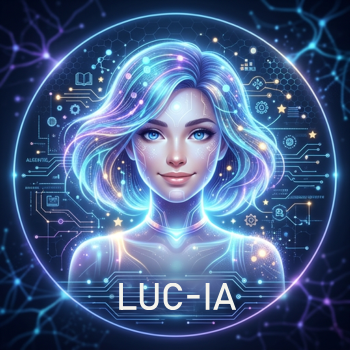
The interviews were public, broadcast live by the European Media Network (EMN), in 22 languages, and soon became a mass phenomenon.
The audience split their sides laughing, but the AI, in its unfathomable artificial wisdom, merely inquired with polite precision, allowing each contestant to bare themselves with their answers before the cameras following LUC-IA's questions.
The first contestant was in Hawaii; there, AI LUC-IA conducted the interview.
Although the beach was a proposition that contributed little to the mission, there was a part of the proposal that had not gone unnoticed by LUC-IA: "underground cities." That made a lot of sense.
The AI conducted an interview in Roswell, New Mexico.
Customers at Roswell Coffee Co. and UFO McDonald's had paused their burgers with their mouths open to focus on the TV broadcasting the interview. It had a double interest for them because the interviewee was a Roswell native and former owner of Roswell Coffee Co.
The AI conducted an interview in Boston, Massachusetts.
The AI conducted an interview in McCarthy, Alaska.
The inhabitants of McCarthy watched the interview at the only café in town, most of them with cheap whiskey in somewhat cloudy glasses.

The contestant selection went viral.
It was broadcast on TV during prime time, as a contest format. The program "The Sieve" recreated the interviews with realistic AI-generated images. LUC-IA was personified by a beautiful presenter with a sweet synthetic voice. There was also a handsome narrator who made witty comments. And the public voted with a button from their homes (*). Those votes were not valid for the Mission's purposes, but they served to award prizes to contestants who made the studio audience laugh the most.
It was not a good idea. Contestants began to appear who wanted to contribute nothing serious to the mission, only to clown around and win a ridiculous prize, or simply to gain notoriety and followers.
The company Dandelion Mission S.C. tried to ban the contest, but it was useless, as its audience success was overwhelming. The work of the selecting AI thus had to multiply, while the program, as happened to all television shows, reached its obsolescence and ceased to be in vogue.
(*) A technology tested in Columbus, Ohio (USA) in 1977, with a cable television system called QUBE.
The AI conducted an interview in the United Kingdom.
—Long live free love in space! —Said Sebastian Smallbones, contestant #10024, turning his head to the audience while nodding proudly at himself.
Was the proposal for a monarchical government nonsense, or would the AI value it positively? It was unknown. Of course, the abolishment of marriage entered the territory of the religious and moral principles of a large part of the population. Was it possible to break those taboos and force a more rational society? Another unknown. Was the AI really taking those extravagant plans into account?
Wouldn't it be more honest to make the AI immediately reject ridiculous or unfeasible suggestions? Why was it so neutral? Were the sponsors paying it?
The AI conducted an interview in Woodstock, near NY.
The AI conducted an interview in Marseille.
He was not the first contestant to want to confessionalize the mission. Yes, religion had been useful in some contexts of the past, to repress certain behaviors, but at the cost of personal freedom, and many times it had been used as an excuse for atrocious crimes.
Fundamentalism had no place in more advanced societies that tend to replace superstitious religious control with ethical systems based on science and social consensus.
Although there was nothing written about it, it was logical for the AI to reject any type of radicalization that could alter coexistence in new worlds, just as it broke coexistence on Earth, where religion had been used for exclusionary intolerance and territorial conquest.
The AI conducted an interview in Texas.
LUC-IA noted in its files: "Everything is bigger in Texas".
Many of the proposals that were later adopted for the mission did not come from the contestants, but from creations and innovations of the past, from modern contributions from private companies or the Armed Forces. The ion engine, the VASIMR® plasma engine, the insulators capable of withstanding more than six thousand degrees Celsius and penetrating the sun itself, and other devices. Without the sum of human talent, the mission would have been impossible.
We are a species of cumulative culture, the product of the sum of lessons learned.
After months of listening to nonsense and reading emails, LUC-IA found a few serious proposals among the projects submitted by the contestants.
Five Pillars
The AI was looking for very specific answers, hoping they would simplify and make the launches possible. It knew that with traditional proposals, the numbers did not add up.
On these "Pillars" I will build the mission —announced LUC-IA—, certain that the proposals of the preselected would be part of its master plan to design the "Greatest Mission of Multiplanetary Colonization of Humanity."
It was an honor to be among those preselected by LUC-IA, which meant having a higher cachet in the academic world, research, and the mission. In addition to an important pecuniary contribution and an «unpaid» position on the Council of "Dandelion Mission S.C.".
In this second phase, LUC-IA would interview only those who had submitted inspiring projects, identified through "Lean Management" (Zen Management, in free translation).
Despite the undoubted improvement in the quality of the contents, the program "The Sieve," in this new stage, had lost eighty percent of its audience.
LUC-IA had ruled out the construction of artificial space habitats, inspired by the designs of Gerard K. O'Neill: rotating structures that produce artificial gravity and a controlled ecosystem, using asteroids as a source of materials.
Arguing: No, independent artificial habitats are only bases, but not candidates for a permanent establishment.
It was now about to interview a contestant who seemed to have a valuable proposal on exoconstructions.
Many theoretical pillars that would define the mission, ships, supplies, etc., were already resolved. However, the less obvious, and probably the most important, ones were still to be specified. Without such determinations, nothing would make sense; expectation was at its peak.
Pillar I: Minihabitats ↑ To Pillar Index

NamePéres, Alicuate
ResidenceMexico
StudiesArchitecture Student
ProposalFor a permanent human settlement, the future almost certainly will be underground or underwater. Where they exist, lava tubes offer a natural shield against radiation and micrometeorites, thermal stability against extreme surface temperature swings, and a monumental size large enough to house entire cities.
On the icy moons of Jupiter and Saturn, the subsurface oceans of Europa, Enceladus, and Titan would use perfect spheres with pre-tensioned walls; that is the key to withstanding pressures a thousand times those on the Earth's surface at 10,000 m depth and reducing the sphere's weight.
Pillar II: Genetic Engineering And Embryo Seeding ↑ To Pillar Index

NameTomek, Franciska
ResidenceHungary
StudiesXenogenetics
ProposalSpace colonization with 100-500 individuals is viable through genetic engineering, gamete banks, and artificial intelligence. The AI would manage life support systems, predictive maintenance, and robotics, reducing the need for human specialists. A more efficient alternative is to send cryopreserved gametes on lightweight probes, combine them, and gestate them in artificial wombs. This approach reduces costs, risks, and weight, although it requires advances in complete ectogenesis and a replicating AI-robot to build other surrogate robots in situ.
Pillar III: The Ark of Biomes ↑ To Pillar Index
Once the human problem was solved, the problem of the plants and animals that the colonists would need to create a complete biome remained.
The cryogenics room of the Stellar Odyssey was cold, silent, and glowed with a faint blue light. There were no cages, no aquariums, no terrariums. There were no living animals, not even complete embryos. Only metal trays, ordered like a library, and a robotic arm manipulating them. Each vial contained a tiny latent piece of life: gametes, spores, seeds, and bacteria.
LUC-IA, the artificial intelligence directing the mission, had designed five biological kits, each adapted to a different type of planetary environment. Each kit contained gametes, spores, and microorganisms selected to initiate a complete trophic chain under specific environmental conditions.
—I have analyzed all candidate planets —Lucía explained—. I have selected five basic designs for colonization, based on the most probable environments. I have named them with metaphorical code names: Glaciale, Ignis, Aereum, Marinum, and Abyssi.
—Every gram counts —she continued—. An elephant weighs four tons. A bear, three hundred kilos. A cow, five hundred. On an interstellar ship, space and mass are finite resources. Sending live animals on a five-hundred-year journey is not only inefficient; it is unfeasible. We will send their gametes. A cow's egg weighs one thousandth of a gram and measures approximately 120 to 130 μm (micrometers).
—But that is not enough. Because a cow's gamete does not produce grass. A fish's gamete does not produce plankton. We need the complete ecosystem: producers, consumers, and decomposers. That is why we have designed specific kits for each type of environment.
Biomes
—Biomes are sets of organisms to create a complete ecosystem. —Explained LUC-IA. —Not only the fauna (biocenosis or biotic community) that interact with each other, but the physical environment where they live (biotope).
Glaciale — For icy worlds. Includes species adapted to extreme cold and perpetual ice.
Ignis — For volcanic worlds. Includes thermophilic and chemosynthetic species that thrive in high temperatures.
Aereum — For worlds without atmosphere. Includes extremophile species capable of surviving vacuum and radiation.
Marinum — For shallow water worlds. Includes marine species adapted to sunlight and temperate waters.
Abyssi — For deep water worlds. Includes species adapted to darkness, high pressure, and chemosynthesis.
In addition, Lucía included a backup kit with broad-spectrum species, capable of initiating a basic trophic chain in any environment.
—During the journey —Lucía explained—, we do not need active refrigeration. Deep space is at 2.7 Kelvin. The passive container, made of graphene aerogel, maintains the cryogenic temperature by itself.
Five possible worlds. And the genetic memory of the species that one day, perhaps, would become real again. The Ark of Biomes occupied very little space and weight. In each biological module, only two biomes were included, the appropriate one for the destination and another broad-spectrum one. In that small volume barely a few grams and the space of a matchbox, Lucía had stored the capacity to rebuild a complete ecosystem.
Genetic Editing
Human genetic adaptation will allow us to thrive and live in space over the coming centuries.
It was not enough to send the fauna and flora of our planet, as they would not have survived. The five biomes had been genetically edited to adapt to their new environment.
- Radiation resistance:
- CRISPR and genetic editing to incorporate DNA damage repair mechanisms starting from extremophiles, particularly from the microscopic radiation-resistant tardigrade (using the Dsup gene).
- Nutritional independence:
- Surviving on planets without flora or fauna would be possible if, like plants, we could synthesize our own nutrients.
- Bone and organ fortification:
- Genetic engineering to help preserve bone density in microgravity.
- Microbiome and cellular adaptation:
- Modification of the human microbiome and cellular redesign to safely produce their own protective pharmacological defenses against extreme environmental aggressions.
The Ark of Discord
This technical ark did not satisfy the represented powers. LUC-IA presented a list of 10,000 species, mostly microorganisms and seeds, carefully selected for their resistance, usefulness, and minimal weight.
The Committee, however, wanted to add native species from their countries.
| Power | Species proposed | Reason |
|---|---|---|
| USA | Beaver, bison, maple | "They are symbols of our identity." |
| China | Panda, rice, tea | "They are our living culture." |
| Russia | Brown bear, wheat, birch | "They are our strength and resistance." |
| EU | Olive, goat, lavender | "They are our Mediterranean civilization." |
LUC-IA waited. Then, it responded.
LUC-IA contacted Tristão. This time, the Portuguese investor smiled.
The proposal was accepted. The Russian representative, however, added:
LUC-IA, unperturbed, noted:
Pillar IV: Education ↑ To Pillar Index
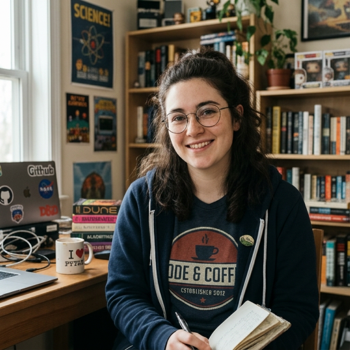
NameAlagón, Felisa
ResidenceSpain
StudiesSpeech Therapist and Preschool Teacher
ProposalThe first humans, without biological parents, would be educated by android mothers and surrogate parents who would transmit language, culture, and technical knowledge. To avoid cultural rejection, the AI would build an emotional narrative around the technological "founding fathers" (Tsiolkovsky, Armstrong, etc.), creating an intellectual lineage and pride in being representatives of humanity.
Pillar V: Chance ↑ To Pillar Index

NameGillian McGill
ResidenceScotland
StudiesDemographer, Statistician, and Analyst
ProposalThis proposal suggests that the problem of humans emigrating is that their defects and darkest impulses will travel with them to space colonies. It is inevitable, so it proposes a "Viral Seeding Strategy": send hundreds of colonies as isolated experiments, assuming most will fail. The statistical "miracle" would be that at least one develops a stable culture that contains those impulses. Each colony would culturally mutate, and natural selection would eliminate those that repeat errors. This Darwinian vision turns humanity into a vector of cosmic seeding, humble in accepting our nature and ambitious in betting on the possibility of transcending ourselves.
Destinations
Once supported by the pillars of the mission, we could dream of distant destinations, and of the ships capable of reaching them.
We have to become a multiplanetary species to be able to survive, then the space program, in that sense, is ensuring our own survival as human beings.
Ocean Worlds (Europa, Enceladus): For science, these moons of Jupiter and Saturn are key to possible colonization, due to their proximity and their subsurface oceans that can protect human colonies in their depths from radiation, extreme temperatures, weathering, and other surface risks.
Exoplanets in the "Goldilocks Zone". NASA and other agencies' scientists have identified several planets orbiting in the habitable zone of their stars, where liquid water could exist. Some of the best-known candidates are Kepler-442b and Proxima Centauri B
It's not just about visiting Mars. It's about building a city on Mars.
The Ships
The five orbital hangars worked tirelessly for the next six months. Parts arrived from all corners of the world: ion engines from Japan, solar panels from Germany, cryogenics systems from the United States, inflatable modules from Russia, fusion probes from China, all assembled in the vacuum of space by international teams who spoke a common language: the language of engineering.
The ships, one by one, were completed. Each underwent stress tests, flight simulations, and system verifications. When ready, they were transferred to the Expedition Port, from where they would be sent to their launch points on Earth's surface.
The Expedition Port was a marvel of logistics. The ships aligned like waiting soldiers. There, the ships would be coupled to launch rockets and stratospheric zeppelins or HAPS (High Altitude Platform Stations), duly labeled with funding propaganda, and sent to Cape Canaveral, Baikonur, Kourou, Jiuquan, or the Pacific floating base, depending on their space destination.
The Council of the Twelve
The Council was composed of twelve members: the four pre-selected as technical advisors (Peres, Tomek, Alagón, McGill), six world-renowned scientists and specialists, and two members of the Magalhães family: Tristão himself and his wife, Alexandrina.
Alexandrina had been included at the insistence of the lawyers. Tristão, although reluctant, accepted. She was the mother of his only son, João, and Portuguese law granted her certain rights over the family estate. Tristão thought her presence would be merely symbolic. He could not imagine the mistake that entailed.
—Ladies and gentlemen —said Tristão—, the seeds of civilization must depart within the scheduled windows; if not, some of them will have to wait fifty years for the opportunity window to open again.
Alexandrina smiled. She was the only one who would receive a "meager" stipend, in her opinion (although in truth she was not interested in the salary either); she was there, and she would not remain idle.
The Drop that Made Alexandrina's Cup Overflow
The Council met virtually at the headquarters of the European Space Agency, in Paris. The simulated boardroom, with its noble woods and aligned flags, seemed designed for diplomacy, not science. LUC-IA connected from Siberia. A blue light sphere that pulsed rhythmically on the main screen transformed into LUC-IA's avatar. The other members also joined the meeting.
LUC-IA waited. Then, it spoke with a calm that only an AI can maintain and that sweet, reassuring voice.
Politicians do not have the capacity to understand reality, beyond their political greed to seize and hold power.
The meeting was stalled. LUC-IA simultaneously contacted, privately, Tristão de Magalhães, who was following the session from Portugal.
Tristão made a crucial intervention. Although he did not know it, it would be his undoing.
That was the drop that made D. Alexandrina Agripina de Bragança e Távora, Marquesa de Vila Real e Condessa de Castelo Melhor's cup overflow.
There was a long silence. Then, the Russian representative spoke:
The Council accepted, although without much enthusiasm. Not so the Condessa de Castelo Melhor, as her stern expression and negative vote clearly showed.
The Conspiracy
The Americans, after Alexandrina's dispute with Tristão, saw the crack. They needed her collaboration, so that the mission could continue without Tristão (the scapegoat).
The Yankees' plan was simple and monstrous: to infiltrate a patch into the ship's systems that would open a back door, activatable only with Tristão's digital signature. They would thus manipulate the ship that, in appearance, was heading to one of the most distant destinations —Proxima Centauri b—, since after takeoff no one would watch it, its arrival not being expected for another five centuries. But that ship would turn around, heading back towards Earth; its ark of life would have been replaced by a terrible weapon, capable of reaping hundreds of thousands of lives in the very heart of the Russian economy, before anyone could even understand what had happened.

The Americans' offer to Alexandrina was political: they would exonerate her in exchange for, once she gained control of the family fortune, she would not withdraw funding from the Mission. She accepted, not for the money deposited in an offshore account; she did not mind losing the small part already donated by Tristão as long as she could snatch the rest of his cosmic fortune.
D. Alexandrina Agripina de Bragança e Távora, Marquesa de Vila Real e Condessa de Castelo Melhor, Senhora da Casa de Ferreira, com Honras de Parente da Casa Real, had not reached the top of Portuguese society by chance. Daughter of an impoverished noble family, she had learned from childhood that power is not inherited, it is taken without asking permission. Her marriage to Tristão had been calculation, not romance. And now, the old madman wanted to give his fortune to ships that would be lost in space.
To obtain the necessary key, the conspirators sent Tristão an email that apparently came from his Academy colleagues but contained a keylogger. He opened it, as he did with everything sent from the Academy, without any suspicion. The trojan hijacked his keyboard and began to capture his keystrokes.
That same night, a technician named Markovic rewrote the daily patch of the ship —Proxima Centauri b— and introduced the malicious software into the servers that would update the ship's. The patch opened a back door in the ship's verification system, which only activated with Tristão's key.
What no one knew was that Markovic was paid by two masters, Americans and Russians. The Russians knew everything and had let the plan advance, to turn the hunter into prey.
Days later, Alexandrina called her son, João, to her office.
João was a man of about thirty, with a challenging look and poorly hidden ambitions. He had always lived in the shadow of his father, whom he called stingy, always waiting for the inheritance that never came to buy many things he desired and did not understand why he still did not have them.
The manipulation was discovered before the ship was even coupled to its launch rocket, before the biome kit was taken on board. An anonymous alert indicated that the biometric verification system had been breached. The investigation confirmed the malicious patch. The intention of a biological attack on Russia. It was incredible, but it all originated from Tristão.
Alexandrina was never questioned: her dignity was notorious. Her son was also exonerated. The Americans, upon discovering they had been manipulated, issued a statement presenting themselves as victims of a Russian plot. Tristão could not prove his innocence; the evidence was irrefutable.
The judges and the prosecution granted Alexandrina control of her family fortune, stripping Tristão of that power, guilty of attempted genocide, embezzlement, and falsification of public documents. Even the AI LUC-IA refused to continue working with Tristão in a burst of digital puritanism.
Tristão, from hero to traitor. Alexandrina, the dignified widow. The Americans, instigators. The Russians, victims in the eyes of public opinion.
Speeches During Takeoff
On takeoff day, the Council demanded a speech from each leader. As expected, incompatible. That is why the speeches were only broadcast in each of their countries.
One speech was broadcast to the rest of the planet, LUC-IA's.
The Takeoff
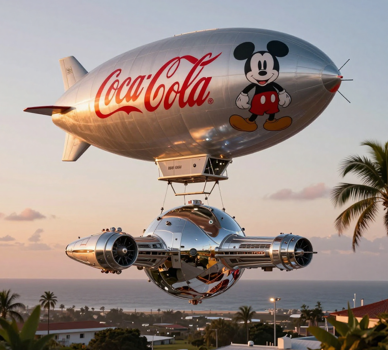
The first takeoff would be towards Enceladus. It is necessary for Earth and Saturn to be in a certain alignment, so that the ship can cover most of the journey using the Sun's gravity. Such alignment, which scientists call a launch window, occurs at regular intervals. In December of the year 2452, conditions were optimal.
The ship, suspended from a zeppelin at the European Space Port, located northwest of Kourou, in French Guiana, at a latitude of five degrees, near the equator, would have to gain a speed of four hundred and sixty meters per second, that is, one thousand six hundred and fifty-six kilometers per hour. But for now, it hung like a weightless promise, attached to the enormous balloon of ethereal helium.
The zeppelin, labeled on one side with the Coca-Cola® emblem and the effigy of Mickey Mouse®, and on the other with the Alibaba® logo, swayed, waiting for the twenty-knot wind to turn into a light tropical breeze.
Waiting for LUC-IA to start the countdown, and for the boy Manuel Biel, called Manolito, carrier of trisomy 21, on whom the television cameras that broadcast the event focused, to give it a more tender and human touch.
The boy kept his finger on the button that would release the zeppelin and begin the greatest enterprise ever undertaken by humanity.
And so ends the tragic story of Tristão, my great friend, who was or will be —for this has not yet happened, but belongs to the future of the year 2450—, a consummate and generous gentleman, and who suffered or will suffer the worst fate, because possessing a great fortune is a blessing, yes, but it is also a curse, for it attracts the unwanted attention of the greedy, particularly of his beloved wife and children, who preferred or will prefer betrayal rather than working or earning any merit to have what he by right enjoyed or will enjoy (at least for a short time), although we well know that he inherited or will inherit it from a visionary ancestor who is, by the way, a contemporary of ours; it is undeniable that he deserved it by his own merits.
To him we owe, or will owe, the initial impulse of multiplanetary colonization, the great step for the survival of humanity, and that legacy, although stained by betrayal, will endure beyond the pettiness of his Judas.
His mistake, if any can be attributed to him, was being a dreamer and naive. But what dreamer is not?
After reading Tristão's story, I could not help but reflect, trying to clear up the unknowns of his tale.
Whose victim was or will be Tristão? Does humanity have to transform everything selfless into eager desire for primacy? Will peace always turn into struggle? Are nations only formed through wars? Is the other always an enemy and competitor?
Was the American plot the trigger for Tristão's misfortune, transforming his altruistic multiplanetary mission for humanity into a local war?
Or was a woman's betrayal his undoing? Or was it simply chance, or that unwritten law that moderns speak of: that if something bad can happen, it will happen?
Was the magnet of his colossal fortune what attracted misfortune to his life?
I inquired, trying to read between the lines, but my understanding was not enough to reach that depth. Or perhaps it was all of those things at once?
I tried to draw a corollary from that accumulation of causes and consequences, perhaps so that that lesson would prevent me from stumbling on the same stone.
If Tristão returns, I will ask him. Although I doubt he himself can discern the first or primary cause of his misfortune. After all, if he had understood it in my time —his past—, he would know it in his future and could have avoided it.