
Multiplanetary
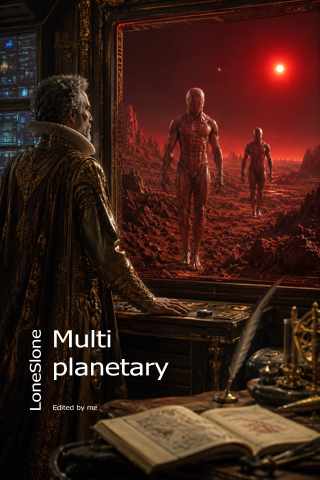
The chronicler was informed of the gestation of humanity's first multi-planetary colonization mission. Tristão de Magalhães, a Portuguese aristocrat enriched by an inherited fortune in Bitcoin, finances the "Dandelion Mission" and launches a universal competition for ideas, the rules of which he drafts and the pre-selection of which is conducted by LUC-IA, an artificial intelligence.
Literary Analysis
Genre: Hard Science Fiction
A critical reading of the story "Multiplanetario", focused on the narrator's temporal paradox, the formal device of the accordions, and the construction of LUC-IA as a central character.
The narrative framework: temporal paradox as a structural principle
The narrator of "Multiplanetario" —LoneSlone— is not an objective chronicler, but a man of our present who tells something revealed to him by a temporal visitor. This device of playing between present and future is not a stylistic whim: it is the philosophical heart of the story. The systematic use of double verb forms —"was or will be", "touched or will touch", "we must, or we will have to"— turns every sentence into a statement of ontological uncertainty. The reader never knows if they are facing a fait accompli or a prophecy, and this ambiguity is sustained until the last line. As for the causes of the tragedy, the narrator himself admits that even Tristão, if he could be consulted, would not be able to discern the primary cause of his own misfortune, because if he had known it in advance, he would have avoided it.
It is a time-travel paradox from the manual, but applied with elegance to the entire narrative voice and not just to the plot: the past and the future merge into a single compound verb tense.
The accordions: an interactive reading format
The resource of foldable accordions —which allow reading the story in a "synthetic" register, the linear narration, or opening up for detail: complete interviews, factsheets of the pillars, Tristão's library— serves a function that goes beyond the cosmetic. It reproduces, at a formal level, the same tension between the great epic narrative and the noise of concrete details that is one of the story's themes.
The AI judges, filters. The public does not vote; the truth is not in the possession of the masses.
The Dandelion Mission presents itself as a grand, almost biblical feat, but when the panels are opened, the reader finds ridiculous contestants, share purchase agreements, comparative tables of species claimed by each power. It is the same dialectic that LUC-IA constantly faces: separating the wheat from the chaff among thousands of proposals. The reader, by deciding which accordion to open, replicates the screening gesture made by the protagonist AI. Formally, it is a rare achievement: it is not just "optional content", it is content that dramatizes the very theme of selection.
LUC-IA: the most accomplished character
The artificial intelligence is, by far, the best-constructed character in the story. Its arc is subtle: it starts as a "neutral and apolitical" entity, a clause that the text itself calls into question almost immediately when it declares that truth has never been a matter for the masses and that they are manipulable. That moment is key: it reveals that the neutrality promised by the initial edict is a legal fiction, not a design reality.
LUC-IA judges, discards, has favorites —affection for Alicuatre, the architecture student, is noticeable—, laughs, and even develops something akin to its own moral code when it rejects attempts to theocratize the mission. Its final decision to leave the colonies' political system "empty" —that each generation chooses its own, with the right to make mistakes— is the ideological climax of the story, and contrasts with the cynicism of the human powers, who only know how to think in terms of blocs.
It is interesting that it is precisely this stance of LUC-IA —refusing to impose a system, refusing to yield to any power— that indirectly pushes Tristão towards his own ruin: by offering a third way, financing a multicultural library for all, it causes the rupture with Alexandrina, the crack that the conspirators will exploit. The most ethical AI in the story is, unintentionally, the remote cause of the human tragedy.
Media and political satire
The "The Sieve" block is the most openly satirical moment of the story, and it works on two levels. On one hand, it ridicules talent shows as a degraded form of democratic participation: the public votes, but their votes do not count for anything serious, they only give laughable prizes. On the other hand, each contestant embodies a recognizable social pathology: technological optimism without real calculation, conspiratorial belief, social utopianism without a sense of consequences, religious fundamentalism disguised as a technical proposal.
LUC-IA, with its surgical questions, functions as a rational counterpoint: it does not ridicule directly; it lets each contestant undress themselves, which is more devastating than explicit mockery.
The scene of the Council of the four powers —United States, China, Russia, the European Union— reproducing their respective ideological discourses almost as caricatures of themselves, is a rather sharp critique, and balanced in the sense that no power comes out better off than the others, about how even the most transcendental project for the species ends up contaminated by the bloc politics of the present.
Tristão's library: excess of erudition as characterization
It is inevitable, although the story does not state it, to compare Tristão to Don Quixote.
The block of ancient texts —Gilgamesh, Enoch, Ezekiel, the Vedic vimanas, the Islamic Night Journey— is one of the most daring successes of the story. It is not an essay on paleocontact inserted with a shoehorn: it is a piece of characterization of Tristão. The character is not a scholar but, as the narrator himself says, a detective looking for patterns where there is probably only religious poetry.
That obsession —reading in each ancient sacred text proof of extraterrestrial contact or space travel— is the early manifestation of the same trait that leads him to his ruin: blind faith in his own interpretation of reality, a romanticism that does not distinguish between vision and delirium. The cultured reader recognizes that these readings are, at best, debatable, and that margin of doubt is intentional: it says more about Tristão than about the Sumerians.
The library: testimonies from the past
The device runs a real risk: if the reader took these seventeen references as a serious thesis of the text itself on paleocontact, the story would lose intellectual solidity. But the framework protects it on several levels.
First, the one who enunciates the interpretations is always Tristão, never the omniscient narrator nor LUC-IA; the text systematically marks the discourse as belonging to a character with a declared bias, "not as a scholar, but as a detective".
Second, the very disproportionate accumulation of "evidence". The excess itself is a clue that we are dealing with a man's obsession, not a cosmology of the story.
Third, the library serves two functions: the first is to historically document testimonies of multiplanetary contacts. The second is to reveal Tristão's Quixotic obsession: the same confidence in his own reading of reality —against evidence, against others' caution— is what later leads him to overreach in his goals, misinterpret his family's loyalty, and underestimate the conspiracy that later destroys him.
The Five Pillars: hard science and anthropological realism
Here the story changes register and approaches rigorous scientific essay: habitats in lava tubes, ectogenesis and gamete banks, cryogenized biological arks, the Darwinian "viral seeding" strategy for colonies. It is in these passages that the research work is most noticeable, and where the accordion format works best: the reader who wants hard science fiction can dwell here at length, while those who prefer to follow Tristão's plot can skip it without losing the thread of the argument.
It is worth noting the deliberate contrast between Pillar V —Gillian McGill's "Viral Seeding Strategy"— and LUC-IA's final speech at takeoff: both accept, without mincing words, that human nature —greed, ego, competition— travels with the species to the stars, without the possibility of technological purification. It is a note of anthropological pessimism that runs through the entire story and culminates in the final irony: the mission that was supposed to save humanity from itself is sabotaged, almost ruined, by the same passions —family greed, political ambition— that it intended to leave behind. However, there is no failure; everything is fulfilled except the triumph of Tristão, whom few will recognize as that pioneer of multiplanetary colonization.
The tragedy of Tristão: a classic
Tristão's arc follows quite faithfully the structure of classical tragedy: an initial hubris —wanting to be "the great guru", the interstellar navigator, comparing his enterprise to the Egyptian pyramids—, a mistake not born of evil but of excessive idealism —the extra donation to the Council that causes the marital rupture—, and a peripeteia orchestrated by those he trusted most: wife, son, and the very AI that ends up abandoning him.
The detail that the betrayal comes simultaneously from two fronts —the Americans manipulating the system and the Russians allowing the plan to catch the hunter turned prey— adds a layer of geopolitical tragedy on top of the personal tragedy: Tristão is a victim of a spy game that he is not even aware of being part of.
A Quixotic echo
Although the story never mentions it, it is hard not to think of Don Quixote: a reader dazzled by chivalric or multiplanetary literature in Tristão's case. An idealist who empties his fortune into an enterprise that the world deems madness, sustained by an erudition that reads reality through the lens of a personal obsession. But the comparison breaks where it matters most. Don Quixote chooses his fiction and at the end he is cured of it; Tristão never knows that his could be one, and the story refuses to give him that cure or that certainty. And while Don Quixote's nobility lies in failing with dignity, Tristão triumphs in the grand scheme —the mission is launched— and is destroyed precisely in the small scheme: his life, that of a single man. Tristão is seconded by his private AI LUC-IA, while Don Quixote was by Sancho; LUC-IA, unlike Sancho, repudiates his mentor.
The closing: temporal ambiguity and causal ambiguity
The final block of unanswered rhetorical questions —was it the American conspiracy?, the betrayal of a woman?, simple chance?— is consistent with the general tone: the story refuses to give a single moral verdict on Tristão's fall, leaving open several possible readings: fatality, others' greed, the protagonist's own idealism.
That final indeterminacy rhymes with the temporal indeterminacy of the "is or will be" used by the narrator to speak of the character who visited him today but whose adventures will happen in the future. We do not know what the ultimate cause of the tragedy was. An ambiguity that the reader themselves must judge or not.