
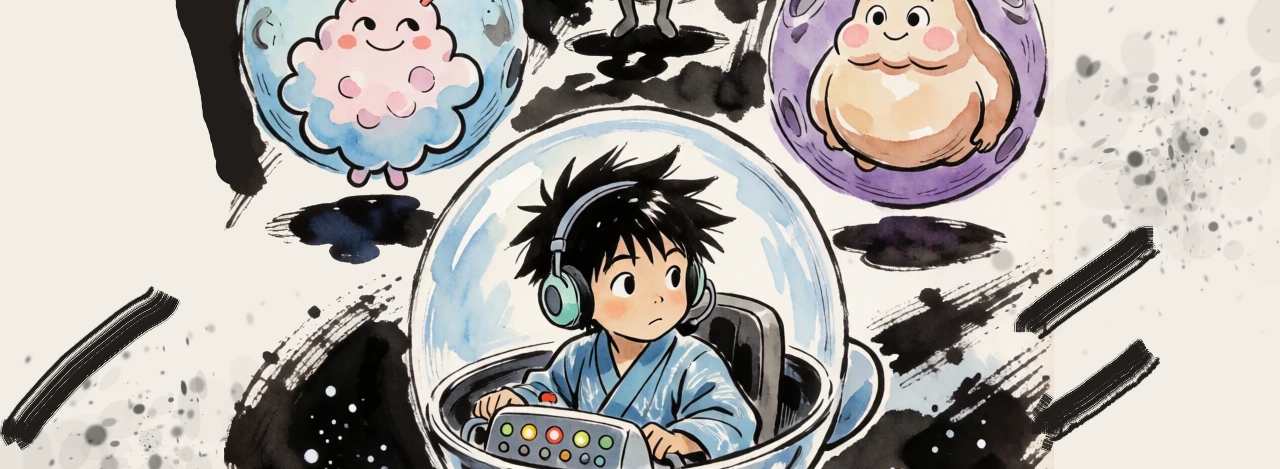
Niyuki Nogi
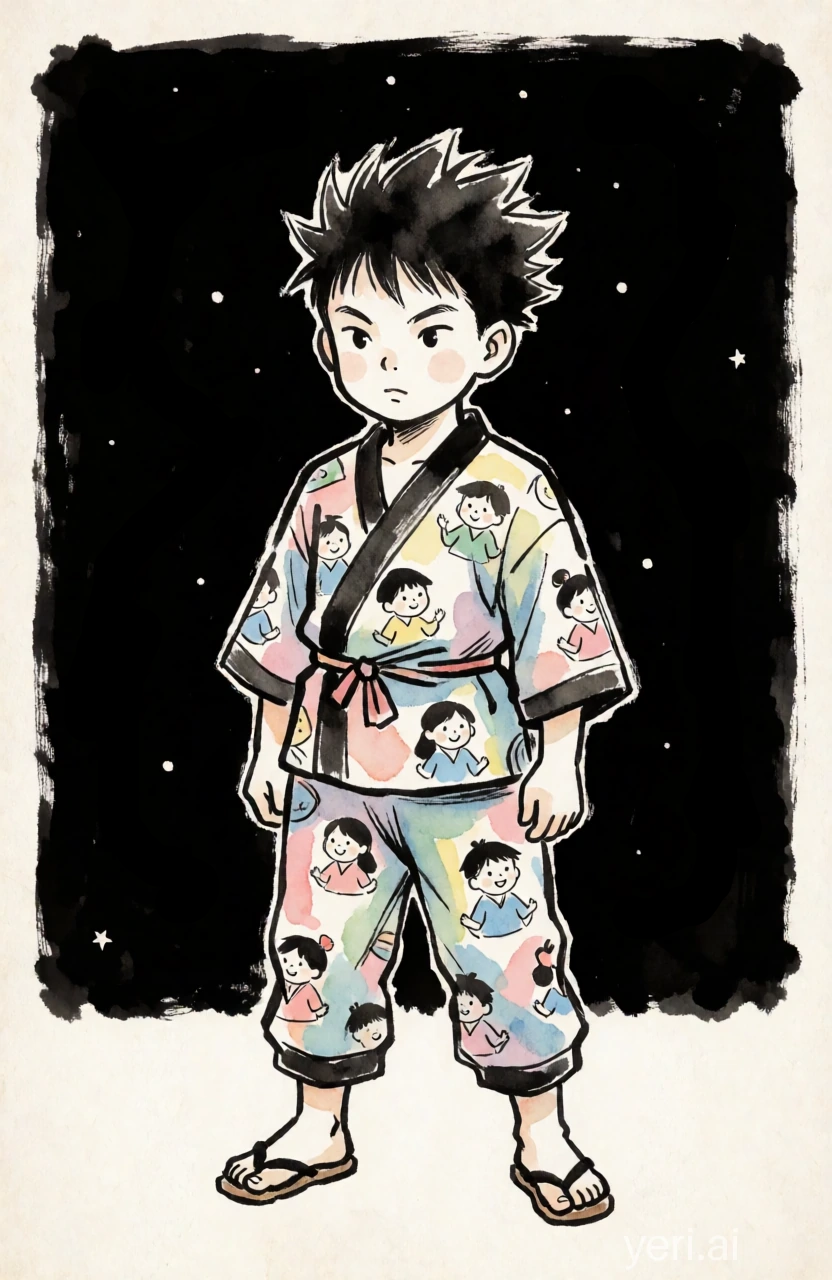
Nogi was a boy who lived in a friendly Japanese city. Like in all Japanese cities, space was scarce, and the Niyuki family lived in the new part of the city with thousands of small, cheap apartments, all identical to one another. The streets were also very similar; only the shops provided a contrast that helped distinguish them. People in his city always walked in a hurry, looking at the ground, and they didn't know each other, or at least they didn't greet each other. Nogi, however, did recognize them, although he didn't greet them either, out of politeness.
Nogi was fascinated by the colorful signs of some shops, particularly Mrs. Misuki's store, which sold candy and small dolls. Nogi was an avid reader; he read about technology and the mysterious universe. He wondered what the stars would be like and if they were inhabited by other children, although the stars couldn't be seen in his city due to the lights and the buildings that blocked the sky.
And the thing is, Nogi asked himself many questions. Too many for a child his age, according to his teachers.
One day, at the market, he saw a big boy eating a huge and delicious three-scoop ice cream. Nogi approached his mother and asked:
—Mom, why have you never bought me a three-scoop ice cream?
His mother looked at him with a stern smile and stroked his hair.
—Because, sweetie, we don't have spare money for that luxury. Besides, eating too many sweets isn't good for your teeth.
Nogi nodded, but another question arose in his head: "Why do some people have money for three-scoop ice creams and others don't?"
That same afternoon, while returning home, they saw a man and a woman arguing heatedly in the middle of the street. Their faces were red and their voices were so loud that they frightened passersby. Nogi held his mother's hand.
—Mom, why do adults shout? —asked Nogi, his eyes wide open.
His mother sighed.
—Sometimes, Nogi, adults forget to listen and forgive. They get angry because they're afraid, because they feel attacked, or because they don't know another way to say what they feel.
Nogi watched as the man and woman separated, each going their own way, and he was sure they didn't know why they had gotten angry. Then he looked at his mother and noticed that her eyes sparkled in a special way. She wasn't exactly crying, but Nogi knew his mother was sometimes sad.
—Mom, why are you sad? —he dared to ask.
His mother knelt in front of him and hugged him tightly.
—Because sometimes I miss having more luck. But don't worry, Nogi, having you fills my heart with joy.
To Nogi, sadness seemed like a grey cloud that sometimes passed over people. And that night, during dinner, his mother told him news that left him frozen. The son of Mrs. Maiko, whom they knew, had robbed a Tachinomi in the neighboring district. A man he knew. This affected him greatly; he had read about robberies, but he never thought that someone he knew could rob another person.
—Why would someone rob another person, Mom? —asked Nogi, putting down his spoon.
His mother turned pale.
—He was probably going through a hard time and made a bad decision, Nogi. It's a very sad thing.
Nogi couldn't understand how someone could be going through such a hard time as to harm another person. All of this seemed like a great mystery to him. And to make matters worse, the next day at school, his friend Kenji told him he wanted to be a soccer player, but during recess he confessed that he actually wanted to be a dancer. When Nogi asked him why he didn't say it in class, Kenji shrugged.
—Because boys don't dance, Nogi. Boys play soccer.
Nogi wondered, "Why is Kenji afraid to say it?"
Nogi's life was a constant "why?". In recent days, inexplicable things had happened that, in his opinion, made no sense at all and went against everything he had been taught.
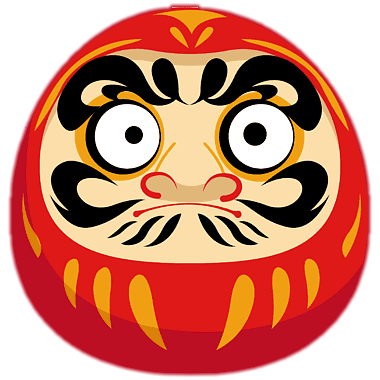
To cheer him up a little, his mother bought him a Daruma doll from Mrs. Misuki's store. It was round, without arms, legs, or eyes, with an angry white face and a full beard.
—This doll is very special, Nogi —his mother told him—. Darumas are symbols of perseverance. Their eyes are painted in a very particular way. When you have a dream, a very important wish, you paint one eye and ask it to help you fulfill it. When you achieve it, you paint the other eye to thank it.
Nogi took the doll carefully. It was small, fitting in the palm of his hand. Nogi looked at its empty eyes and immediately knew what his wish was. He didn't want a three-scoop ice cream. He didn't want toys. He wanted to understand. He wanted to know why the world worked in such a strange way.
He took a black marker and, with great concentration, painted the Daruma's left eye.
—Daruma, I want to travel to other worlds —he whispered—. I want to understand everything.
That night, while he slept, something extraordinary happened. A shiny letter, as if made of moonlight, appeared on his pillow. Nogi woke up and read it with his heart pounding.
"Dear Niyuki Nogi,
You have been selected for the first children's interstellar exploration mission. A spaceship awaits you on the roof of your building at 12 o'clock. You must travel alone. Adults cannot come, because only children remember how to ask the right questions.
Sincerely, The Special Space Ministry."
Nogi looked at the clock. He didn't hesitate; he was brave. He put on his jacket, looked at the Daruma doll on the shelf, and decisively climbed the stairs to the roof. There, under a black sky, a spaceship that looked like a giant, transparent soap bubble awaited him.
The door opened with a soft hiss. Nogi entered and saw that the interior was very simple: a padded seat and a control panel with many small lights and a screen, a single button, and headphones with a small microphone, which he put on immediately.
A warm, metallic voice spoke to him:
—Welcome, Nogi. To pilot this ship, you just have to say where you want to go. What is your first destination?
Nogi thought. He wanted to understand the world, so he decided to start with the beginning: happiness.
—I want to go to a planet where everyone is happy —he said.
The ship rose silently and, in the blink of an eye, Nogi found himself flying over a world of pastel colors and rivers of caramel. He landed in a beautiful place; the screen showed the message: Landing on Planet Happy 301.
Happy 301
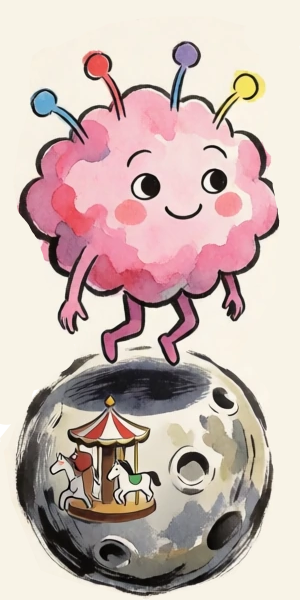
The planet looked like a fairground. There, the aliens were beings Nogi had never imagined. They called themselves Happys. Their bodies were made of spheres of soft, bright pink material. Their eyes were inverted crescent moons, always smiling, and small colored springs sprouted from their heads that vibrated with every laugh. Smiles rose from their cheeks into the sky, forming clouds of joy. They walked by sliding, and when they hugged, they stuck together like two pieces of gum, making a little sound like "Smassh!" and took several seconds to separate with a noise like "Pop!" The "Smassh!-Pop!" were repeated frequently.
—It's wonderful! —exclaimed Nogi—. You're all so happy!
One of the beings slid over to him. —They call me Happy Hip.
—Of course! —he said—, here we are always happy. It's the rule! —he said, as a smile came out of his cheeks.
Nogi frowned.
—The rule? —he asked—. But what happens when you're sad?
Happy's smile froze for a second. His springs went stiff and his crescent moon eyes became straight.
—We can't be sad. It's forbidden. Sadness turns off the springs and the smiles don't rise.
—But how silly! —said Nogi—. Sadness is also part of life. My mother is sometimes sad, and I love her just the same.
A small group of Happy aliens had gathered around them. They seemed confused. One of them, the smallest, who had the shortest springs, began to tremble. Suddenly, his smile began to fade. The little Happy began to cry, and tears streamed from his eyes.
—I wanted to say I was sad because I lost my best friend! —he confessed—, but I couldn't because everyone laughed foolishly all the time.
Suddenly, a bunch of Happys began to sob. Their springs turned off, their eyes became straight lines, and their bodies deflated like old balloons. They had been holding in their sadness for so long that they burst with grief. Nogi realized that forced happiness wasn't real—"What a silly thing," he affirmed. True joy, he thought, cannot exist if there is no room for sadness. They are like day and night; they need each other to give each other meaning.
He helped the Happys accept their sadness, and when they did, they began to shine again, but now with a more intense light. He said goodbye to them and boarded his ship.
There he learned that happiness without sadness is a very harmful thing—you cannot force anyone to be happy all the time.
—Take me to a sad planet —he said.
Oh, no!
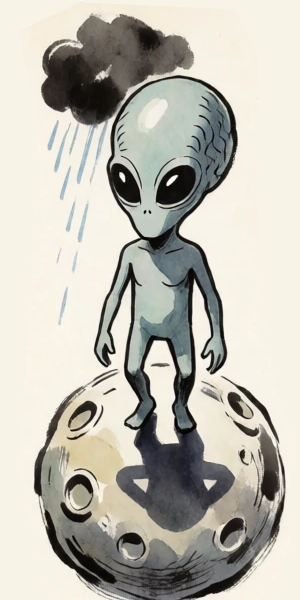
He arrived at a place called Oh, no! There, the little houses were grey and the shop signs, even the candy ones, were also grey. The ground was cobblestone and the sky was covered with clouds that constantly dripped. The aliens of this world were the Sad Ones. They had elongated bodies, enormous heads with two breathing holes but no mouth, and large, tearful black eyes.
—Why are you all so sad? —asked Nogi, sheltering from the constant drizzle.
A being called Sad Stan answered him between sobs. His skin was so grey that he was almost indistinguishable from the background.
—Because that's how life is. Sad. Nothing happy ever happens.
Nogi looked around and saw a small green shoot emerging between the grey rocks.
—Look! —said Nogi—. A flower!
Sad Stan looked up. For an instant, his tears stopped falling and his skin turned a lighter grey, almost pearly.
—It's just a flower, it will soon wither.
—But it's alive right now —insisted Nogi—. Doesn't it give you a little joy to see something so beautiful?
The Sad Ones fell silent. One of them, timidly, managed a smile. His skin turned a silvery grey and his tears became small dewdrops that sparkled like diamonds. Then another. And another. It turned out they had forgotten that good things also existed.
Nogi taught them to value and remember the small happy events to balance the sad ones.
But he also understood that sadness wasn't entirely bad. Sometimes, he thought, crying helps the heart empty itself of sorrows and refill with hope. The Sad Ones, with their new understanding, began to have moments of joy that made their tears less frequent.
Nogi said goodbye to the Sad Ones and departed again. There he learned that sadness is not the solution to fake happiness, nor is pretending joy you don't feel the solution to sadness.
Gluttony Eat, Swallow 1001
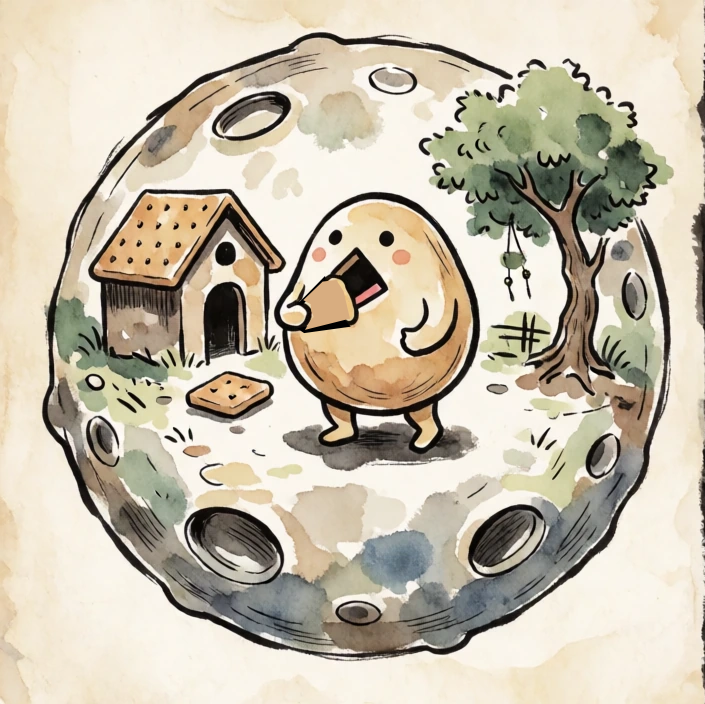
His next stop was the planet of the gluttonous aliens, a world called Gluttony Eat, Swallow 1001. In that world, everything could be eaten; the little houses were made of cookies, the street trees gave candy, all the urban furniture had to be replaced often because benches, traffic signs, sidewalks—everything could be eaten and was tasty. The aliens here were huge balls with rolls of fat hanging one over another, with a mouth that occupied their entire face. They called themselves Eat-Swallows. They had short, chubby legs that barely allowed them to move. But the most curious thing was their eyes: tiny and very close together, because they hardly used them to look; they only needed them to locate the next meal. They sniffed constantly.
—Eat everything! —they encouraged Nogi—. Eating is the only thing that matters!
Nogi, who couldn't eat sweets often, felt overwhelmed. He saw a small Eat-Swallow that was about to burst, but kept eating.
—Why don't you stop? —Nogi asked him.
The little Eat-Swallow, who was a bright orange color from all the candy, answered with a trembling voice:
—Because I'm afraid I won't have enough later. My grandfather always said you never know when the next meal will come. And besides, I'm hungry!
Nogi saw a fountain that gave out three-scoop ice creams, but he had lost his appetite. He understood that excess was no better than scarcity. He told them about the importance of moderation and enjoying food without anxiety. He told them that moderation required great effort, but it was worth it. Some Eat-Swallows, the younger ones, listened to him and decided they would make an effort not to eat so much, all the time. The Eat-Swallows learned to use their tiny eyes to see others and their enormous mouths to talk more, and they began to have time to play, walk, read, or do many other activities.
Nogi reflected that the problem wasn't eating, but the fear of the unlikely lack of food, since in that world where food abounded everyone was afraid of not having enough. He also learned that fear turns the world into a prison and, more importantly: that having a three-scoop ice cream doesn't guarantee happiness.
Body One, Two, Trex
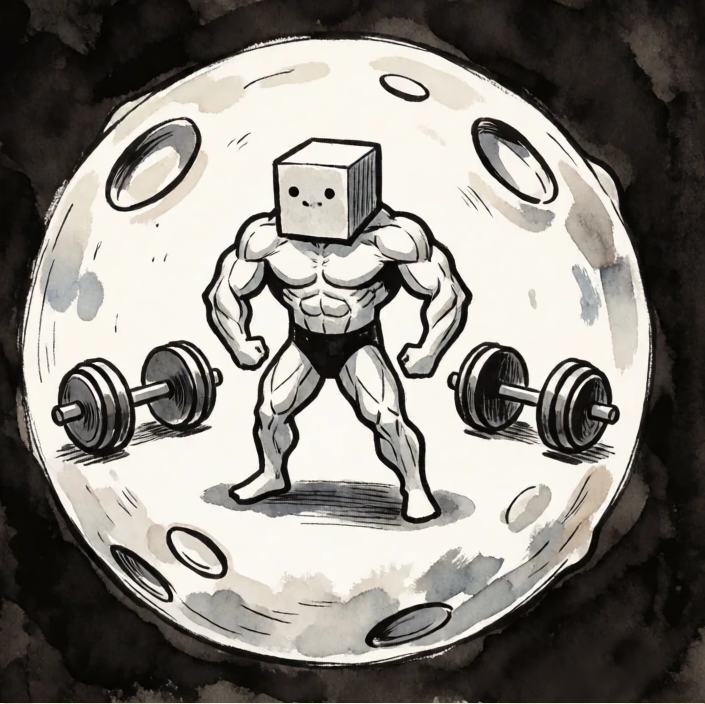
Then he visited the planet of body worship, a world called Body One, Two, Trex. The aliens here were the Musculitos. They had bodies of burnished steel; they had developed muscles so defined that they seemed carved from rock. But their cubic heads were disproportionately small, almost like a die on top of a giant's body. They lacked necks, so their tiny eyes always looked forward, toward the goal. They had strong arms and legs, which allowed them to take great strides, even impossible leaps. They constantly challenged each other, possessed by a fierce competitive instinct. "I bet I'll get there first" seemed to be their favorite phrase. Their skin was shiny and healthy, but their eyes... their eyes were empty, without shine, without curiosity. They didn't read, they didn't think, they didn't ask questions. They were like beautiful statues that could run and jump, but didn't know why they did it.
—Is winning the only thing that matters? —asked Nogi, exhausted just watching them.
A "Musculito," sweaty and out of breath, answered him while lifting a super-heavy weight.
—Of course! If you don't win, you can't win! The body counts!
Nogi observed them and saw a Musculito who always came last and seemed very sad. He approached him.
—Do you like competing? —he asked.
The Musculito shook his small head.
—No, but I can't do anything else. Everyone tells me I have to be the best. My arms are strong, but not as strong as theirs.
Nogi proposed a game without winners, a cooperative game where they had to use their small heads to solve riddles. At first they resisted, but when they saw how fun it was to build something together, they relaxed and laughed without worrying about first place. It was then that Nogi noticed something that caught his attention. The Musculitos who had only dedicated themselves to training, those with the most enormous muscles, were incapable of solving the simplest riddles. There was no joy in their eyes.
"Cultivating the body is good, but if you forget to share, to cultivate your intellect, and to enjoy small things," thought Nogi, "you will be nothing more than a piece of meat with eyes." He said goodbye to the Musculitos, leaving that idea written on a piece of paper.
Knowledgeland 1.0
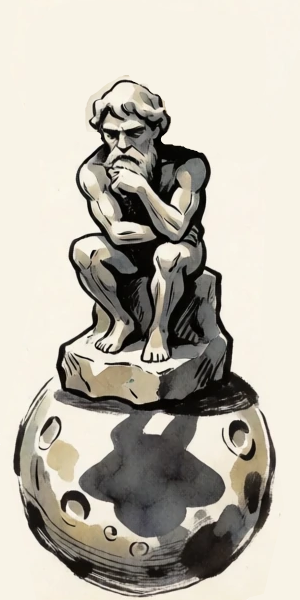
Afterward, his ship took him to the planet of the Wise, a world of infinite libraries called Knowledgeland 1.0. The aliens here were the Know-It-Alls. They had enormous heads, so big that they needed both hands to hold them, adorned with venerable grey hair and beards, and their bodies were tiny, insignificant, with arms and legs as thin as toothpicks. Their eyes were as big as plates and had multiple pupils that moved in different directions, allowing them to read several books at once. They spoke with deep, measured voices, and each word was accompanied by a little puff of smoke that contained the essence of their thought.
—We know almost everything —they said arrogantly, moving their heads with effort to look at Nogi.
Nogi, excited, asked them:
—Then, why in my world do adults shout at each other? Why do some people rob others? Why is my mother sad?
The Know-It-Alls fell silent. Their multiple pupils stopped. Their antennas stopped vibrating.
—That's not in the books —said one, with a trembling voice—. We have no answer for that.
Nogi smiled.
—Then you don't know everything. Knowledge isn't only in books; it's also in asking questions and listening to others.
The Know-It-Alls, humiliated but also curious, asked him to stay and teach them. Nogi kindly refused. He could still visit another planet in the minutes he had left before returning.
There he learned that the important thing isn't having all the answers, but asking the necessary questions as doubts arise along your path.
Giving Take, Give 2000
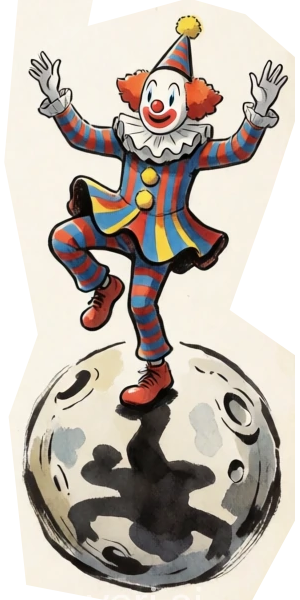
The last place he visited was "Giving Take, Give 2000," the planet of the "give everything." In that world, what was both most scarce and abundant was wrapping paper. The aliens here were the Givers. They were luminous, dancing clowns. Their hands were long and skilled at wrapping gifts. And they could materialize objects of light to give away. The brighter their light, the more they could give. When they gave something, their light intensified for a moment, but then dimmed slightly. The youngest were small colored sparks, almost transparent, while the oldest had an intense but flickering light, like a candle that's about to go out. On that planet, they lived very briefly; they became old at fifteen, because the energy they were born with and needed to give was quickly exhausted without being replenished.
—Why do you give so much? —asked Nogi—. Aren't you afraid of being left with nothing?
A Giver, who shone with an intense golden light, answered him:
—Giving is our reason for being. The more you give, the more satisfaction you get. Giving isn't losing, it's gaining.
Nogi watched how the Givers gave away everything they had without holding anything back. They were happy, yes, but Nogi noticed something worrying. An old Giver was sitting in a corner, alone, with nothing to offer. His light had become dim, almost extinguished. He had been left with nothing. He had given so much that he no longer had even a little light for himself.
Nogi approached him.
—What's wrong? —he asked.
The old Giver raised his dying light.
—I've given everything —he whispered—. Now I have nothing. Not even a little light to keep shining.
Then Nogi understood two things: First, giving is wonderful, but you also have to know how to keep something for yourself. If you give everything away, you're left with nothing. Balance, he thought, is the key. It's not about not giving; first is yourself. A little foresight is necessary.
Second: giving everything is bad, because you prevent others from working to achieve their own goals. Not having is the reason to strive and provide.
The younger Givers listened to Nogi; they continued giving but kept a part without calling it selfishness. Now many worked to materialize what they needed and their energy was recharged. The world "Giving Take, Give 2000" became fairer, and the give-everything would enjoy longer lives.
There he learned that sometimes giving someone everything they want hurts them instead of helping.
Nogi thanked them and, with his heart still full of questions but many of them answered, asked the ship to take him back home. When he landed on the roof of his building, the sun was beginning to rise. He quietly went down the stairs and, happy, got into bed.
The New Nogi
But he was no longer the same Nogi. He had seen worlds where happiness was an obligation, sadness a condemnation, food an obsession, competition a disease, knowledge a wall, and generosity exhaustion. Each planet had given him an answer, a piece of a huge puzzle. Now he understood, for example, that people who dedicate themselves only to sports without cultivating their minds can be strong, but not wise. And that giving without measure can be as dangerous as giving nothing. He had met the Happys, the Sad Ones, the Eat-Swallows, the Musculitos, the Know-It-Alls, and the Givers. Each one had taught him something different, because all excesses are deficiencies.
In the following days, Nogi didn't tell everything to his mother at once. Instead, the lessons emerged in small moments, like drops of dew.
One afternoon, he saw a man run so fast that he almost ran over an old woman. Nogi thought of the Musculitos and murmured to himself: "He runs very fast, but perhaps he doesn't know where he's going. He's just a piece of meat with eyes."
Another day, his friend Kenji gave him his snack because Nogi had forgotten his. Nogi accepted, but then remembered the old Giver and told him:
—Kenji, you're very generous, but you don't have to give everything you have. Keep half for yourself; it's not good to be left with nothing.
Kenji looked at him strangely, but smiled and split his snack into two equal halves.
Little by little, Nogi shared small reflections with others. One night, while they were having dinner, Nogi put down his fork and said:
—Mom, I think I understand why you sometimes get sad. It's like on the planet Oh, no!. Sadness isn't bad. Sometimes it helps joy to come later. And I also think adults get angry because they forget to reflect and listen, like the Know-It-Alls who only read books without sharing real life.
His mother looked at him with surprise.
—Planet Oh, no!, Nogi? Know-It-Alls? —she asked, smiling—. What strange dreams you have!
Nogi shrugged and smiled mischievously.
—Dreams that make me think. And that's good, right?
—Yes, dear —his mother answered, kissing his forehead—. That's very good.
Nogi didn't need to explain his whole journey. The important thing was that now he saw the world with a different understanding. The Daruma doll had granted his wish. He took it with respect and, with the black marker, painted its second eye.
—Thank you, Daruma —he whispered—. You fulfilled my wish. I traveled to the stars and learned many things. I don't have all the answers, but I know that the right questions are the path. And I also know that life is a balance that doesn't consist of definitive or extreme solutions, but in understanding each situation and taking time to reflect and find the right solution.
The Daruma, with its two open eyes, seemed to smile at him. Nogi placed it in a special place in his room, where he could see it every morning and remember his journey. And although no one ever knew that he had traveled to the stars, everyone noticed that Nogi was different. He no longer worried about the questions. He embraced them. And he turned them into small answers that made his world a little bit better.
Because, as Niyuki Nogi discovered, the universe is an immense place, and questions, no matter how small they may seem, have the power to change the world. And sometimes, the most important answer isn't in a book, but is discovered in the mishaps that happen to us; it's in every question we dare to ask and in every situation we allow ourselves to share, listening and reflecting.
And that's the end of this story of questions. But remember: if you ever see something you don't understand, if you see an adult losing their temper, if you can't have the same as others, if you see someone sad, if you hear talk of violence, if you can't eat all the candy you want, or if someone tells you what you have to believe, do as Nogi did: ask yourself why. Don't settle for what others impose on you. Travel as far as your imagination allows, even to the stars if necessary, to find your own answers.