
Niyuki Nogi
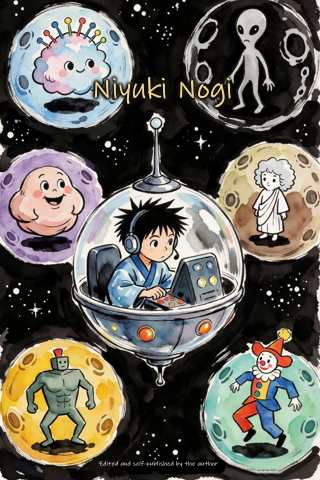
A curious boy travels through the universe in a bubble spaceship, visiting six planets where he discovers that all excesses hide deficiencies. He learns that true wisdom lies in asking questions.
Literary Analysis
Genre: Children's philosophical tale
Niyuki Nogi: when children's literature dares to ask questions
There are stories that entertain and stories that plant seeds. Niyuki Nogi belongs to the second category. LoneSlone builds a work that, under the appearance of a space adventure, hides a philosophical treatise on the human condition, without ever losing the lightness that children's audiences demand.
The first thing that surprises is the boldness of the premise. The protagonist, a poor boy from a grey, anonymous city, does not seek treasures or powers. He seeks to understand why the world works the way it does. This narrative decision places the story in a tradition that is uncommon in current children's literature, closer to Saint-Exupéry's The Little Prince than to the typical action adventures of the genre.
The structure of travelling through planets, each inhabited by a society that takes a human flaw to the extreme, works like clockwork narrative machinery. But LoneSlone avoids the danger of falling into mechanical allegory thanks to a tone that oscillates between tenderness and humour. The Happys who explode in tears after years of forced happiness, the Eat-Swallows who devour their own world for fear of scarcity, the Musculitos who are "pieces of meat with eyes": all these images have the power of great literary symbols.
The narrative style is another achievement. LoneSlone writes with a clarity that does not renounce depth. The sentences are short, the dialogues natural, the descriptions just right. Nothing is too much, nothing is missing. This economy of means allows the message to arrive without stridency, like water that soaks the earth without making a noise.
But perhaps the most valuable thing about the story is its ability to deal with adult themes without losing the child's perspective. Poverty, inequality, parental sadness, social pressure, body worship, consumerism, misunderstood generosity: all these issues appear in Nogi's journey, but always filtered through the curiosity of a child who asks why. That clean gaze, which does not judge but asks, is the great virtue of the tale.
The Daruma, that eyeless doll that comes to life when a wish is made, is a successful magical object. It is not a fairy godmother nor a wonderful lamp. It is a symbol of perseverance, a reminder that dreams are built with effort. The fact that Nogi paints its second eye at the end, in gratitude, turns the journey into a closed and perfect cycle.
In the panorama of current children's literature, Niyuki Nogi stands out for its thematic daring and narrative honesty. It does not underestimate its audience, it does not simplify the complex nor complicate the simple. It offers questions instead of answers, and that, in a genre that often settles for easy morals, is an act of resistance.
There are echoes of the great tradition of universal children's literature, from the aforementioned Little Prince to Carroll's Alice, through Aesop's fables. But LoneSlone does not imitate; rather, he builds his own voice, a voice that knows how to be at once tender and critical, playful and profound.
When finishing the reading, one has the feeling of having travelled with Nogi, of having visited those absurd planets that, in the end, are our own world. And, like him, one is left with the certainty that questions are more important than answers, because they are what keep us alive, curious, human.
Niyuki Nogi is, in short, a story that deserves to be read and re-read. For children, who will find in it a fascinating adventure. For adults, who will rediscover the importance of asking questions. And for all those who believe that children's literature can, and should, be literature with a capital L.