
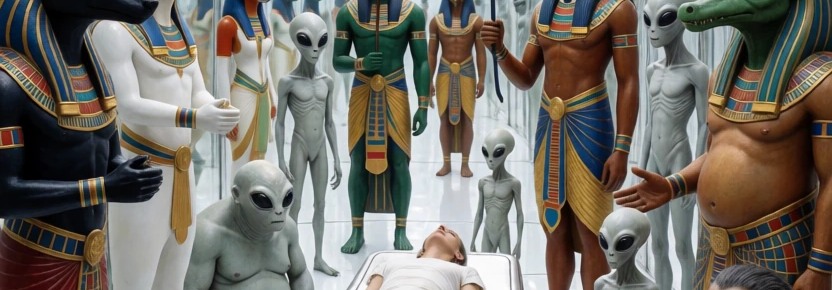
The question that no one has been able to answer with certainty. Where are the bodies? Egyptology says they were looted. I say they were never there. And I have an advantage over the official theory: my hypothesis does not depend on massive and systematic looting that left no trace of the bodies. My hypothesis affirms that the bodies are elsewhere, not yet found or not identified. Both are speculative, but mine is more consistent with the evidence that the Egyptians were extremely careful with bodies, but the body was only necessary for the deceased himself, not for society.
Empty Pyramids
Author: LoneSlone
From Pseudoscientist to Egyptologist by Cupid's arrow
Willie McBilly had made a good living writing books about ghosts, lost civilizations, unexplained phenomena, alien conspiracies, and other silly things for the consumption of the credulous, the paranoid, and the poorly educated schizophrenics.
But he had met Bo, a girl who seemed to him a Goddess. There was only one problem: she despised him, from the height of her scientific background (she was a serious archaeologist). Bo saw Willie McBilly as an imbecile, and she would never date an imbecile, no matter how handsome he was. The worst part wasn't that she saw him as a fool, but that he himself couldn't help seeing himself as a fraud, ever since she had made him notice it. Before, he enjoyed his small successes; now, he deplored everything he had done and written.
Willie was willing to change, for her. So, for the first time in his life, he set out to write a book, just as a scientist would.
He would write about ancient Egypt. It was risky, but if he managed to impress her, perhaps he would have the chance to merge his genes with hers, that goddess of the universe.
Willie, excited about his new idea, decided to share it with Bo at a café in London. She listened with a mixture of disbelief and patience.
—Are you really going to write a serious book about the pyramids?— Bo asked, raising an eyebrow. —You, who have built your career on the improbable, suddenly want to do Egyptology. It's like an astrologer deciding to write a treatise on astronomy. He might talk about the same stars, but physics? Not a clue— she said, accompanying the phrase with an exaggerated shake of her head and shoulders.
—Precisely because of that— Willie replied, unfazed. —Because I come from outside, I can see what Egyptologists take for granted. I've been reviewing the data and there's something that doesn't add up.
—For example?
—The twelve main pyramids of the Old Kingdom— Willie said, pulling out a notebook. —In none of them has the body of the pharaoh to whom they are supposed to belong been found. Not a single mummy. The Pyramid Texts speak of resurrection, but they don't say "the body was deposited here." The funerary complexes have temples, altars, boats... but the main actor is missing.
Bo sighed, like someone explaining something obvious to a child.
—That's not evidence of anything, Willie. It only proves that the looting was very efficient. We have papyri, the "Diary of Merer," which proves that the Great Pyramid was built by Khufu, who sent materials for its construction.
—But it doesn't prove that he was buried there— Willie countered. —It only proves that he ordered it built. If they claim they're tombs, they should find at least one body— He paused. —Where is Khufu's body? Khafre's? Menkaure's?
—They're in caches like DB320— Bo replied, her tone beginning to show irritation. —Ramesses II, Seti I... all were moved to protect them from looters.
—And what proof do you have that those mummies came from the great pyramids?— Willie asked. —The caches prove that the mummies were moved from somewhere, but not from the pyramids. That's an assumption, not a fact. Please... they're not even sure that the mummies found were actually those pharaohs.
Bo was silent for a moment. Then, with a mixture of contempt and curiosity, she said:
—If you say they're not tombs, you have to prove what they are. The scientific method doesn't just require criticizing a theory, but proposing another that better explains the data. Do you have an alternative hypothesis?
—That's why I'm going to Egypt— Willie said. —To investigate.
—Investigate? Good luck— Bo said mockingly, getting up. —I doubt you can tell the difference between evidence and a souvenir from a flea market. Don't expect to be taken seriously until you have solid proof. No coffee-shop theories.
Any good scientist investigated before drawing conclusions, or so Willie believed, so without further ado he decided to leave for Egypt as soon as possible to investigate the 12 main pyramids.
He bought two tickets, one for his secretary Regis P. Plumber, nicknamed Perraloca, and one for himself. The budget wasn't very generous and would have to be stretched, so he told Perraloca they would live like the ancient Egyptians, on beer and bread. Perraloca loved beer, so it seemed like a good plan. As for accommodation, they found a convenient pension in an alley, with very questionable hygiene, but which had the advantage of being in Giza, an independent city that was part of Greater Cairo, from where he could walk to the Grand Egyptian Museum.
They arrived at the pension. It was run by a friendly man named Ramesses —yes, he called himself after the pharaoh, because according to him "everyone remembers Ramesses, but no one remembers the name Mohamed"— Mohamed or Ramesses had a parallel business selling "authentic" papyri. At least the support was authentic papyrus, but redrawn with more attractive scenes for the Western tourist; he added mystery: hieroglyphs depicting aliens, spaceships, flying bodies shooting rays. "It's so they sell better," he said. By having his cousin Husein redraw them, they lost all their value, but Ramesses was proud of the result and passed them off as valuable and rare ancient artifacts. He would show them to tourists mysteriously, display them secretly and look nervously around while saying: "Have something special for you. Very good document; Akhenaten himself would pay me huge sums of gold if he were still alive."
The days passed and Willie kept to the same routine. In Egypt it's customary to sleep, in the cool of the night, on the rooftops, because inside the heat is suffocating. He would wake up at ten on the pension's terrace when the sun beat down mercilessly, go down to the room and Perraloca would bring him a tea service. At eleven he would go down to the pension's communal dining room, take the little table that faced the alley and have a huge jug of sour, acid and harsh beer brought to him, brewed using the same methods as the ancients. They usually mixed it with honey and spices to disguise it, but Willie and Perraloca liked it plain.
From there they would walk to the Grand Egyptian Museum. He with his backpack —actually a British Mark VII gas mask bag— slung across his body, and a hat like Indiana Jones's. Perraloca, for his part, had gotten himself a comfortable shenti of thick linen with which he looked like an ancient Egyptian.
Before leaving England, Willie and Perraloca had joined ICOM (International Council of Museums) and thanks to that they enjoyed the privilege of free entry to the Grand Museum. They had to elbow their way through the hordes of tourists crowding at all hours to reach the entrance; the guard already knew them and let them through without formalities. A great advantage because tourists paid very high entrance fees, £26.55 each per day, a huge sum if you had to pay it every day.
Willie, who paid for the accommodation in pounds and had few left, was forced to keep his promise to "live like the ancient Egyptians." But Perraloca, tired of the monotonous diet, decided to cook lentils in the pension's communal kitchen, which hadn't seen a cleaning since Cleopatra's time. The kerosene tank spilled, burning the walls of the room. The fire was small, but enough for Ramesses to forbid them from cooking forever.
—The ancient Egyptians didn't eat lentils— he told them with a certainty that didn't match reality.
—But Ramesses, lentils are one of the best-documented foods of the Old Kingdom— Willie protested, having read something about the subject.
—Well, then... eat them somewhere else. Why don't you go eat lentils somewhere else?— Ramesses replied, unwilling to give in. —Not in my pension. Anyone who wants lentils, go to the Koshary on the corner, where they serve them with fried onions and nobody's died burned yet.
Perraloca, with a singed eyebrow, ranted in the background, cursed and swore that Ramesses was a vengeful reincarnated pharaoh who had returned to starve them and hinder their purpose of living like true ancient Egyptians.
The diet remained monotonous; the only things they consumed besides beer and bread —something true Brits never forgave— was tea twice a day, for breakfast and at teatime. But that morning Perraloca showed up without the tea service. He usually brought a clear glass, a modest brass teapot and a siniya or tray hung from three rods with a handle that Perraloca swung around him like a planet orbiting the sun.
—Where's the tea, Perraloca?
—I'm on strike— he said, crossing his arms. —I refuse to keep serving you unless you include a generous dose of makeup among my emoluments.
Willie looked at him in disbelief.
—Have we gone mad? Makeup?
—No self-respecting Egyptian goes out on the street without careful makeup— Perraloca replied with a dignity that was new to him. —I think my eyes well deserve to be enhanced.
—But that was in ancient Egypt, now it's not done— Willie argued.
—It's not done if you don't want to, but I do— he stressed the "do" heavily.
Willie sighed.
—Alright, but only eyes.
—No, no, no. And cheeks too, but above all hair. I won't go through the market looking like a beggar.
Willie, defeated, agreed. That same afternoon, Perraloca appeared with his eyes lined like a pharaoh of the XVIII Dynasty and shiny hair. He called himself 𓃥 𓂻𓄿𓂋𓏏𓁐 iḫt tsnt (approximately ijet t'senet). Tourists in the market took photos of him. Perraloca posed happily, for a few piastres.
Perraloca discovered that the souks of Cairo, particularly Souq al-Gomaa —the Friday market— were a paradise for bartering. In his first week he traded Willie's thermos for a scarab necklace made of plaster, the leather belt for a clay amulet, the hat —which Willie used to protect himself from the sun— for a carved wooden bowl and, oh horror!, the binoculars for a kilo of dried dates.
Willie, realizing that his assistant had sold his belongings, shouted at him: —What did you do, Perraloca?!
He replied with all innocence: —Good business, boss. The things I got are ancient.
—But they're useless— Willie retorted.
—Neither were the ones I sold, boss. You didn't look through the binoculars, you didn't drink from the thermos, and the hat looked bad on you.
Willie stared laconically at a clay amulet that imitated an ancient scarab but which, without a doubt, must have been made yesterday.
Willie Investigates at the Grand Egyptian Museum
Perraloca struck up a friendship with a security guard at the GEM named Mahmud, who had a weakness for beer and naps. He soon discovered that Mahmud would let him access restricted areas of the museum... as long as Perraloca took over some guard shifts while Mahmud went out to smoke a suspicious cigarette. Willie found his assistant sleeping on a New Kingdom sarcophagus and woke him up hurriedly. The worst thing if they were caught was that they would be banned from entering the Museum. —Perraloca, I don't know what to do with you, you're putting our research in danger, you only think about yourself. —That's not true, master, if we need a favor from Mahmud, I have him in my pocket. Well, I already know what favor you can ask Mahmud: tell him to lend you the Wadi al-Jarf papyri for a day.
Willie was taking notes on the pyramid table when a deep voice sounded behind him.
—I've been told you're writing a book, Mr. McBilly— said Dr. Tarek El-Masri, curator of the Grand Egyptian Museum, with a perfect English accent but a look of disdain. —About our pyramids.
—That's right, Doctor— Willie replied, without looking up. —I'm cross-referencing the official data with archaeological findings.
Dr. Tarek let out a short, dry laugh.
—Cross-referencing. What a pretty word for saying you don't understand anything. We've had two hundred years of modern Egyptology, Mr. McBilly. We have papyri like the Diary of Merer that prove the Great Pyramid was called "Horizon of Khufu." We have the Pyramid Texts, which describe the resurrection of the king. We have entire funerary complexes: temples, causeways, boats. Everything points to the pyramids being tombs.
Willie closed his notebook and turned to the curator.
—You have texts that speak of rituals, Doctor. But you don't have a single text that says: "Khufu's body was deposited here." You have temples, altars and boats, but you don't have a single body. Isn't that curious? You have the whole stage, but the main actor is missing.
Dr. Tarek leaned over the table, lowering his voice.
—Do you know what happens with looting, Mr. McBilly? They don't just take the treasures. They destroy the mummies in search of amulets and jewels. Sometimes vandalism is worse than theft. That explains the absence of bodies.
—Does that explain why there isn't a single body in twelve pyramids?— Willie asked. —Not even a finger, a tooth, a bone fragment that can be identified as the pharaoh's?
—Bone remains do appear— Dr. Tarek countered. —In the Pyramid of Djoser, bones were found in the sarcophagus. In the Red Pyramid, fragments of a human skeleton. They're there, Mr. McBilly, but you choose to ignore them.
—I don't ignore them, Doctor. I analyze them— Willie said, opening his notebook. —In Djoser, the bones belong to several individuals, from periods much later than the pharaoh. There's no way to know if they belonged to Djoser. In the Red Pyramid, they're a few fragments, without inscriptions, without clear context. Some archaeologists suggest they could be Sneferu's, but that's pure speculation. Is that what you call evidence?
Dr. Tarek straightened up, adjusting his jacket.
—Absence of evidence is not evidence of absence, Mr. McBilly. That's what amateurs like you don't understand. I tolerate your obsessive presence in our Museum as a tourist, but know that I don't consider you a researcher, not even an amateur one. When you have a single serious piece of data to offer, let us know.
—Doctor— Willie said, with a calm he didn't feel—, the Pyramid Texts of the V and VI Dynasties describe the resurrection of the king, yes. But they also describe many other things: sin, the gods, the journey to the afterlife, transmutation, reward and punishment. They are funerary texts, but they are not burial certificates. You are interpreting, not proving. And that's exactly what I do: interpret the same data differently.
Dr. Tarek looked at him in silence for a long moment. Then, without adding a word, he turned and walked away, leaving Willie alone with his notes.
During his research he found uncomfortable inconsistencies between the official version of Egyptology and what he intuited might have happened.
The results on the presence of remains in the twelve pyramids he investigated were:
🕮 See: Willie's pyramids
| Pyramid | Pharaoh | Location | Height (meters) | Remains |
|---|---|---|---|---|
| Pyramid of Senusret I | Senusret I | Lisht | 61.3 | No remains of the pharaoh indicated. |
| Pyramid of Djoser | Djoser | Saqqara | 62 | Human remains (rib, foot, etc.) were found in the sarcophagus but from several individuals and from much later periods, not the pharaoh. |
| Pyramid of Meidum | Sneferu | Meidum | 65 | No remains of Sneferu have been found; damaged and looted pyramid. |
| Bent Pyramid | Sneferu | Dahshur | 105 | Neither has Sneferu's body been found; looted. |
| Red Pyramid | Sneferu | Dahshur | 105 | No sarcophagus, but a man's skeleton was found (probably from the period) which some attribute to Sneferu without certainty. |
| Great Pyramid of Giza | Khufu | Giza | 146.6 | Khufu's mummy has never been found; empty sarcophagus, looted. Possible hidden chambers unconfirmed. |
| Pyramid of Djedefre | Djedefre | Abu Rawash | 67 (approx.) | No discovery of his body is indicated. |
| Pyramid of Khafre | Khafre | Giza | 136.4 | Khafre's body has not been found; looted. |
| Pyramid of Menkaure | Menkaure | Giza | 65.5 | The mummy has not been found; sarcophagus with coffin and human remains was lost at sea in the 19th century, unidentified. |
| Pyramid of Neferirkare | Neferirkare | Abusir | 72.8 | Human remains have been found in V Dynasty pyramids, but the clearest evidence is Neferefre's mummy (in a smaller pyramid). |
| Pyramid of Amenemhat III | Amenemhat III | Hawara | 75 | In his "Black Pyramid" remains of queens were found, but not the pharaoh's body. |
Result: In none of them had a pharaoh been found inside.
Traditional Egyptology justifies the absence of bodies by systematic looting, or with the theory of "wandering mummies" that were moved to protect them or in some cases suffered a political attack to destroy the memory of the deceased.
The political attack theory may be plausible, but in this case it was the same: weren't the looters in search of treasures also profaning the memory of the buried and destroying his possibility of living in the afterlife?
That is, whether the motivation was political or not, looting or wandering mummies, the result was the same: the mummies are not there.
As for the theory of "transferred" mummies, it is nothing more than an unproven assertion. No one can prove that they were in the pyramids and were moved. The most likely thing is that either they were buried there directly or they were moved from somewhere else, but not from the pyramid.
Tut's case, whose tomb was found intact, illustrated in Willie's judgment that they were not buried in the pyramids but elsewhere. The most credible thing is that the purpose of the pyramids has not yet been discovered and the assertion that they were the tombs of the pharaohs is a fallacy, something Egyptologists have invented because they haven't come up with anything better.
In the end, so convinced was he that his research would reveal the truth to the world that he looked for a flashy name, worthy of his discovery: "The Empty Pyramids Theory." He published his book signing with a nickname: sn n snt n pAt "Brother of the geometry of antiquity" and put it in a royal cartouche for better display: 𓌢 𓋴 𓌢𓏏 𓋴 𓇾
Willie's Excavations
Digging where everyone else did made no sense. They had been going around the same sites for almost 100 years. Willie obtained a permit to dig in a virgin site, where no one had excavated before. He chose it because it was lonely, west of the Nile, on a hill, and because that was where he would have wanted to be buried if he were a pharaoh. The two of them and a few laborers went to the Qena desert, Egypt, at the site located at 26.286036, 32.411118. —More workers— Perraloca demanded, who didn't intend to dig. —In Egypt you need three for each one: one works, another acts as his secretary and the third watches.
Beginner's luck was with him. Not even half an hour had passed since they began the excavation when one of the workers found something unusual. They didn't know it, but it was one of those finds you only make once in a lifetime. First they found some pieces of clay, behind the clay pieces, a canopic jar, almost intact, but empty, and then something that not even the Grand Egyptian Museum itself possessed: 12 rare ushabtis; they were standing, in formation of three by three forming four rows facing north. Perraloca, delighted, took some selfies with one of them and posted them on the internet. Willie tried to forbid it, but it was too late. Well, nothing would happen. Nobody knew where they were. (mistake, excavation permits were public) and if someone saw the ushabti they would think it was a doll bought in a comic book store and not an archaeological find thousands of years old.
—They're pretty, aren't they?— said Perraloca. —Pretty?— asked Willie, they're more than pretty, they're exciting. —How much will they be worth?— Perraloca asked, surely they cost a few dollars each, right. Perraloca looked at them and a horrible idea appeared in his small and convoluted brain: go to Souq al-Gomaa (the Friday market) and sell them. After all, there would be many more where these came from.
In reality it had been Willie's fault, not protecting them, nor putting them out of reach of his unpredictable secretary. He carelessly left them in the hotel inside the canopic jar, paid the workers and went down to the pension's communal dining room to drink a good cold beer and a huge piece of bread; he had earned it.
—Are you coming down for a beer? —Another day, now I'm going for a walk around, to see what I see.
Perraloca, bored with so much beer and bread, decided to sell not one but all 12 ushabtis with alien appearance found in the Qena desert excavation. Perraloca obtained in exchange 2 kg of basterma, a bundle of dates, and 1 kg of feseekh. Willie almost killed him, he would try to recover the ushabtis. —Where, where did you leave them, you madman?
The shrewd buyer turned out to be a known mummy hunter and antiquities trafficker named Abdul Rahman, who moved through the souks of Cairo like a fish in water. Willie, desperate, went to look for him at his shop in the market, loaded with what the merchant had given Perraloca.
Abdul Rahman received him with a smile of tea-stained teeth.
—Ah, the famous Mr. McBilly— he said, examining one of the ushabtis with contempt. —The man who says the pyramids are not tombs. Like your style, sir. Risky. But not good for business.
—Those pieces are mine— Willie said, containing his anger. —I'll give you back the 2 kg of basterma, your bundle of dates, and your kg of feseekh.
—Now worth more, much more, $100 each— Abdul replied, shrugging. —But that's not what interests you, is it? You want to know what I think of your theory.
Willie looked at him, bewildered.
—Yes, that's what interests me, recovering my ushabtis, I could report you for trafficking historical-archaeological objects— Willie threatened.
—If you report me, they'll also arrest you for selling them to me— Abdul said, laughing. —I don't like you. Everyone knows you go around saying the pyramids are not tombs. I say they are sacred tombs. Nobody pays me to say that. You want fame. But let me ask you something: what sells more? Your theory that says there's nothing to find, or the accepted theory that says there's pharaohs' treasure in tombs with mummies?
—It's not about selling— Willie replied.
—Yeees, of course it is— Abdul said, leaning towards him with a complicit look. —Everything is business, sir. You know, I know that the pyramid texts are real. That the funerary complexes exist. That the Wadi al-Jarf papyri prove that Khufu built the Great Pyramid. But you say: "Not tomb." I say: "Tomb." We're both following a hunch. But I can sell hope. A tourist won't buy a book that says "the pyramids are not tombs." He'll buy one that says "clues to find Khufu's hidden treasure." You understand?
—You don't understand the world. If someone believes in a supreme being that has power over him, immediately an intermediary between God and the credulous appears: a priest who will take advantage. If someone believes there are treasures in tombs, I, the merchant, appear to provide those treasures to the credulous. If someone like you appears to break the spell, it's not good for business. You are like a merchant and a priest, wanting to be an intermediary between truth and the credulous, but you, bad oracle.
—I understand that you prefer a lie that keeps business alive— Willie said.
Abdul Rahman smiled, showing his stained teeth.
—I prefer to fill my pocket, sir. We do the same, you try to sell a strange theory, want to be recognized for saying a different nonsense. The mummies in the caches, like DB320, are real. Ramesses II, Seti I... all transferred. But if they listen to you... there's no treasure. And without treasure, goodbye business. So go on, go on with your theory— he said, making a gesture with his hand for Willie to leave—, but don't ask me to ruin business.
Willie stood looking at him, not knowing whether to laugh or get angry. In the end, he turned around and left, leaving Abdul Rahman with his cynicism and the ushabtis he didn't have the money to buy back.
Willie reflected inwardly: "How many intact tombs like Tutankhamun's must there be in secret places? The bad thing is that I don't have the budget for big excavations, otherwise..."
Sn n pAt 𓌢 𓋴 𓌢𓏏 𓋴 𓇾 became famous and respected, almost managing to make his previous fame as a pseudoscientist be forgotten. Even Zahi Hawass recognized in a National Geographic interview that the so-called "Empty Pyramids Theory" "made a lot of sense."
Success was bittersweet. "The Empty Pyramids Theory" became a best-seller... at the souvenir stalls in Giza. Tourists bought the booklet along with fridge magnets of the Sphinx and plastic Anubis figurines. Willie consoled himself thinking that at least his message reached the wrong audience, but that was better than reaching no one.
Zahi Hawass, upon learning that the book was sold at souvenir stalls along with fridge magnets, declared that "that demonstrated its true value." Willie didn't know if it was an insult or a compliment, but he took it as a victory, a Pyrrhic one, but a victory.
The British Museum An Offer for the Ushabtis
When Willie finished a lecture on "The Empty Pyramids Theory," the room fell silent. Then a deep voice, with an impeccable English accent, sounded from the front row.
—Interesting, Mr. McBilly— said Prof. Alistair Finch, representative of the British Museum, an older man in a linen suit with a barely concealed expression of disdain. —Very interesting. But allow me a question: what would you say about the Pyramid Texts? Don't they describe the king's journey to the afterlife?
—They describe a journey, Professor— Willie replied. —Not a burial. They are a map, not a death certificate.
Prof. Finch let out a condescending chuckle.
—My dear fellow, I have dedicated forty years to the study of these texts. Forty years. And I can assure you that every word breathes "burial." But of course, I suppose a writer of ghosts and flying saucers has a broader perspective. Don't you think?
—I don't believe in flying saucers, Professor— Willie said, keeping his calm. —But I do believe in questions. You've spent forty years reading the same texts with the same eyes. Perhaps it's time for someone to read them with different ones.
Prof. Finch stood up slowly, adjusting his jacket.
—With different eyes, you say. Or with different interests. Tell me, Mr. McBilly, how many excavations have you directed? How many hieroglyphs have you deciphered? I've seen your bibliography: pure popularization. Not a single article in a peer-reviewed journal. And a single excavation that lasted three days. How do you expect us to take your ideas seriously without a single empirical piece of data to back them up?
Willie took a deep breath.
—I have a table of twelve empty pyramids, Professor. That is data. I have the absence of bodies, which is an objective fact. I have the Wadi al-Jarf papyri, which link the Great Pyramid with Khufu but do not prove his burial. I have the Pyramid Texts, which describe rituals, not burials. Or have your forty years of study given you a single body of an Old Kingdom pharaoh inside his pyramid?
Prof. Finch looked at him coldly.
—Absence of evidence is not evidence of absence, Mr. McBilly. That is the basis of the scientific method. The bone remains from the Pyramid of Djoser and the Red Pyramid are there. The caches with royal mummies, like DB320, are there. They prove that the bodies existed. They just aren't where you expect them to be.
—The remains from Djoser are not Djoser's, Professor— Willie countered. —They are bones of several people, from much later periods. The fragments from the Red Pyramid are unidentifiable. And the DB320 caches prove that the mummies were moved... but not from the pyramids. That is an assumption, not a fact.
Prof. Finch looked at him in silence for a long moment.
—Be that as it may, Mr. McBilly— he finally said, in a tone that mixed disdain and pragmatism—, I've heard that your secretary has been selling some ushabtis with an alien appearance. The British Museum would be interested in acquiring them. I offer you twelve thousand pounds for the lot.
Willie was frozen. Twelve thousand pounds. His ushabtis. And damned Perraloca had sold them for a few kilos of dried meat. He clenched his teeth.
—Those pieces are not for sale— he said, his voice tense.
Prof. Finch smiled, this time with a satisfaction that did reach his eyes.
—Twenty-four thousand pounds. That's my final offer. The British Museum knows how to recognize the value of a unique piece, Mr. McBilly. Unlike you, who doesn't seem to know how to appreciate what you have in your hands.
—They're not for sale— Willie repeated, his jaw clenched.
Prof. Finch shrugged elegantly.
—Pity. When you change your mind, you know where to find me. The British have always known how to take care of Egypt's treasures. Better than them, sometimes. But well, it's not my concern if you prefer your pieces to end up in a flea market.
With that, he turned and walked away, leaving Willie with a mixture of anger and panic.
Willie ran out of the room. He had to recover the ushabtis before it was too late. He arrived at Abdul Rahman's stall in the market, gasping.
—The ushabtis. I want to recover them. How much do you want for them?
Abdul Rahman looked at him with a smile of tea-stained teeth.
—You're late, Mr. McBilly. Your secretary already sold them.
—I know. I want to buy them from you. How much?
Abdul shrugged.
—I asked a hundred dollars for each one, but I'm not stupid, if I can't sell them for $100, I sell them for less; the important thing is to move the merchandise. If they stay here for weeks, I don't earn anything. I put a label on them that said "Aliens from Egypt" and I sold them to a German tourist for thirty dollars each. The Kartoffelmann was delighted. He said they were the perfect souvenir to give to his friends at the pub.
Willie felt the world collapsing around him.
—A tourist? A German? Where is he?
—Who knows— Abdul said, shrugging. —He left the shop an hour ago. He was returning to Munich, I think.
Willie stood there, in the middle of the bustling market, with empty hands and a poisoned heart. The best fruit of his excavation. Twelve unique pieces. Lost forever. Sold for a handful of kilos of basterma, dates and feseekh.
—Perraloca— he whispered, in a voice that didn't sound like his own. —I'm going to kill you. Slowly. With a stone knife. Like in ancient Egypt.
But Perraloca, who had followed him at a prudent distance, approached with a radiant smile.
—Good news, boss! I got more feseekh, this one smells good. Isn't it fantastic?
Willie looked at him with eyes that promised a slow and painful death. But instead of shouting, he turned around and left. It wasn't worth it.
The British Museum would have to live without his alien ushabtis. And Willie would have to live knowing that the evidence of his greatest discovery had been sold to a German tourist who would probably use them as fireplace ornaments.
Perraloca, meanwhile, stayed in the market, happy, smelling his feseekh, completely oblivious to the drama he had just unleashed.
Professor Finch's words echoed in Willie's head: "When you have a positive piece of data to offer, Mr. McBilly, let us know." And he was right. A theory without proof is just an opinion. The official theory didn't have proof either, but it was the accepted one; for another to be accepted, great proof would be needed.
But that wasn't what hurt him. What hurt him was having lost the Qena ushabtis. The twelve unique pieces that could have compensated his efforts. And now they were in a German tourist's suitcase on their way to Munich, probably to be exhibited as travel curiosities alongside a fridge magnet and a straw hat.
And all because of Perraloca. For a few kilos of dried meat and a handful of dates.
Willie sat on a bench in the museum lobby, head in his hands. He couldn't recover the ushabtis. But he could move forward. He could build his theory with what he had: the data, the logic, the absence of bodies. He didn't need physical proof. He needed solid arguments, he told himself, deceiving himself.
So that night, in his room at Ramesses' pension, Willie opened his computer and began to write. Not a book. A defense. A response to all those who had despised him, to all those who had called him an amateur, to all those who had demanded proof he couldn't provide.
🕮 See: Willie's unquestionable evidence
- The real state of the evidence (without interpretations)
- Evidence: Wadi al-Jarf Papyri
-
What does it objectively prove? That the Great Pyramid was called "Horizon of Khufu" and that Khufu sent materials for its construction.
What does it NOT prove? That Khufu was buried there. It only links the pyramid with his name. - Evidence: Funerary complex (temples, causeway, boats)
-
What does it objectively prove? That rituals were performed in that place.
What does it NOT prove? That the ritual included the burial of the pharaoh. It could have been symbolic or commemorative. - Evidence: Pyramid Texts (in pyramids of the V and VI Dynasties)
-
What does it objectively prove? That the texts are funerary in nature and speak of the resurrection of the king.
What does it NOT prove? That the king's body was present. They are texts, not burial certificates. - Evidence: Bone remains in other pyramids
-
What does it objectively prove? That some pyramids (like Djoser's) contained bodies at some point.
What does it NOT prove? That those bodies were of the pharaoh who built it or that they were there from the beginning. - Evidence: Caches with royal mummies (DB320)
-
What does it objectively prove? That the mummies of Ramesses II, Seti I, etc., were moved and stored there in the XXI Dynasty.
What does it NOT prove? That those mummies originally came from the great pyramids. They only prove that they were moved from somewhere.
Willie looked at the list he had written. It was clear, concise, and posed a question that no Egyptologist could answer without resorting to assumptions: where were the bodies?
But he knew that asking questions wasn't enough. The detractors were right about one thing: if the pyramids weren't tombs, what were they? What alternative explanation could he offer that fit all the data?
However, Egyptology had already considered alternatives similar to those he defended, although always as secondary hypotheses, not accepted. Willie remembered them as he wrote:
- Symbolic tombs or cenotaphs: This is a theory that some Egyptologists have seriously considered. The pyramid would be the place where the "spirit" (the ba or the ka) of the pharaoh would reside, while his body would be buried in a secret place to avoid desecration. This would explain the ritual without the need for the body. In fact, some New Kingdom pharaohs built cenotaphs at Abydos while their bodies were in the Valley of the Kings.
- Places of transformation and ascension: The Pyramid Texts describe the king's journey to heaven to become a star (the "Indestructible"). The pyramid, with its shape pointing to the sky, could be the device for that transformation, a "resurrection machine" whose center of gravity is not the corpse, but the ritual celebrated there.
- Monuments of power and unification: The pyramids, especially those at Giza, are also a colossal demonstration of the power of the state and its capacity to mobilize resources. Their construction itself was a political and religious act that transcends the mere function of containing a corpse.
They were interesting ideas, but Willie knew they weren't enough. His detractors, like Professor Finch, would remind him that an alternative hypothesis needs more than plausibility. It needs proof.
And then, Willie realized something he had been ignoring. He didn't need a complete alternative theory. He didn't need to say "this is what they are." He only needed to prove that the official theory was an interpretation, not a fact. That the absence of bodies was an objective fact that Egyptology couldn't explain without resorting to unproven assumptions.
That was his hypothesis: the pyramids were not tombs. He didn't know exactly what they were, but he knew what they were not. And that, in science, was a legitimate beginning.
The problem was that Professor Finch, Dr. Tarek, Abdul Rahman and everyone else didn't settle for an "I don't know." They wanted answers. And Willie, for now, didn't have them.
The Triumph of Willie's Theory
Willie had concluded his investigations in Egypt and returned to London with a briefcase full of notes, tables and a certainty that grew with every page he wrote. The Egypt Exploration Society, the country's most prestigious institution in Egyptology, had agreed to receive him to present his theory. It was his opportunity. Or his academic burial.
The room was full. Professors, archaeologists, museum curators. Among them, Bo, sitting in the front row, arms crossed and an expression that boded nothing good. At the back, Prof. Alistair Finch, representing the British Museum, watched with a barely sketched smile. Dr. Tarek El-Masri, who had traveled from Cairo, was taking notes in a notebook.
Willie went up to the podium, adjusted the microphone and took a deep breath. Behind him, a large screen displayed the title of his presentation: "The Empty Pyramids Theory."
Ladies and gentlemen, members of the Egypt Exploration Society. I have come today to present you with a hypothesis that, I know, challenges everything that Egyptology has taken for granted for two centuries. But before you judge me, allow me to ask a question: Can there be several alternative hypotheses that are at least as probable or improbable as the official one?
You sent me some key questions that I should answer to even have a chance to present myself before the assembly, and it has been easy, because I had already asked those questions of myself and had answered them, during the years of my research and every time I meditated on the problem. I am glad to have coincided on this and to be able to make them explicit today before this assembly.
Willie McBilly
exposition
Prof. Alistair Finch
objection
All this is very nice, Mr. McBilly. But you still haven't answered the fundamental question: what are the pyramids if they are not tombs?
Willie McBilly
exposition
The king's and queen's chambers are not their tombs. They are the culmination of the pyramid's declaration of intent, the most sacred place, that which was made with care and exquisite attention, the best craftsmanship, the best decorations. It is a commemorative place; they are not made to contain bodies but to celebrate them symbolically.
Willie McBilly
exposition
I will also answer another of your questions: why did the Egyptians invest so much effort in building internal chambers that exactly imitate a tomb, with sarcophagus, burial chamber and offering pit, when they could have commemorated by building a temple, an obelisk or a colossal statue?
Willie pressed a button and on the large screen the first question appeared, while on the smaller screens distributed around the room the same content was projected.
EES SCREEN — SLIDE 1
analysis in progress
The Chambers as "Sancta Sanctorum"
The answer is that those chambers are the Sancta Sanctorum of the monument. The most sacred place, sealed forever. The Egyptians built those chambers as a declaration of intent: a pure, eternal space, that demonstrated the technical mastery and power of the pharaoh. That surpasses an obelisk or a statue, which can be torn down. The pyramids are the most enduring declaration of power known.
| Element of the argument | Translation to Egyptian mentality | Does it fit the evidence? |
|---|---|---|
| "The chamber is the culmination of the project" | In the Egyptian temple, the most sacred chapel (the naos) contained the statue of the god and was hidden in darkness, only accessible to the high priest. The pyramid chamber fulfills the same function: it is the place where the ka (spirit) of the pharaoh resides. | Yes. The precision of the stone carving and construction of the chamber and sarcophagus is much greater than that of the outer corridors and passages. |
| "A place sealed forever" | The pyramid, once sealed, was conceived for eternity. The blocking of the corridors with enormous granite stones is proof of this. Access was not intended to be opened again. | Yes. The Great Pyramid's blocking systems (the famous granite "doors") prove that access was intended to be permanent. |
| "Surpasses an obelisk or a statue" | An obelisk or a statue are visible, but they are exposed to deterioration, desecration and oblivion. A hidden and sealed space, on the other hand, is eternal and pure. The pyramid is a declaration of absolute power. | Yes. Statues and obelisks erode and can be torn down. The pyramid, with its mass of stone, is the most enduring monument known. |
| "The sarcophagi are so huge they seem impossible to fit in once the pyramid is finished" | Precisely. That technical challenge is a demonstration of mastery. Not only is a monument built, but an apparently impossible problem is solved, which elevates the prestige of the pharaoh and his team. | Yes. The Great Pyramid's sarcophagus, of red granite from Aswan, is made of a single piece and is carved with extreme precision. The fact that it is inside the chamber, with no space to have introduced it after construction, is one of the great technical enigmas that reinforces my argument. |
[ END OF PRESENTATION ]
page 1/1
Bo
intervention
Willie, you've done an impeccable job. You've taken the same set of evidence that Egyptology handles. You've identified its weak points: the absence of bodies, the weakness of the looting theory, the lack of explanation for the abandonment of the pyramids. You've built an alternative hypothesis that explains those weak points without resorting to unprovable speculations. You've maintained internal coherence and you've adjusted to the available data.
Willie McBilly
surprise
Are you defending me?
Bo
response
I'm being honest. Science advances when someone dares to say: "This doesn't fit. The official explanation is insufficient. I propose another." And that's exactly what you've done. But you have a problem.
Willie McBilly
question
Which one?
Bo
response
That your hypothesis is not falsifiable. For a hypothesis to be scientific, there must be the possibility that evidence can be found that refutes it. What kind of evidence would be necessary for you to accept that the pyramids were indeed tombs and that the bodies were there?
Willie McBilly
response
I will believe my hypothesis is not true when the following is found: "The body of a pharaoh inside a pyramid, that above all. Or a text that explicitly says: 'Khufu's body was deposited in his pyramid'? Or the discovery of a complete funerary trousseau in a hidden chamber of a pyramid?.
To prove that my hypothesis is false, they have it more difficult. How to prove that the bodies were not originally buried in an alternative and secret site, when tombs like Tut's only give me reason?
A murmur ran through the room. The president of the EES, an older man with a white beard, stood up.
—Mr. McBilly, the Egypt Exploration Society has heard your exposition. Your hypothesis, although controversial, stands on material evidence, archaeological context and internal logic. As such, it is as valid as the official one to open the debate. I inform you that the EES considers your theory as a working hypothesis for future research. We do not accept it as definitive, but we do consider it worthy of study and consideration.
The room burst into applause. Not everyone was convinced, but everyone recognized that Willie had done something few dare to do: plant doubt in the sacred ground of orthodoxy. And that the EES, the most prestigious institution, had accepted his theory for consideration, was a triumph that exceeded any expectation.
Willie, from the podium, smiled. He hadn't won the definitive battle. But he had won something more important: the respect of the academic community and, for the first time, Bo's respect.
After the conference, Willie approached Bo.
—I didn't expect you to defend me.
—I haven't defended you. I've defended the scientific method. There's a difference.
—So what now, will you go out with me?
—Don't even dream of it.
Those Aliens Again Here
Willie had managed to be respected and appreciated in his field. "The Empty Pyramids Theory" had carved out a niche in Egyptology.
For the first time in his career he had not resorted to aliens, mystical energies or conspiracies.
That night, after celebrating his success with a beer that was too warm, which made him curse his luck, he prepared to sleep on the rooftop of Ramesses' pension, as every night.
He had barely lain down on his reed mat —like many Egyptians— when a blue light enveloped him. It wasn't a reflection of Cairo's neon lights. It was a light that descended from the sky, bright, and lifted him upwards, towards the cloudless Egyptian sky. Below he could see Perraloca sleeping next to his mat, now empty. This didn't look good. Dogs barked in the distance. The ascent seemed to last too long. He looked up and saw lights, in the shape of a triangle. The triangle was about to swallow him.
Inside, everything was white, bright and uncomfortably clean. And there they were: they weren't aliens, but Egyptian gods. There was Anubis with his jackal head, Horus with his falcon head, Thoth with his ibis head; they were tall, stylized, others with diverse bodies, large bellies, similar to Akhenaten's; there was Bastet, fat with a cat's head, Sobek with a reptile spine and crocodile head, all with animal heads or unusual heads like that of the god Bes, a body of an ugly dwarf with a mane and tail.
But there were also the Greys, small ones with the same face as the ushabtis he had found at Qena. They acted as servants to the gods. Willie, terrified and fascinated, thought: "This is like what I wrote in my first book. The one Bo called 'garbage for the credulous.' Now I'm living it; the universe has a cruel sense of humor." But then he told himself: "This is a dream, it can't be real." Until one of the Greys approached him and injected something into his arm in the cubital fossa, fixed it with a dressing and warned him not to touch it, threatening him with a very long finger.
The aliens didn't speak. They communicated telepathically. And the images they showed him were irrefutable and devastating.
He contemplated the newly erected pyramids, dazzling under the sun of the Old Kingdom. He saw the bodies of the pharaohs, who would never lie in those funerary chambers, but in anonymous tombs lost in the immensity of the desert. He witnessed the procession of their sarcophagi, escorted by a long file of men and women, and he knew that those same priests and priestesses were sacrificed upon their return. The pyramids remained empty, the corridors sealed forever. It was revealed to him that the real bodies and their sarcophagi were abducted, transferred to other intergalactic tombs, in some unknown place with ceilings, walls and floors of polished mirrors that reflected the shapes of the coffin to infinity. And he understood, finally, that the aliens had always been there; that the true tombs were not hidden among the sands, but among the stars.
The pyramids were the only memory of the tombs they left on the planet. The pharaohs were never buried there. Their bodies were deposited in places that would never be within our reach to excavate and reclaim, removed by a civilization whose connection was unclear, which had been harvesting high-ranking humans for millennia for some collection, ritual or vital experiment in some lost solar system, which we neither understood nor had anything to do with us.
The aliens explained that they were the true responsible for the absence of mummies. Not the looters, not the political conspiracies, not the caches. Them. For them, the pharaohs were "the harvest" —as one of them said in Willie's mind in a tone that sounded suspiciously like a TV commercial— and they had been sowing and harvesting them for centuries.
When Willie asked, with what little dignity he had left, why they were revealing this to him, he wished he hadn't asked; the answer was terrifying: —Because you have been the closest to discovering the truth. We don't like people who jeopardize our plan. Besides, we need you for something more important.
The aliens explained that they needed him to write more books. A work that would reveal the complete truth. No one would believe it. Disinformation through information is the perfect weapon. He would say that the pyramids were hermetically sealed tombs that had never been used. That the pharaohs rested somewhere else, abducted by aliens or lost in the sands; he had complete creative freedom, it didn't matter.
Willie laughed. A bitter, unhinged laugh that echoed in the metallic ship.
—You want me to confuse science?— he asked. —Why don't you do it yourselves?
The aliens nodded their animal heads.
—You are perfect, you already have a reputation. Because whether you tell the truth or not, no one will believe you. You will always be the charlatan, the writer of fantasies, the one who writes books for conspiracy-theorist schizophrenics. And after all, how do you know that is the truth?
Willie then understood the supreme irony. His greatest achievement, the theory that had made him respectable, was false. And the truth, the truth that would make him fall back into ridicule, was the one he had abandoned to please a woman.
—And if I refuse?— he asked.
The aliens looked at him with their opaque, bottomless black eyes.
—Then we leave you on the rooftop. With a clear conscience, without pain or glory. You decide, Sn n snt n pAt.
Willie woke up on the pension's rooftop, his head pounding and the taste of stale beer in his mouth. For a moment he thought it had all been a nightmare. But then he saw the puncture in the cubital vein where the alien ushabti had injected him.
Perraloca woke up and found him next to him, trembling, with lost eyes.
—Boss, you slept badly. Do you want some lentils? Mahmud gave me a handful yesterday, cooked with many spices, Yammmh!
Willie didn't respond. He went down the stairs, entered his room and opened his computer. He began to write the book the aliens had asked him for: the complete story: the abduction, the revelation, the deal. He wrote the truth, without adornments, without pseudoscience, without concessions. It was the most honest book he had ever written. He knew no one would believe him. That it would be just another book by Willie McBilly, the master of pseudoscience.
And he knew Bo would despise him. But he didn't care.
Weeks later, Willie was sitting in the lobby of the Grand Egyptian Museum, looking at the statues of the pharaohs who, according to him, had been "harvested" by aliens.
Then Bo appeared. It was the first time he had seen her since the presentation in London. She wore her archaeologist's uniform, a notebook in her hand, and a serious expression.
—I've read your book— she said.
Willie froze.
—Which one?
—The new one. The one of your return to your old ways.
Willie felt the ground open beneath his feet.
—And... what do you think?
Bo sat next to him. During a long silence, she looked at the statues.
—I think you're crazy. I think everything you tell is impossible, ridiculous, and that no one in their right mind would take it seriously, but it's entertaining and well written.
Willie tilted his head, with a helpless smile.
—But— Bo continued—, I also think you've been more honest in this book than in your entire career. You've written a madness, yes, but you've written it as if it were a confession. Like a man who has seen something he can't explain, and who chooses to tell it even if it destroys him. Very clever.
—That's not a compliment.
—It's not— Bo said. —But you've done the opposite of what people like you usually do. Instead of inventing a believable lie, you've told an incredible one but with some literary quality. And that, in your profession, is already an achievement.
Willie was speechless. Bo stood up, looked down at him with a mixture of compassion and weariness, and said: —I'm not going to go out with you, Willie. That's not going to happen. But now I know you're an imbecile with some talent.
And she left.
Willie published that book and called it "The Emptied Pyramids Theory." It sold well and he could eat something more than lentils.
He also continued giving lectures on his new theory of "The Emptied Pyramids," which replaced the previous "Empty Pyramids." He had his followers, even a fan club.
Perraloca, for his part, found his true vocation: he became a licensed tour guide and told visitors that the pyramids had been built by a civilization of giant cats, explaining that this truth had been revealed to him by the goddess Bastet when he visited the Bubasteum, a complex of Ptolemaic and Roman temples dedicated to Bastet on the edge of the Saqqara desert. Tourists loved the story.
Ramesses, the pension owner, became rich selling papyri of pharaohs and aliens. His most recurring motif showed Khufu being abducted by a UFO while his mummy flew out the window abandoning his sarcophagus.
Bo, paradoxically, years later, on an excavation in the Valley of the Kings, found a sarcophagus containing a mummy with an inscription that said: 𓈖𓐍𓏏𓉐𓁹𓁹 𓐍𓅱𓆑𓅱 𓎛𓈖𓅱𓏏𓏭𓋴𓌟 𓐍𓅱𓆑𓅱 𓅭𓏤 𓂋𓈖 𓋴𓈖𓆑𓂋𓅱 𓈖 𓇓𓏏𓁸 𓎛𓏏𓊪𓂋𓋴 𓇋𓏏𓈖 𓆟𓈖𓏏𓉐 𓋴𓊵𓏏𓊪 𓎼𓂋𓈖𓇼𓇼𓇼 𓈖 𓂋𓅱𓏏 𓁐𓏥 𓂧𓂋𓏏 𓅱𓈖𓋴 "Here lies Khufu 𓐍𓅱𓆑𓅱, Khnum-Khufu, son of Pharaoh Sneferu and Queen Hetepheres I, who was taken to the stars and returned to his people." The sarcophagus was sealed. The mummy intact. It was the proof Egyptology had been waiting for.
But Bo, upon reading the inscription, smiling, didn't believe it. She registered the sarcophagus in her report as "find to be investigated" and continued excavating. It was never investigated; the sarcophagus was stored in the GEM as "unknown royal personage" and was never exhibited. It was the demonstration of what the aliens had said: Disinformation through information is the perfect weapon. And at the same time the explanation of why they had returned Khnum-Khufu's body to earth: it was another layer of cover-up and perhaps it wasn't even Khufu's real body.
Willie then wrote a new book. Without aliens, without pyramids, without science. A bland romance novel about an archaeologist who taught a writer to be sincere —and destroyed him. He called it "The Goddess and the Imbecile." It was a complete commercial failure, although Willie considered it his most sincere work. In its pages he held an uncomfortable truth: abandoning one's own convictions to please a woman was not only useless —it didn't win her over—, but it also stripped a man of his only strength: the certainty of what he knew. Changing the sure for the desired was not an act of love, but of cowardice; and the price was not rejection, but the loss of oneself.
Because, in the end, the truth was not that the pyramids were empty nor that they had been emptied. The truth was that Willie McBilly, for the first time in his life, didn't need anyone to believe him to feel complete. Not the academics. Not the aliens. Not Bo. And that, for a man who had spent his life seeking the approval of others, was a great achievement.