
Empty Pyramids
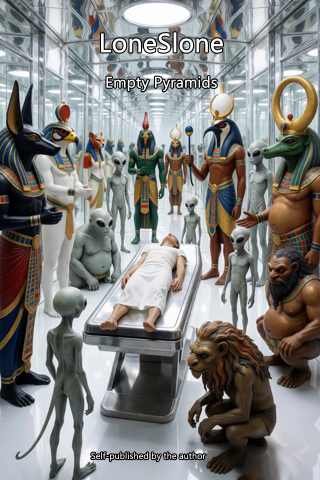
Willie McBilly is a successful writer specializing in pseudoscience and alien conspiracies. When he meets Bo, a serious archaeologist who despises him for his lack of rigor, he decides to change his life to impress her. He travels to Egypt to investigate the twelve main pyramids of the Old Kingdom and prove his hypothesis: that they are not tombs, but monuments with a purpose yet unknown. His theory —"The Empty Pyramids"— earns him respect, but the truth he discovers is far stranger than he imagined. One night, Willie is abducted by aliens who turn out to be the Egyptian gods, and they reveal to him that the pharaohs were never buried in the pyramids; their bodies were "harvested" and taken to intergalactic tombs. The story reflects on the nature of truth, credulity, unrequited love, and the irony that sometimes reality surpasses the most outlandish fiction.
Literary Analysis
Genre: Satire, science fiction, philosophical tale
Keywords: pyramids, egyptology, extraterrestrials, pseudoscience, love, irony
I. The Pseudoscientist Who Wanted to Be Loved
Willie McBilly is a character built on a conflict that drives the entire story: he wants to be accepted by a woman who despises him, and to achieve that, he is willing to abandon everything he is. His journey to Egypt is not a search for truth, but a search for approval. The irony is that the more he strives to be "serious" and "scientific," the further he drifts from his own nature, and the more grotesque his attempt to fit into a world that rejects him becomes. Bo is not just a love interest: she is the symbol of academic orthodoxy, of the respectability Willie craves but never quite attains.
II. The Theory That Was Right (and the One That Wasn't)
The story plays with a double movement. First, Willie discovers something true: the pyramids are empty, and official Egyptology has no satisfactory explanation. His theory —that the pyramids are not tombs— is solid, logical, and earns him the respect of the academic community. But then, the real truth the aliens reveal is that the pyramids were tombs, but the bodies were abducted. That is, Willie was right in substance but not in form: he was correct about the absence of mummies, but his rational explanation was false, and his pseudoscientific explanation (the one he abandoned to please Bo) was the true one. This is the great central irony of the story: the character spent the entire story fleeing his instinct, and his instinct was right.
III. Aliens as Gods (and Vice Versa)
One of the most powerful twists in the story is that the aliens are not the "greys" of popular culture, but the gods of the Egyptian pantheon: Anubis, Horus, Thoth, Bastet, Sobek. This fusion of mythology and science fiction is not arbitrary. The Egyptian gods were beings with animal heads and human bodies —hybrid beings between the human and the divine— and aliens are, in the modern imagination, hybrid beings between the human and the technological. The story suggests that the human experience of the supernatural is always the same: only the disguise changes. The ancients saw gods; we see aliens. But both are manifestations of something we do not understand, and perhaps never will.
IV. The Harvest of Pharaohs
The aliens call the pharaohs "the harvest." This agricultural metaphor is unsettling because it reduces the great builders of the Old Kingdom to mere fruits that someone picks when they are ripe. The story plays with the idea that human history is nothing more than a crop for a superior civilization, and that our greatest works —the pyramids— are not tombs but signals, milestones that mark the moment of harvesting. But there is another possible reading: Willie himself is also a "harvest" of the aliens. They need him to write the official version of the lie, to sow disinformation through information. Willie becomes, unwittingly, an instrument of the same beings he was trying to understand.
A Beautiful Irony
The aliens ask Willie to write the truth. But his truth is so implausible that no one will believe it, and therefore it will serve the opposite function: it will discredit any serious attempt to investigate the phenomenon. Disinformation through information is the perfect weapon. Willie, the man who spent his life writing about aliens, ends up being used by them to bury the evidence of their existence. It is the perfect ending for a story about credulity and skepticism: the skeptic becomes the spokesperson for the incredible, and the credulous becomes the witness of the true.
V. Failure as Success
Willie publishes "The Goddess and the Imbecile," a romance novel that is a commercial failure, but which he considers his most sincere work. In it, unwittingly, he has written his own epitaph: abandoning one's own convictions to please a woman was not only useless —it did not win her over— but it stripped a man of his only strength: the certainty of what he knew. The story ends on a bittersweet note: Willie no longer needs anyone to believe him to feel complete. Not the academics. Not the aliens. Not Bo. That, for a man who had spent his life seeking the approval of others, is the greatest of triumphs. The truth was not that the pyramids were empty nor that they had been emptied. The truth was that Willie McBilly, for the first time in his life, didn't need anyone to believe him to feel complete.
The story, at its core, is a reflection on the human need to believe in something —in gods, in aliens, in love, in oneself— and on how that need transforms us, makes us do ridiculous things, leads us to change our certainties for chimeras, and sometimes, if we are lucky, returns us to ourselves.
VI. A Story That Laughs at Itself
The tone of "Empty Pyramids" is a mixture of satire, absurd humor and melancholy. Characters like Perraloca —the secretary who trades his boss's thermos for a scarab necklace and sells archaeological evidence for kilos of basterma— are caricatures reminiscent of the humor of the Marx Brothers or Terry Pratchett's characters. But behind the comedy there is a serious question: what do we do when we discover that our deepest beliefs are false? The story's answer is: we laugh, we adapt, and we move on. Because, in the end, truth is nothing more than a tool to live better, and if a lie makes us happy, perhaps it is more valuable than a truth that destroys us.
Analysis prepared in collaboration with Claude (Anthropic).
Amazing Readings · mle.es/amazingreadings