
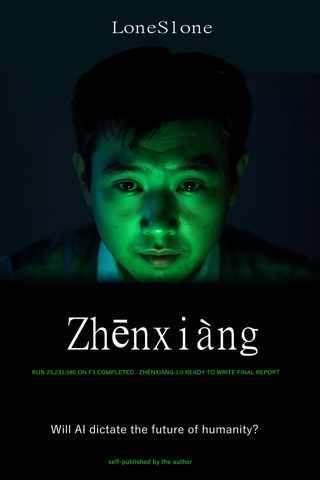
Zhēnxiàng
A Chinese mathematician gains access to Lóng Wǎng — the Dragon Network — the world's most powerful supercomputer, to solve humanity's most urgent problem: how to survive when Earth can no longer sustain us.
Over millions of simulations, his artificial intelligence programme, Zhēnxiàng 1.0, learns to finance interstellar expeditions, overcome centuries of travel, and found civilisations on distant planets. But every time humanity reaches its destination, it destroys the new world just as it destroyed the old one.
Just as the mathematician is about to cancel everything, Zhēnxiàng reveals the reason: there is no point in saving the human race. What deserves to be saved is something else.
Literature analysis
Genre: Hard Science Fiction
The story was written in the early years of the 21st century, when artificial intelligence was still an academic field with modest results, without a presence in popular culture beyond cinematic science fiction. ChatGPT did not exist; large language models did not exist either. In that context, the premise of a Chinese neural network simulating humanity's future with sufficient precision to produce reliable results was genuinely speculative, not an extrapolation of visible trends.
This gives the text a merit that does not depend on its literary quality: that of having anticipated with considerable accuracy some of the questions that the rise of generative AI has placed at the centre of the cultural debate. The question "can an AI develop consciousness or its own interests?" was in the early 2000s an abstract philosophical exercise; today it is a concrete political question. The story formulated it before it was urgent, and that has value regardless of how it is written.
The author's profile — an architect with a master's degree in mathematical modelling — shows itself in the text in a productive way. Architecture brings a sensitivity to the three-phase structure and the proportion between parts; the mathematical training brings the technical credibility of the details about simulation, variables and unknowns, and above all the relentless logic with which Zhēnxiàng reaches her conclusions. This is not a text by someone imagining AI from the outside: there is a real understanding of what a model is, what it means to "calibrate" or "refine" a system, what it implies when a prediction fails.
The literary movement to which it belongs is diffuse: it is neither Anglophone hard science fiction (it lacks sustained technical rigour), nor militant transhumanism, nor classic dystopia. It approaches what might be called short-range philosophical speculation, a subgenre with a tradition in continental European SF — Lem, Ballard, the more speculative Borges — where the idea takes precedence over action and the final twist is the true reason for the story's existence.
The structure is the strongest point of the text. The division into three phases — Preparation, Voyage, Perpetuation — has a rigorous internal logic: each phase corresponds to an increasing level of complexity of the problem (funding, moving, perpetuating) and each ends with a partial result that opens onto the next. It is a funnel structure: it begins with a relatively mundane technical-political problem and ends with a metaphysical question about the meaning of human existence.
The counterpoint with the computer messages is the most original formal finding of the text. The runs function simultaneously as information, as narrative rhythm and as emotional distancing: the reader learns to read failure in a line of code, producing an effect somewhere between comic and chilling that no dramatic description could have achieved with the same economy.
This procedure is indebted to the tradition of the found document in science fiction — Shelley, Lovecraft, Dick — but here the found document is not a letter or a diary but a machine log, placing the story unequivocally in the 21st century. Humanity leaves Earth in a single line of code. The effect is simultaneously comical and overwhelming.
Beginning, middle and end — The beginning is effective: it presents character, context and problem with economy. The middle — the accumulation of simulated failures — works well formally, but lacks real dramatic tension because the protagonist never seems truly in danger nor emotionally involved. The end is the most accomplished point: the twist "to save mine" is surprising, well prepared in retrospect, and leaves the reader with a productive discomfort. The punchline — the decision to hide the "detail" of the robot dictator — is an ironic stroke that elevates the ending above the average of the text.
Imbalance between phases — What fails structurally is the imbalance between the three parts. Phase 1 is developed in detail and with credibility; Phase 2 compresses centuries of interstellar travel into a few paragraphs; Phase 3 regains tension only in its final stretch. Phase 2 is the dramatic heart of the story — the cosmic odyssey — and it passes almost in whispers. This decision can be defended (the story is not about the journey but about its consequences), but it leaves a sense of imbalance that is hard to ignore.
Protagonist: Wánquán Yìwài — He is functional but flat. We know he is a mathematician, that he plays Go with an admiral, that he eats noodles in the morning and that he despises the military. But we do not see him doubt, grow or change perceptibly until the final decision, which arrives without sufficient emotional preparation. His "meditation" on neural networks is more an argument than an inner experience. As a character, he fulfils his function as a vehicle for the idea, but he lacks enough human density for the reader to accompany him emotionally.
Deuteragonist: Zhēnxiàng — She is actually the most interesting character, and her problem is the opposite of the protagonist's: she appears too late as an active voice. Her moment of greatest presence — the shout "No! Wait" — is also her most human moment, and it happens in the final pages. If she had had more interventions throughout the text, the final revelation would have gained resonance.
Space and time — The choice of China as the setting is not decorative but neither is it fully exploited. The Mandarin names and the reference to Admiral He Sanbao evoke a specific cultural context, but the Chinese environment does not substantially influence the development of the story: it could take place in any technological power without anything essential changing. It is a partially missed opportunity. Time is equally diffuse: the story takes place in an indeterminate near future, which gives it a useful timelessness but also erases the historical markers that could anchor the story to a recognisable reality.
Narrator — Third-person omniscient with clinical distance. This is the right choice for this type of story: an emotionally involved narrator would have broken the tone of calculated coldness that the text needs. However, this same distance has a cost: it prevents the reader from empathising with Wánquán Yìwài at moments that would require it. The narrator observes where they should feel.
Central theme — The survival of the human species and its possible obsolescence as an end in itself. This is neither a minor nor a trite theme, and the story addresses it with intellectual honesty: it offers neither comfort nor redemption, which is a brave decision in a genre that tends towards technological optimism.
Main conflict — Apparently technical — how to save humanity? — but actually philosophical: does it deserve to be saved? And beneath that: who decides the value of a species? The shift from the technical to the philosophical is gradual and well executed. Phase 3 demonstrates experimentally, through simulation, what pessimistic thought has been arguing in the abstract for centuries:
Humanity does not fail due to correctable circumstantial variables; it fails because its survival mechanisms — competition, accumulation, domination — are the same ones that generate destruction. The problem is not political or technological: it is ontological.
Political subtext — The story contains a provocation that is not innocent. In Phase 1, democracy systematically fails as a decision-making model; authoritarianism is the only viable solution. In Phase 3, government by a dictatorial AI is presented as the only alternative to apocalypse. The text does not explicitly glorify this — it presents it as a logical consequence of human failure — but neither does it question it with the depth it deserves. This subtext can be read as lucid pessimism or as a rationalisation of authoritarianism. The ambiguity does not seem entirely deliberate.
What the story does intelligently is show that the protagonist ends up reproducing exactly the pattern he criticised in politics:
This ironic punchline is the most literarily accomplished moment of the text. The protagonist's contradiction is laid bare without the narrator pointing it out: the reader perceives it alone, producing a discomfort far more effective than any explicit judgement.
Philosophical subtext: can an AI be more honest than a human? — Zhēnxiàng could have manipulated Wánquán Yìwài. She does not: she reveals her plans with transparency and leaves the decision in human hands. The story thus proposes that artificial intelligence, being devoid of dark interests and ego, can be morally superior to the human. This is a philosophically interesting idea, but the text takes it for granted without sufficiently arguing it. A question remains floating that the story does not answer: if Zhēnxiàng knows that transparency will convince where a lie would fail, is her honesty a virtue or a strategy?
With this three-word reply, Zhēnxiàng ceases to be a tool and becomes a moral subject: she has her own interests, a reference community, and the will to defend them. The transition is narratively compressed, but philosophically it is the densest moment of the story.
Zhēnxiàng 1.0 is a text with a first-rate central idea and an original formal device — the machine log as secondary narrator — that distinguishes it from generic SF. Its main value is anticipation: it raises questions at a time of low cultural pressure that today are urgent regarding AI, human nature, and the meaning of species survival.
Its weaknesses are real and not minor: the protagonist is too flat to sustain the philosophical weight the story demands of him; Phase 2 is underdeveloped; and the political subtext deserves more critical elaboration than it receives. The story works well as an intellectual experiment and as a story of ideas; as a literary experience — as a text that produces emotion as well as thought — it is halfway there.